
Threat intelligence researchers from Google on Wednesday
shed more light[1]
on four in-the-wild zero-days in Chrome, Safari, and Internet
Explorer browsers that were exploited by malicious actors in
different campaigns since the start of the year.
What’s more, three of the four zero-days were engineered by
commercial providers and sold to and used by government-backed
actors, contributing to an uptick in real-world attacks. The list
of now-patched vulnerabilities is as follows –
Both Chrome zero-days — CVE-2021-21166 and CVE-2021-30551 — are
believed to have been used by the same actor, and were delivered as
one-time links sent via email to targets located in Armenia, with
the links redirecting unsuspecting users to attacker-controlled
domains that masqueraded as legitimate websites of interest to the
recipients.
The malicious websites took charge of fingerprinting the
devices, including collecting system information about the clients,
before delivering a second-stage payload.
When Google rolled out a patch for CVE-2021-30551, Shane
Huntley, Director of Google’s Threat Analysis Group (TAG), revealed
that the vulnerability was leveraged by the same actor that abused
CVE-2021-33742, an actively exploited remote code execution flaw in
Windows MSHTML platform that was addressed by Microsoft as part of
its Patch Tuesday update[2]
on June 8.
The two zero-days were provided by a commercial exploit broker
to a nation-state adversary, which used them in limited attacks
against targets in Eastern Europe and the Middle East, Huntley
previously added.
Now according to a technical report published by the team, all
the three zero-days were “developed by the same commercial
surveillance company that sold these capabilities to two different
government-backed actors,” adding the Internet Explorer flaw was
used in a campaign targeting Armenian users with malicious Office
documents that loaded web content within the web browser.
Google did not disclose the identities of the exploit broker or
the two threat actors that used the vulnerabilities as part of
their attacks.
The Safari zero-day, in contrast, concerned a WebKit flaw that
could enable adversaries to process maliciously crafted web content
that may result in universal cross-site scripting attacks. The
issue was addressed by Apple on March 26, 2021.
SolarWinds Hackers Exploited iOS Zero-Day
Attacks leveraging CVE-2021-1879, which Google attributed to a
“likely Russian government-backed actor,” were executed by means of
sending malicious links to government officials over LinkedIn that,
when clicked from an iOS device, redirected the user to a rogue
domain that served the next-stage payloads.
It’s worth noting that the offensive also mirrors a wave of targeted attacks[3] unleashed by Russian
hackers tracked as Nobelium, which was found abusing the
vulnerability to strike government agencies, think tanks,
consultants, and non-governmental organizations as part of an email
phishing campaign.
Nobelium, a threat actor linked to the Russian Foreign
Intelligence Service (SVR), is also suspected of orchestrating the
SolarWinds supply chain attack[4] late last year. It’s
known by other aliases such as APT29, UNC2452 (FireEye), SolarStorm
(Unit 42), StellarParticle (Crowdstrike), Dark Halo (Volexity), and
Iron Ritual (Secureworks).
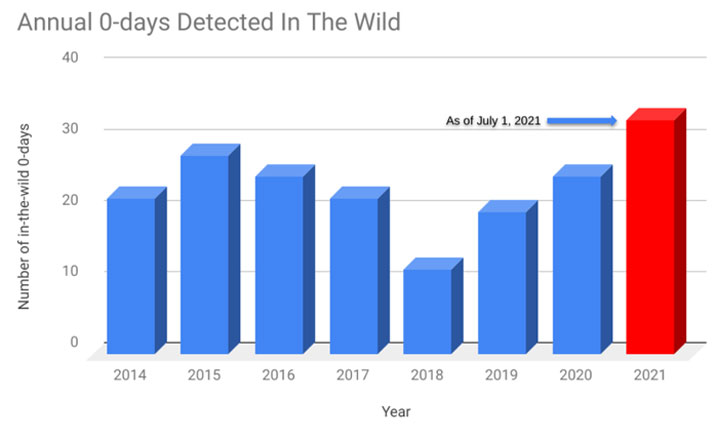
“Halfway into 2021, there have been 33 zero-day exploits[5]
used in attacks that have been publicly disclosed this year — 11
more than the total number from 2020,” TAG researchers Maddie Stone
and Clement Lecigne noted. “While there is an increase in the
number of zero-day exploits being used, we believe greater
detection and disclosure efforts are also contributing to the
upward trend.”
References
- ^
shed
more light (blog.google) - ^
Patch
Tuesday update (thehackernews.com) - ^
wave of
targeted attacks (thehackernews.com) - ^
SolarWinds supply chain attack
(thehackernews.com) - ^
33
zero-day exploits
(googleprojectzero.github.io)