Are you aware of how secure your domain is? In most
organizations, there is an assumption that their domains are secure
and within a few months, but the truth soon dawns on them that it
isn’t.
Spotting someone spoofing your domain name is one way to
determine if your security is unsatisfactory – this means that
someone is impersonating you (or confusing some of your recipients)
and releasing false information. You may ask, “But why should I
care?” Because these spoofing activities can potentially endanger
your reputation.
With so many companies being targeted by domain impersonators,
email domain spoofing shouldn’t be taken lightly. By doing so, they
could put themselves, as well as their clients, at risk.
Your domain’s security rating can make a huge difference in
whether or not you get targeted by phishers looking to make money
quickly or to use your domain and brand to spread ransomware
without you knowing it!
Check your domain’s security rating with this Free DMARC
Lookup[1] tool. You may be
surprised by what you learn!
How Do Attackers Spoof Your Domain?
The act of email spoofing involves an attacker using a forged
identity of a legitimate source in order to impersonate another
person or masquerade as an organization. The procedure can be
carried out as follows:
- Manipulating the domain name: Attackers can
use your domain name to send emails to your unsuspecting recipients
who can fall prey to their malicious intentions. Popularly known as
direct-domain spoofing attacks, these attacks are especially
harmful to a brand’s reputation and how your customers perceive
your emails.
- Forging the email domain or address: wherein
attackers exploit loopholes in existing email security protocols to
send emails on behalf of a legitimate domain. The success rate of
such attacks is higher as attackers use third-party email exchange
services to carry out their malicious activities that do not verify
the origin of email sending sources.
Since domain verification was not built into the Simple Mail
Transfer Protocol (SMTP), the protocol on which email is based,
newer email authentication protocols, such as DMARC, provide
greater security.
How Can a Low Domain Security Impact Your Organization?
As most organizations send and receive data through email, it is
crucial that they use a secure connection in order to protect their
brand. In the event of inadequate email security, it can lead to
big problems for both enterprises and individuals. In terms of
communication platforms, email is still the most widely used. Email
sent out from a data breach or hack can be devastating for your
organization’s reputation. Such spoofed emails can also facilitate
the spread of malware, spyware, and spam. It is therefore
imperative to re-examine how security is deployed within email
platforms.
In 2020 alone, brand impersonation accounted for 81% of
all phishing attacks, while a single spear-phishing attack resulted
in an average loss of $1.6 million. Security researchers
predict that this will double by the end of 2021. In turn, this
increases the need for organizations to improve their email
security as soon as possible.
In contrast to multinational businesses, small businesses and
SMEs are still averse to the idea of implementing email security
protocols. This is because it’s a common myth that SMEs do not fall
on the potential target radar of cyber-attackers. Unfortunately,
that isn’t true. Hackers target organizations based on the security
vulnerabilities and problems of their email security, not on the
size of the organization. Therefore, any organization with poor
domain security might be a target.
Learn how you can get a higher domain security rating with this
email security rating guide[2].
Leverage Authentication Protocols to Gain Maximum Domain
Security
While checking your domain’s email security rating, a low score
can be due to the following factors:
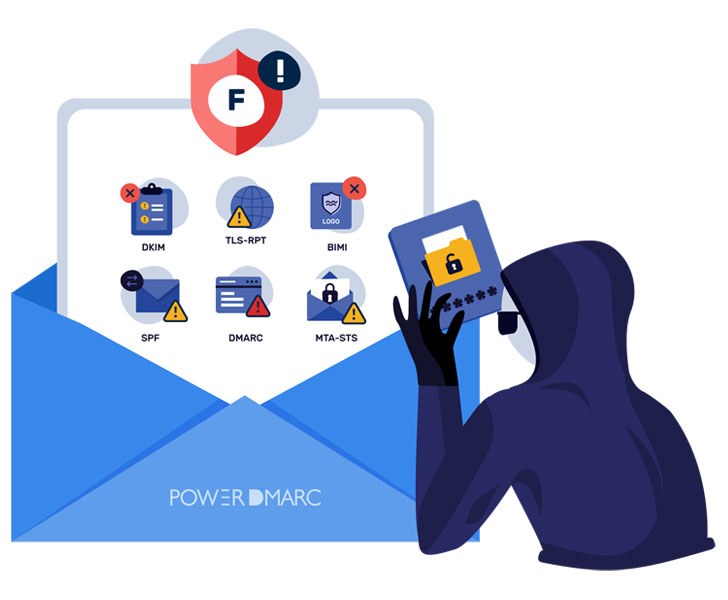
- You don’t have email authentication protocols like SPF, DMARC,
and DKIM deployed within your organization - You have deployed the protocols but have not enforced them for
your domain - You have errors in your authentication records
- You have not enabled DMARC reporting to gain visibility on your
email channels - Your emails in transit and server communication are not secured
over TLS encryption with MTA-STS[3] - You have not implemented SMTP TLS reporting to get notified on
issues in email delivery - You have not configured BIMI for your domain to improve your
brand recollection - You have not resolved SPF permerror with dynamic SPF
flattening
All of these factors make your domain more vulnerable to email
fraud, impersonation, and domain abuse.
PowerDMARC is your one-stop email authentication SaaS platform
that brings all the authentication protocols (DMARC, SPF, DKIM,
MTA-STS, TLS-RPT, BIMI)[4]
across a single pane of glass to make your emails safe again and
improve your domain’s email security posture.
Its DMARC analyzer simplifies protocol implementation by
handling all the complexities in the background and automating the
process for domain users. Taking advantage of your authentication
protocols in this way allows you to maximize the power of your
security solutions.
Sign up for your free DMARC report analyzer[5]
today to get a high domain security rating and protection against
spoofing attacks.
References
- ^
Free DMARC Lookup
(powerdmarc.com) - ^
email
security rating guide (powerdmarc.com) - ^
MTA-STS
(powerdmarc.com) - ^
BIMI)
(powerdmarc.com) - ^
DMARC
report analyzer (powerdmarc.com)
Read more http://feedproxy.google.com/~r/TheHackersNews/~3/lzggSH7jkMU/can-your-business-email-be-spoofed.html