Siemens on Friday shipped firmed updates to address a severe
vulnerability in SIMATIC S7-1200 and S7-1500 programmable logic
controllers (PLCs) that could be exploited by a malicious actor to
remotely gain access to protected areas of the memory and achieve
unrestricted and undetected code execution, in what the researchers
describe as an attacker’s “holy grail.”
The memory protection bypass vulnerability, tracked as
CVE-2020-15782 (CVSS score: 8.1), was discovered by
operational technology security company Claroty by
reverse-engineering the MC7 / MC7+ bytecode language used to
execute PLC programs in the microprocessor. There’s no evidence
that the weakness was abused in the wild.
In an advisory[1]
issued by Siemens, the German industrial automation firm said an
unauthenticated, remote attacker with network access to TCP port
102 could potentially write arbitrary data and code to protected
memory areas or read sensitive data to launch further attacks.
“Achieving native code execution on an industrial control system
such as a programmable logic controller is an end-goal relatively
few advanced attackers have achieved,” Claroty researcher Tal Keren
said[2]. “These complex systems
have numerous in-memory protections that would have to be hurdled
in order for an attacker to not only run code of their choice, but
also remain undetected.”
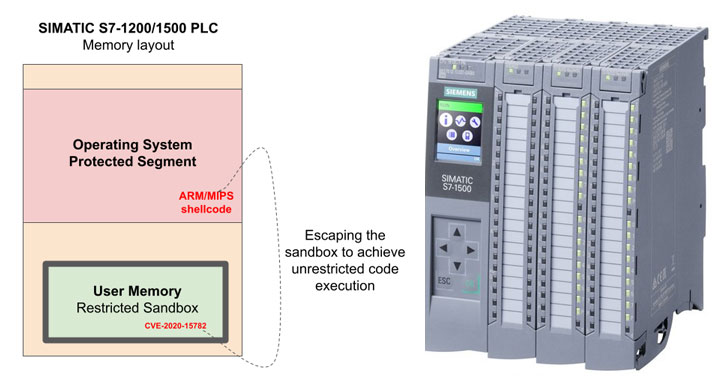
Not only does the new flaw allow an adversary to gain native
code execution on Siemens S7 PLCs, but the sophisticated remote
attack also avoids detection by the underlying operating system or
any diagnostic software by escaping the user sandbox to write
arbitrary data and code directly into protected memory regions.
Claroty, however, noted that the attack would require network
access to the PLC as well as “PLC download rights.” In jailbreaking
the PLC’s native sandbox, the company said it was able to inject a
malicious kernel-level program into the operating system in such a
way that it would grant remote code execution.
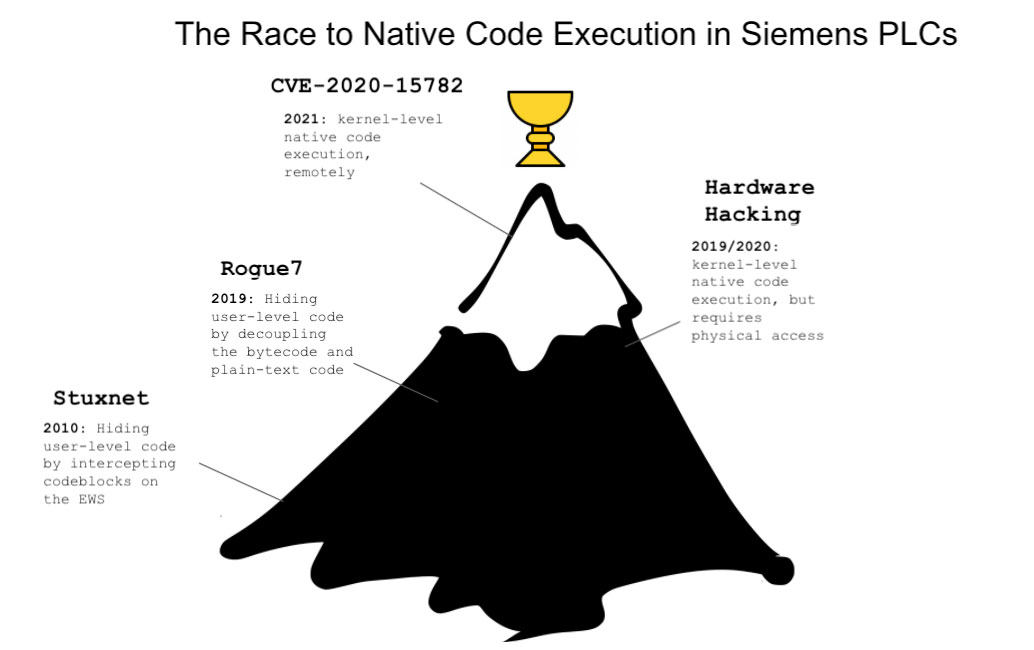
This is far from the first time unauthorized code execution has
been achieved on Siemens PLCs. In 2010, the infamous Stuxnet[3]
worm leveraged multiple flaws in Windows to reprogram industrial
control systems by modifying code[4]
on Siemens PLCs for cyber espionage and covert sabotage.
Then in 2019, researchers demonstrated a new class of attacks
called “Rogue7[5]” that exploited
vulnerabilities in its proprietary S7 communication protocol to
“create a rogue engineering station which can masquerade as the
TIA[6]
to the PLC and inject any messages favourable to the attacker.”
Siemens is “strongly” recommending users to update to the latest
versions to reduce the risk. The company said it’s also putting
together further updates and is urging customers to apply
countermeasures and workarounds for products where updates are not
yet available.