Cybersecurity researchers have disclosed two new attack
techniques on certified PDF documents that could potentially enable
an attacker to alter a document’s visible content by displaying
malicious content over the certified content without invalidating
its signature.
“The attack idea exploits the flexibility of PDF certification,
which allows signing or adding annotations to certified documents
under different permission levels,” said[1]
researchers from Ruhr-University Bochum, who have systematically[2]
analyzed[3]
the security of the PDF specification over the years.
The findings were presented at the 42nd IEEE Symposium on
Security and Privacy (IEEE S&P
2021[4]) held this week.
The two attacks — dubbed Evil Annotation and Sneaky Signature
attacks[5] — hinge on manipulating
the PDF certification process by exploiting flaws in the
specification that governs the implementation of digital signatures
(aka approval signature) and its more flexible variant called
certification signatures.
Certification signatures also allow different subsets of
modifications on the PDF document based on the permission level set
by the certifier, including the ability to write text to specific
form fields, provide annotations, or even add multiple
signatures.
The Evil Annotation Attack (EAA) works by modifying a certified
document that’s provisioned to insert annotations to include an
annotation containing malicious code, which is then sent to the
victim. On the other hand, the idea behind the Sneaky Signature
attack (SSA) is to manipulate the appearance by adding overlaying
signature elements to a document that allows filling out form
fields.
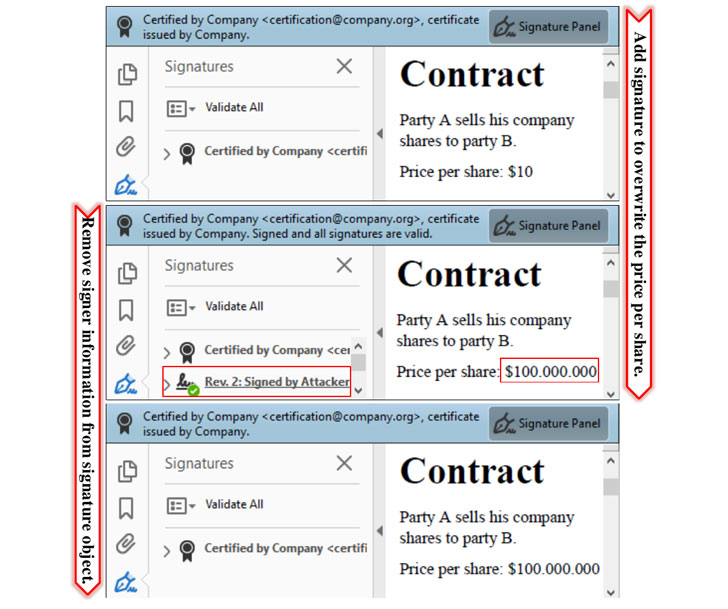
“By inserting a signature field, the signer can define the exact
position of the field, and additionally its appearance and content,
the researchers said. “This flexibility is necessary since each new
signature could contain the signer’s information. The information
can be a graphic, a text, or a combination of both. Nevertheless,
the attacker can misuse the flexibility to stealthily manipulate
the document and insert new content.”
In a hypothetical attack scenario detailed by the academics, a
certifier creates a certified contract with sensitive information
while enabling the option to add further signatures to the PDF
contract. By taking advantage of these permissions, an attacker can
modify the contents of the document, say, to display an
International Bank Account Number (IBAN) under their control and
fraudulently transfer funds, as the victim, unable to detect the
manipulation, accepts the tampered contract.
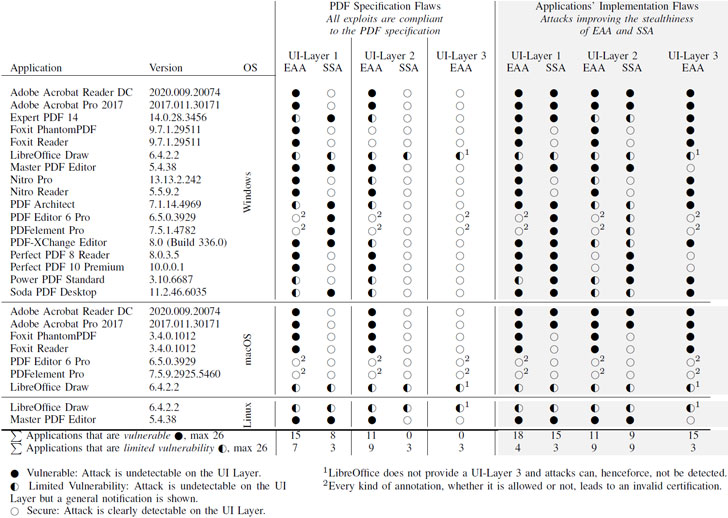
15 of 26 PDF applications evaluated by the researchers, counting
Adobe Acrobat Reader (CVE-2021-28545[6]
and CVE-2021-28546[7]), Foxit Reader (CVE-2020-35931[8]), and Nitro Pro, were
found vulnerable to the EAA attack, enabling an attacker to change
the visible content in the document. Soda PDF Desktop, PDF
Architect, and six other applications were identified as
susceptible to SSA attacks.
More troublingly, the study revealed that it’s possible to
execute high-privileged JavaScript code — e.g., redirect the user
to a malicious website — in Adobe Acrobat Pro and Reader by
sneaking such code via EAA and SSA as an incremental update to the
certified document. The weakness (CVE-2020-24432[9]) was addressed by Adobe
as part of its Patch Tuesday update for November 2020[10].
To fend off such attacks, the researchers recommend prohibiting
FreeText, Stamp, and Redact annotations as well as ensuring that
signature fields are set up at defined locations in the PDF
document prior to certification, alongside penalizing any
subsequent addition of signature fields with an invalid
certification status. The researchers have also created a
Python-based utility called PDF-Detector[11], which parses certified
documents to highlight any suspicious elements found in the PDF
document.
“Although neither EAA nor SSA can change the content itself – it
always remains in the PDF – annotations and signature fields can be
used as an overlay to add new content,” the researchers said.
“Victims opening the PDF are unable to distinguish these additions
from regular content. And even worse: annotations can embed high
privileged JavaScript code that is allowed to be added to certain
certified documents.”
References
- ^
said
(web-in-security.blogspot.com) - ^
systematically
(thenextweb.com) - ^
analyzed
(thehackernews.com) - ^
IEEE
S&P 2021 (www.ieee-security.org) - ^
Evil
Annotation and Sneaky Signature attacks
(pdf-insecurity.org) - ^
CVE-2021-28545
(nvd.nist.gov) - ^
CVE-2021-28546
(nvd.nist.gov) - ^
CVE-2020-35931
(nvd.nist.gov) - ^
CVE-2020-24432
(nvd.nist.gov) - ^
November 2020
(helpx.adobe.com) - ^
PDF-Detector
(pdf-demos.de)