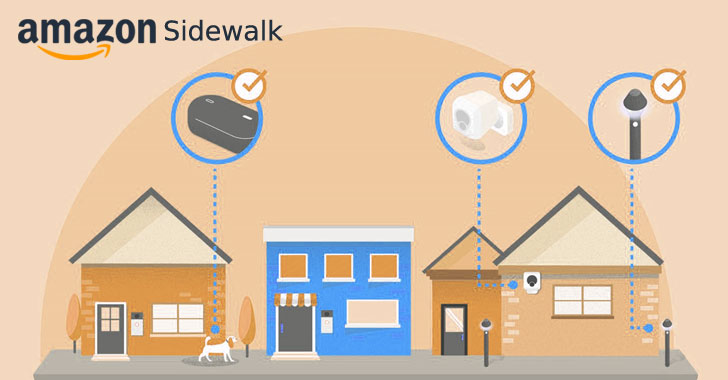
Starting June 8, Amazon will automatically enable a feature on
your Alexa, Echo, or other Amazon device that will share some of
your Internet bandwidth with your neighbors—unless you choose to
opt out.
Amazon intends to register its family of hardware devices that
are operational in the U.S.—including Echo speakers, Ring Video
Doorbells, Ring Floodlight Cams, and Ring Spotlight Cams—into
Sidewalk as it readies to roll out the shared mesh network in the
country next week.
Initially announced[1]
in September 2019, Sidewalk[2]
is part of Amazon’s efforts to build a long-range wireless network
that leverages Bluetooth, 900 MHz spectrum (FSK[3]), and other frequencies
to help Echo, Ring, Tile trackers Sidewalk-enabled devices
communicate over the internet without Wi-Fi.
Amazon is expected to flip the switch on Sidewalk in the U.S.
for all capable devices by default come June 8[4], co-opting millions of
devices into the network and providing near-ubiquitous
connectivity.
Sidewalk is designed to extend the working range of
low-bandwidth devices and help devices stay connected even if they
are outside the range of a user’s home Wi-Fi network. It achieves
this by pooling together a small sliver of internet bandwidth from
the participating devices to create what’s a shared low-bandwidth
network.
The mechanism that undergirds Sidewalk is conceptually analogous
to how Apple leverages its huge installed base of Apple devices to
help locate lost devices using its Find My
network[5]. But Sidewalk also
extends beyond location tracking for virtually any kind of
short-range two-way communication. Besides utilizing Bluetooth Low
Energy (BLE), Sidewalk also makes use of long-range wireless
technology known as LoRa[6]
to help devices stay connected and continue to work over longer
distances.
Elaborating on the protections baked into Sidewalk, the retail
and entertainment behemoth said that packets traversing through the
network are secured by three layers of encryption and that it has
safeguards in place to prevent unauthorized devices from joining by
using Sidewalk credentials created during the device registration
process to authenticate their identity.
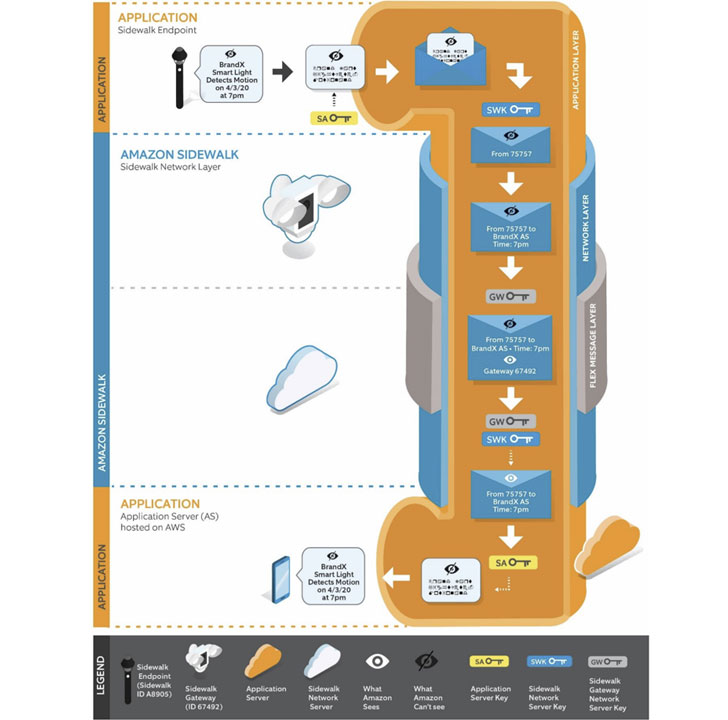
“Sidewalk protects customer privacy by limiting the amount and
type of metadata that Amazon needs to receive from Sidewalk
endpoints to manage the network,” the company said[7]
in a white paper while stressing that Sidewalk has been implemented
with security protocols to prevent disclosure of private
information and any commands that may be transmitted over the
network.
Each transmission between an endpoint (say, leak sensors, door
locks, or smart lights) and its respective application server is
also identified by a unique transmission-ID (TX-ID) that changes
every 15 minutes to prevent tracking devices and associating a
device to a specific user.
That said, Sidewalk does need to know a third-party
Sidewalk-enabled device’s serial number to route the message to its
respective application server. “The routing information that Amazon
does receive for operating the network components of Sidewalk is
automatically cleared every 24 hours,” it added. Amazon also noted
in the whitepaper that endpoints reported as lost or stolen would
be blocklisted.
While the security guarantees of the undertaking are without a
doubt a step in the right direction, it’s been established
repeatedly that wireless technologies like Bluetooth[8]
and Wi-Fi[9]
are prone to critical flaws that leave devices vulnerable to a
variety of attacks, and a proprietary connectivity framework like
Sidewalk could be no exception. This is setting aside the
possibility that the technology could be abused as surveillance tools[10] to track a partner and
encourage stalking discreetly.
How to Opt-Out and Turn Off Amazon
Sidewalk?
A matter of more concern is that Sidewalk is opt-out rather than
opt-in, meaning users will be automatically enrolled into Sidewalk
unless they choose to turn it off explicitly.
In an FAQ on the Sidewalk page, Amazon says that should users
opt to disable the feature; it’s tantamount to “missing out on
Sidewalk’s connectivity and location related benefits,” adding “You
also will no longer contribute your internet bandwidth to support
community extended coverage benefits such as locating pets and
valuables with Sidewalk-enabled devices.”
Owners of Echo and Ring devices can elect to opt-out of the
device-to-device network either via Alex or Ring apps by following
the below steps:
References
- ^
announced
(www.aboutamazon.com) - ^
Sidewalk
(www.amazon.com) - ^
FSK
(en.wikipedia.org) - ^
come
June 8 (www.aboutamazon.com) - ^
Find My network
(thehackernews.com) - ^
LoRa
(en.wikipedia.org) - ^
said
(m.media-amazon.com) - ^
Bluetooth
(thehackernews.com) - ^
Wi-Fi
(thehackernews.com) - ^
abused
as surveillance tools (www.fastcompany.com) - ^
Alexa
app (www.amazon.com) - ^
Ring
app (support.ring.com)