Well, if you have then you have surely enacted web scraping
functions without even knowing it!
To put in simpler terms, Web scraping, or also known as web data
extraction, is the process of recouping or sweeping data from
web-pages. It is a much faster and easier process of retrieving
data without undergoing the time-consuming hassle of manual data
extraction methods.
Web scraping[1]
uses advanced automatic tools to reclaim data from millions and
billions of websites.
The Basics of Web Scraping
First, some common terms you’ll need to know:
- The Crawler: The web crawler or popularly known as a
‘spider,’ is an automated website scraping tool that skims
through the internet for information. The spider usually surfs the
internet and follows links, and explores various web pages to
gather or “scrape” up any information. - The Scraper: A scraper or web scraper is a comprehensive
website scraper tool that quickly gathers unambiguous data
from several web pages. Their designs and functionality depend on
the type of projects.
Why Penetration Testers Need Web Scraping?
Web scraping has been a crucial part of many successful businesses
as well as corporate sectors. While it’s commonly used in other
sectors, it is also useful in penetration testing.
Penetration testing (also known as pen testing) is security
testing. In ethical practice, a cyber-security specialist will test
computer systems, web applications, or networks to discover
security vulnerabilities that a hacker could exploit. This tests
the computer’s efficiency to protect data in case of any security
breach.
It can be done manually or automated with software
applications.
How can an efficient solution help make pen-testing
easier?
Before we dive into the details of effective penetration testing,
let us first know the initial stages of carrying out an effective
penetration test.
- Planning and scrutiny
- Examining
- Gaining access
- Maintaining access
- Investigating
Here are some of the tools that can help with penetration testing:
- Port Scanners: This is a type of website scraper
tool that quickly gathers accurate information about a specific
target in an isolated network environment. These tools can carry
out activities like the SYN-SYN-ACK-ACK sequence for TCP
ports. - Vulnerability Scanners: This type of tool is used to
scan and find any exposure to a specific system. There are two
types of vulnerability scanners available. Network-based
vulnerability scanners are used to only scan the targeted system
and TCP/IP powered devices that are prevalent in this kind of
environment. Another kind is known as the host-based vulnerability
scanners are used to scan the whole operating system for any
software related issues. - Application Scanners: These are web scraping
tools that are used to examine any vulnerability in web-based
applications.
What is the best solution for pen-testing?
If you are looking for quick solutions for your security breaches
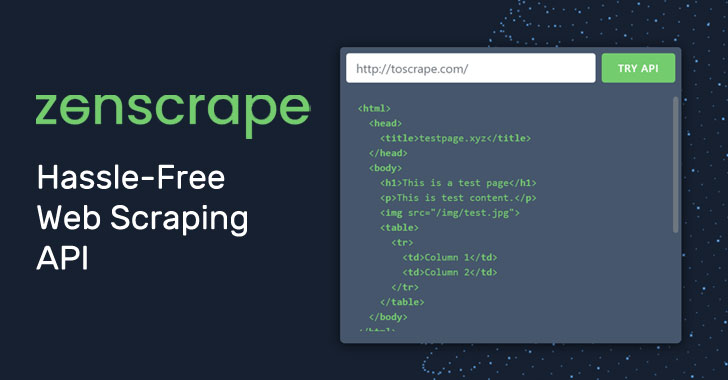
or to stay ahead in the game, try Zenscrape. It uses comprehensive,
customized tools that target your specific needs. Plus, the
interface is relatively simple to use.
It provides lightning-fast response times, and there are no
limitations to submitting the number of requests. The API will
return a JSON object having the HTML markup for the given
website.
You get to choose from standard proxies as well as premium
proxies. If a website uses captchas to stop web scraping, the
premium proxies will come handy. Zenscrape offers premium proxies
from more than 300 locations.
Dealing with Proxies on Zenscrape
Zenscrape offers Residential Proxies
that are legitimate IP addresses and impossible to be banned
because they are not attached to any subnetworks. They are directly
attached to a physical location, and thus they are highly
anonymous.
Another benefit of using Zenscrape is the Rotating
Proxies. Your request will never get blocked because every
individual request is submitted using a unique IP address from the
list of 30+ million IP addresses that Zenscrape provides. If a
particular request fails, the API will automatically try the
request with a different IP so that you receive the valid responses
only.
How to use Zenscrape
- First, create a free or trial account on Zenscrape. You can
sign up for it from the home page itself by just clicking the
sign-up option. - After creating an account, check your email for a confirmation.
This confirmation is done to verify your address. - After verification, Zenscrape creates an API key for you.
Please do not share it with others.
Now, after you received your API key, it can be used with the help
of a CURL command shown below:
curl
“https://app.zenscrape.com/api/v1/get?apikey=YOUR_API_KEY&url=https%3A%2f%2
Next, click on the request and sit back while Zenscrape
automatically browses through the targeted websites and quickly
responds to your issues. Yes! It is that simple.
Penetration testing is easier than ever
There are numerous tools for scraping, but Zenscrape is the
one-stop solution for your web scraping problems. It is a web
scraping API platform that caters to all scraping needs. Plus, you
do not have to be a computer genius to use web scraping; its
interactive user-interface makes tasks easier than ever.
Zenscrape uses Artificial intelligence tools to troubleshoot
every security issue and aids you in penetration testing
activities.
Get in touch with the Zenscape team now and share your
requirements in the contact request[4]
page.
References
- ^
Web scraping
(en.wikipedia.org) - ^
Zenscrape
(zenscrape.com) - ^
Residential Proxies that are legitimate
IP addresses (medium.com) - ^
contact request
(zenscrape.com)