
Cybercriminals are resorting to search engine poisoning
techniques to lure business professionals into seemingly legitimate
Google sites that install a Remote Access Trojan (RAT) capable of
carrying out a wide range of attacks.
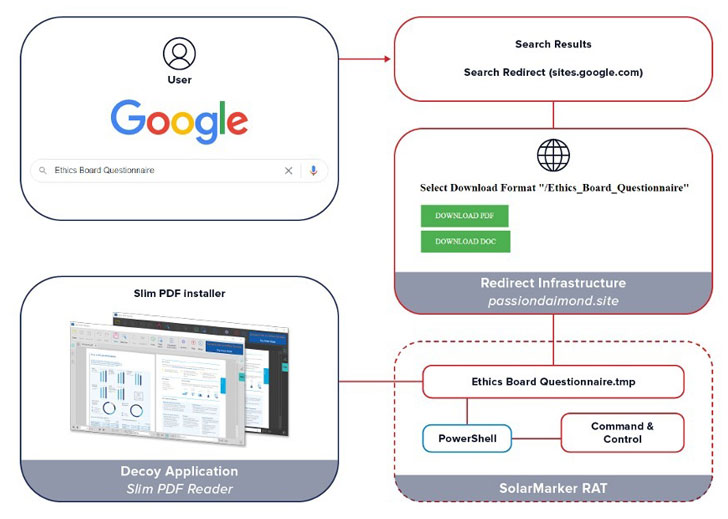
The attack works by leveraging searches for business forms such
as invoices, templates, questionnaires, and receipts as a stepping
stone toward infiltrating the systems. Users attempting to download
the alleged document templates are redirected[1], without their
knowledge, to a malicious website that hosts the malware.
“Once the RAT is on the victim’s computer and activated, the
threat actors can send commands and upload additional malware to
the infected system, such as ransomware, a credential stealer, a
banking trojan, or simply use the RAT as a foothold into the
victim’s network,” researchers from eSentire said[2]
in a write-up published on Tuesday.
The cybersecurity firm said it discovered over 100,000 unique
web pages that contain popular business terms or keywords such as
template, invoice, receipt, questionnaire, and resume, thus
allowing the pages to be ranked higher on the search results, and
therefore, increasing the likelihood of success.
Once a victim lands on the attacker-controlled website and
downloads the document being searched for, it becomes an entry
point for more sophisticated threats, ultimately resulting in the
installation of a .NET-based RAT called SolarMarker (aka Yellow
Cockatoo, Jupyter, and Polazert).
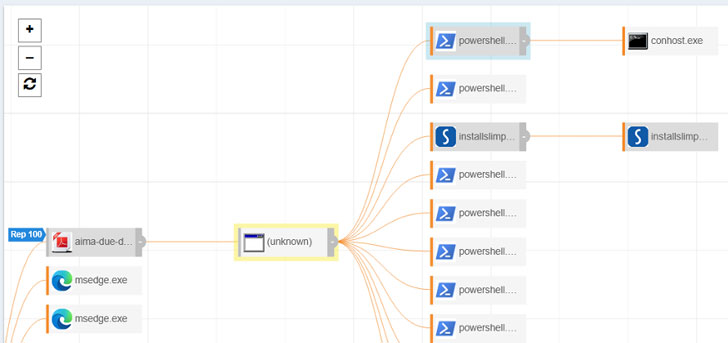
In one case investigated by eSentire, which involved an employee
of a financial management company, the malware executable was
disguised as a PDF document that, when launched, deployed the RAT
along with a legitimate version of Slim PDF as a decoy.
“Another troubling aspect of this campaign is that the
SolarMarker group has populated many of their malicious web pages
with keywords relating to financial documents,” said Spence
Hutchinson, eSentire’s manager of threat intelligence.
“A financial cybercrime group would consider an employee,
working in the finance department of a company, or an employee,
working for a financial organization, a high value target.
Unfortunately, once a RAT is comfortably installed, the potential
fraud activities are numerous.”
References
- ^
redirected
(developers.google.com) - ^
said
(www.esentire.com)