Facebook-owned WhatsApp recently addressed two security
vulnerabilities in its messaging app for Android that could have
been exploited to execute malicious code remotely on the device and
even compromise encrypted communications.
The flaws take aim at devices running Android versions up to and
including Android 9 by carrying out what’s known as a
“man-in-the-disk” attack that makes it possible for adversaries to
compromise an app by manipulating certain data being exchanged
between it and the external storage.
“The two aforementioned WhatsApp vulnerabilities would have made
it possible for attackers to remotely collect TLS cryptographic
material for TLS 1.3 and TLS 1.2 sessions,” researchers from Census
Labs said[1]
today.
“With the TLS secrets at hand, we will demonstrate how a
man-in-the-middle (MitM) attack can lead to the compromise of
WhatsApp communications, to remote code execution on the victim
device and to the extraction of Noise protocol keys used for
end-to-end encryption in user communications.”
In particular, the flaw (CVE-2021-24027[2]) leverages Chrome’s
support for content providers[3]
in Android (via the “content://” URL scheme) and a same-origin
policy bypass in the browser (CVE-2020-6516), thereby allowing an
attacker to send a specially-crafted HTML file to a victim over
WhatsApp, which, when opened on the browser, executes the code
contained in HTML file.
Worse, the malicious code can be used to access any resource
stored in the unprotected external storage area, including those
from WhatsApp, which was found to save TLS session key details in a
sub-directory, among others, and as a result, expose sensitive
information to any app that’s provisioned to read or write from the
external storage.
“All an attacker has to do is lure the victim into opening an
HTML document attachment,” Census Labs researcher Chariton
Karamitas said. “WhatsApp will render this attachment in Chrome,
over a content provider, and the attacker’s Javascript code will be
able to steal the stored TLS session keys.”
Armed with the keys, a bad actor can then stage a
man-in-the-middle attack to achieve remote code execution or even
exfiltrate the Noise protocol[4]
key pairs (used for end-to-end encryption) gathered by the app for
diagnostic purposes by deliberately triggering an out of memory
error remotely on the victim’s device.
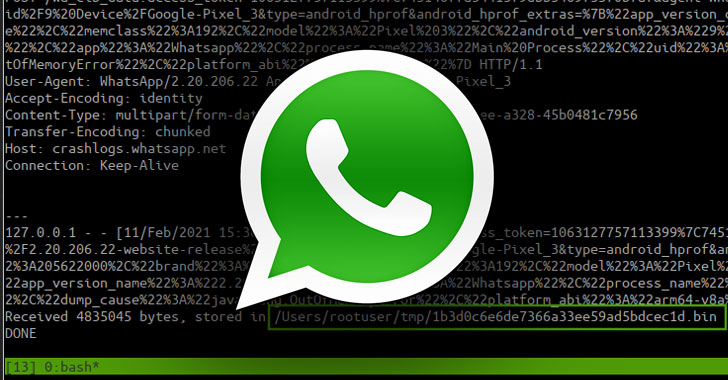
When this error is thrown, WhatsApp’s debugging mechanism kicks
in and uploads[5]
the encoded key pairs along with the application logs, system
information, and other memory content to a dedicated crash logs
server (“crashlogs.whatsapp.net”). But it’s worth noting that this
only occurs on devices that run a new version of the app, and “less
than 10 days have elapsed since the current version’s release
date.”
To defend against such attacks, Google introduced a feature
called “scoped storage[6]” in Android 10, which
gives each app an isolated storage area on the device in a way that
no other app installed on the same device can directly access data
saved by other apps.
The cybersecurity firm said it has no knowledge on whether the
attacks have been exploited in the wild, although in the past,
flaws in WhatsApp have been abused to inject spyware[7]
onto target devices and snoop on journalists and human rights
activists[8].
WhatsApp users are recommended to update to version 2.21.4.18 to
mitigate the risk associated with the flaws. We have reached out to
the company for comment, and we will update the story if we hear
back.
“There are many more subsystems in WhatsApp which might be of
great interest to an attacker,” Karamitas said. “The communication
with upstream servers and the E2E encryption implementation are two
notable ones. Additionally, despite the fact that this work focused
on WhatsApp, other popular Android messaging applications (e.g.
Viber, Facebook Messenger), or even mobile games might be
unwillingly exposing a similar attack surface to remote
adversaries.”
References
- ^
said
(census-labs.com) - ^
CVE-2021-24027
(census-labs.com) - ^
content
providers (census-labs.com) - ^
Noise protocol
(www.noiseprotocol.org) - ^
uploads
(twitter.com) - ^
scoped
storage (thehackernews.com) - ^
inject
spyware (thenextweb.com) - ^
journalists and human rights
activists (thenextweb.com)