
Cybersecurity researchers on Wednesday disclosed details of an
evolving malware that has now been upgraded to steal sensitive
information from Apple’s macOS operating system.
The malware, dubbed “XLoader,” is a successor to another
well-known Windows-based info stealer called Formbook[1]
that’s known to vacuum credentials from various web browsers,
collect screenshots, log keystrokes, and download and execute files
from attacker-controlled domains.
“For as low as $49 on the Darknet, hackers can buy licenses for
the new malware, enabling capabilities to harvest log-in
credentials, collect screenshots, log keystrokes, and execute
malicious files,” cybersecurity firm Check Point said in a report[2]
shared with The Hacker News.
Distributed via spoofed emails containing malicious Microsoft
Office documents, XLoader is estimated to infected victims spanning
across 69 countries between December 1, 2020, and June 1, 2021,
with 53% of the infections reported in the U.S. alone, followed by
China’s special administrative regions (SAR), Mexico, Germany, and
France.
While the very first Formbook samples were detected in the wild
in January 2016, the sale of the malware on underground forums
stopped in October 2017, only to be resurrected more than two years
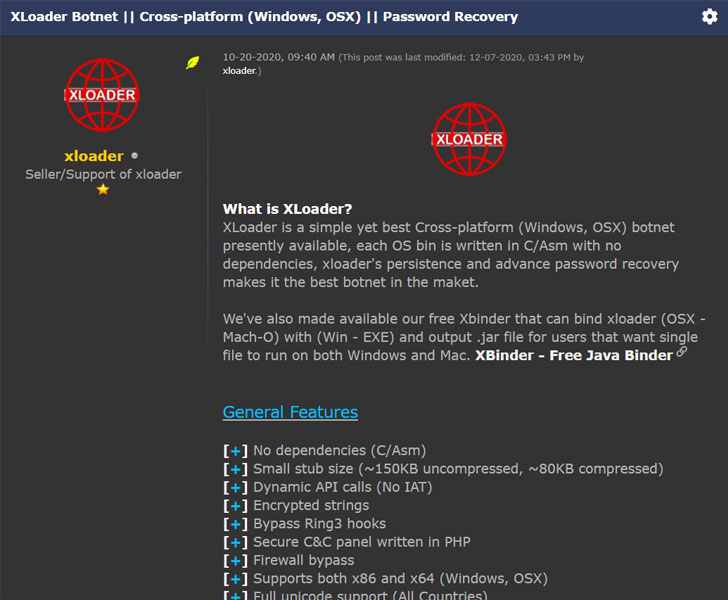
later in the form of XLoader in February 2020. In October 2020, the
latter was advertised for sale on the same forum which was used for
selling Formbook, Check Point said. Both Formbook and its XLoader
derivative are said to share the same codebase.
According to statistics released by Check Point earlier this
January, Formbook was third among the most
prevalent malware families[3]
in December 2020, impacting 4% of organizations worldwide. It’s
worth noting that the newly discovered XLoader malware for PC and
Mac is not the same as XLoader
for Android[4], which was first
detected in April 2019.
“[XLoader] is far more mature and sophisticated than its
predecessors, supporting different operating systems, specifically
macOS computers,” said Yaniv Balmas, head of cyber research at
Check Point. “Historically, macOS malware hasn’t been that common.
They usually fall into the category of ‘spyware’, not causing too
much damage.”
“While there might be a gap between Windows and MacOS malware,
the gap is slowly closing over time. The truth is that macOS
malware is becoming bigger and more dangerous,” Balmas noted,
adding the findings “are a perfect example and confirm this growing
trend.”
References
- ^
Formbook
(thehackernews.com) - ^
report
(research.checkpoint.com) - ^
most prevalent malware families
(www.checkpoint.com) - ^
XLoader for Android
(www.trendmicro.com)