
Endpoint devices like desktops, laptops, and mobile phones
enable users to connect to enterprise networks and use their
resources for their day-to-day work. However, they also expand the
attack surface and make the organisation vulnerable to malicious
cyberattacks and data breaches.
Why Modern Organisations Need EDR
According to the 2020 global risk report[1]
by Ponemon Institute, smartphones, laptops, mobile devices, and
desktops are some of the most vulnerable entry points that allow
threat actors to compromise enterprise networks. Security teams
must assess and address the security risks created by these devices
before they can damage the organisation. And for this, they require
Endpoint Detection & Response (EDR).
EDR solutions provide real-time visibility into endpoints and
detect threats like malware and ransomware. By continuously
monitoring endpoints, they enable security teams to uncover
malicious activities, investigate threats, and initiate appropriate
responses to protect the organisation.
The Limitations of EDR
Modern enterprise networks are complex webs of users, endpoints,
applications, and data flows distributed across on-premises and
multi-cloud environments. As EDR solutions only provide visibility
into endpoints, many security gaps and challenges remain,
significantly increasing the risk of cyberattacks going
unnoticed.
- Malware disabling/abusing EDR agents: The
emergence of sophisticated hacker groups like Lapsus$[2]
is another risk that EDR tools can’t deal with. In late 2021,
Lapsus$ hacked into several large companies by compromising remote
endpoints and turning off their EDR tools. They were thus able to
hide their malicious behaviour on the infected endpoints and
achieve their goal of stealing sensitive company data. Another
problem is that threat actors can abuse the “hooking” technique
that EDRs use to monitor running processes. This technique enables
EDR tools to monitor programs, detect suspicious activities, and
gather data for behaviour-based analytics. However, this same
process allows attackers to access a remote endpoint and import
malware. - BYOD: In recent years, many organisations have
shifted to remote work models that allow employees and third-party
users to access enterprise resources via remote networks and
unsecured mobile devices. These devices are outside the control of
security teams and their EDR tools. Consequently, their security
solutions cannot keep up with all these endpoints, much less
protect them or the enterprise network from malicious attacks. - Unsupported devices: Also, not every connected
endpoint can support EDR agents. This is true for legacy endpoints
like routers and switches, as well as newer IoT devices. Further,
with connected Supervisory Control and Data Acquisition (SCADA) and
Industrial Control System (ICS) environments, some endpoints may be
outside the organisation’s control and thus outside the EDR’s
security perimeter. Consequently, these endpoints and systems
remain vulnerable to threats like malware, DDoS attacks, and crypto
mining. - Maintaining/deploying EDR: Finally, with agent
based EDR products, it can be a huge burden for security teams to
install and maintain agents on every endpoint across the enterprise
network environment.
Closing EDR’s Security Gaps with Network Visibility and
NDR
One of the most effective ways to close the security gaps
highlighted above is by adding Network Detection and Response (NDR)
to the enterprise cybersecurity stack for the following
reasons:
- Cannot disable NDR: As a log data based NDR
such as ExeonTrace[3]
collects data from multiple different data sources in the network
(and does not rely on specific devices), the detection algorithms
cannot be circumvented. Therefore, even if an EDR is disabled by
malware, the NDR will detect it. - Identification of shadow IT: An NDR solution
not only allows to monitor the network traffic between known
network devices but also identifies and monitors yet unknown
devices and networks. And of course, also endpoints without EDR
agents are included in the network analytics (such as BYOD). - Misconfigured firewalls and gateways: Unproper
configured firewalls and gateways can be entry doors for attackers
– an NDR allows for detection before exploitation. - Tamper-proof data collection: Network-based
data collection is more tamper-proof than agent-based data; ideal
for digital forensics required by regulators. - Complete visibility of the whole network: As
no agents are required, an NDR solution such as ExeonTrace allows
for complete visibility of all network connections and data flows.
It thus provides greater visibility across the entire enterprise
network and any potential threats across it.
Conclusion
As organisations become increasingly complex and add more
end-user devices to their networks, they require a reliable
monitoring solution to protect their endpoints from potential
threats. However, Endpoint Detection and Response (EDR) provides
such endpoint protection only to a certain extent. There are
numerous drawbacks of EDR that allow sophisticated cybercriminals
to surpass their security perimeter and exploit network
vulnerabilities.
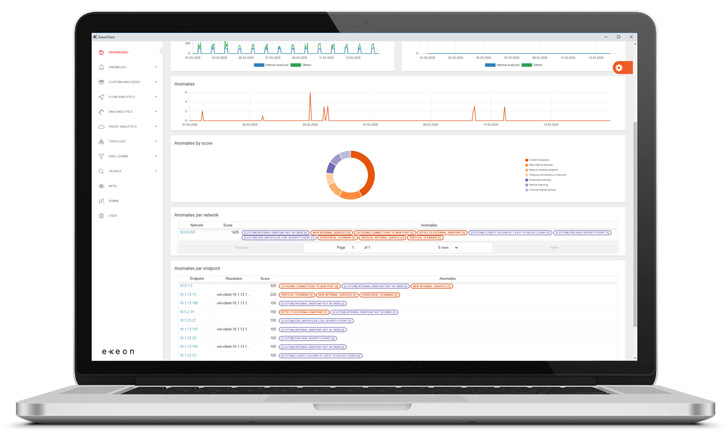 |
| ExeonTrace Platform: Screenshot of Dashboard |
To fill the security gaps left by EDR solutions, organisations
must reinforce their security defences. Network Detection and
Response (NDR) solutions like ExeonTrace are a reliable and proven
way to monitor network traffic and thus complete enterprise
cybersecurity stacks. As EDR and NDR solutions are complementary,
their combined detection capabilities can effectively protect
organisations from sophisticated cyberattacks.
Book a free
demo[4] to discover how
ExeonTrace can help address your security challenges and make your
organisation more cyber resilient.
References
- ^
risk
report (www.keeper.io) - ^
Lapsus$
(michaelkoczwara.medium.com) - ^
ExeonTrace
(nextgen.exeon.com) - ^
Book a free demo
(nextgen.exeon.com)
Read more https://thehackernews.com/2022/09/why-organisations-need-both-edr-and-ndr.html