to build their software products. According to industry estimates,
open source components account for 60-80% of the code base in
modern applications.
Collaboration on open source projects throughout the community
produces stronger code, squashing the bugs and catching the
vulnerabilities that impact the security of organizations who look
to open source components as the key to their application building
success.
Thanks in part to the “thousand eyeballs” of the community, the
number of reported vulnerabilities in open source projects is on
the rise, spiking 51% in
2017[1] from the previous
year.
This is even more concerning since, as shown in the same study,
most vulnerabilities are found in popular projects. Data shows that
32% of the top 100 open source projects have at least one
vulnerability, meaning that developers have their work cut out for
them, no matter which components they are using in their
products.
While it is better to know about vulnerabilities that remain in
the dark, giving teams the opportunity to patch before being
exploited by hackers, keeping up with the workload of remediating
vulnerable components can pose a significant challenge for
organizations.
The answer would appear to embrace the shift-left model that has
long been associated with DevOps, extending the approach to
incorporating security practices early in the software development
lifecycle.
Security starts with developers, from their creation of the code
through the post-deployment remediations where fixing
vulnerabilities can be quite time-consuming.
According to our recent survey on challenges facing developers
in using open source, respondents reported that they spend 15 hours a
month[2] on average dealing with
open source vulnerabilities.
While in itself a significant chunk of time, what was surprising
was that only 3.8 of these hours actually went towards the work of
remediating the vulnerabilities, apparently, the rest of the time
was spent trying to understand where to start in tackling the
vulnerabilities.
Addressing The Challenge Of Finding And Fixing Vulnerable Open
Source Components
Ideally, developers should be able to know early on in their
process if a component that they want to use for their product has
any known vulnerabilities associated with it before they commit it
to their code.
By catching issues before they become a part of the product,
developers can save themselves plenty of time that would otherwise
be spent before a release, swapping out the vulnerable component
and reconfiguring their product that has been built on top of the
risky component.
Considering the widespread use of open-source components and the
exponential rise in the number of disclosed open source
vulnerabilities, performing these checks for known vulnerabilities
manually is not a viable option, particularly when developers hope
to stick to a schedule without compromising on security.
What they need are automated tools, backed up by comprehensive
databases of known vulnerabilities, that can quickly identify which
open source components are being used and show the developer at a
glance if they have any issues to contend with before making their
push.
Introducing WhiteSource Bolt For GitHub
WhiteSource has launched a free tool to simplify working with open
source for developers. WhiteSource
Bolt[3] is an app on
GitHub’s marketplace that can alert on vulnerable open source
components in your repositories in real-time, provide detailed
information and even suggest fixes.
This new offering helps developers use better and more secure
open source components from the early stages of coding and, most
importantly, provides security alerts to the environment where
developers are actually working – GitHub.
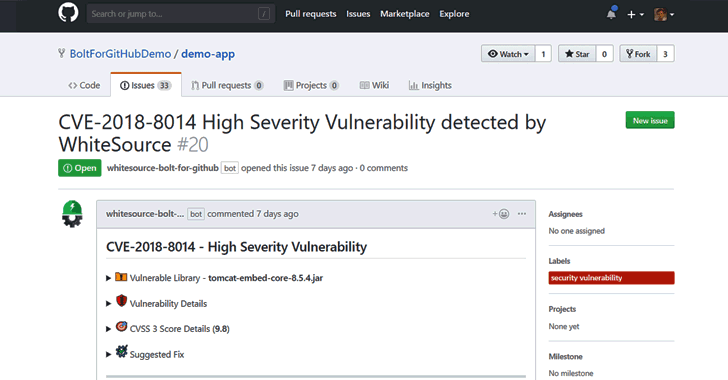
The app scans public and private repositories to identify open
source components with known vulnerabilities. Security alerts
auto-generate issues within GitHub where the user can view
important details such as references for the CVE, its CVSS rating,
a suggested fix, and other information that can help them to help
plan their remediations.
There is even an option to assign the vulnerability to another
team member using the milestones feature.
For most developers, GitHub is the first place to go to when
looking for a solution to a problem, providing them with the right
library or framework to get the job done.
With Bolt for GitHub, WhiteSource gives developers the slimmed
down version of our enterprise-level product for free, making it
easier for developers to work securely.
By offering this free tool for developers on GitHub, WhiteSource
hopes to make open source security simpler, integrating it into the
workflow that is already an instinctive part of how developers
write code.
By integrating directly into GitHub’s platform, developers can
ensure the security of their products without ever having to leave
the page.
To get started with this free tool, follow this link to
download the application[4].
References
- ^
51% in 2017
(resources.whitesourcesoftware.com) - ^
15 hours a month
(resources.whitesourcesoftware.com) - ^
WhiteSource Bolt
(github.com) - ^
follow this link to download the
application (github.com)
Read more http://feedproxy.google.com/~r/TheHackersNews/~3/iWlQrt60U7c/whitesource-bolt-github-security.html