
If you are thinking about performing a penetration test on your
organization, you might be interested in learning about the
different types of tests available. With that knowledge, you’ll be
better equipped to define the scope for your project, hire the
right expert and, ultimately, achieve your security objectives.
What is penetration testing?
Penetration testing, commonly referred to as “pen testing,” is a
technique that simulates real-life attacks on your IT systems to
find weaknesses that could be exploited by hackers. Whether to
comply with security regulations such as ISO 27001, gain customer
and 3rd party trust, or achieve your own peace of mind, penetration
testing is an effective method used by modern organizations to
strengthen their cyber security posture and prevent data
breaches.
Read about the different types of penetration testing to find
out which type you can benefit from the most:
Network penetration testing
As the name suggests, a network penetration test aims to
identify weaknesses in your network infrastructure, be that on the
premises or in cloud environments. It is one of the most common and
crucial tests to perform to ensure the security of your
business-critical data.
Network penetration testing covers a broad range of checks,
including insecure configurations, encryption vulnerabilities, and
missing security patches in order to determine the steps a hacker
could take to attack your organization. Security professionals
often categorize this test into two different perspectives:
external and internal.
External penetration testing involves searching
for vulnerabilities that could be exploited by any attacker with
access to the internet. In this scenario, penetration testers are
trying to get access to your business-critical systems and data in
order to determine how an attacker without any prior access or
knowledge would be able to target your organization. You can think
of this test as being performed from the perspective of an
“outsider”.
In contrast, internal penetration testing is
concerned with testing your internal corporate environment. This
type of testing considers scenarios in which an attacker has
managed to gain an initial foothold within your corporate network,
for example by exploiting a vulnerability in one of your
internet-facing systems, or through the use of social engineering.
In this case, the test is performed from an “insider” perspective,
with an objective of finding a way to steal sensitive information
or disrupting the operations of an organization.
Generally speaking, external weaknesses are considered to pose a
more serious threat than internal. For one thing, a hacker has to
overcome an external security barrier before accessing your
internal networks and pivoting to other systems. If you haven’t
conducted any kind of penetration testing before, an external or
“perimeter” test is often the best place to start, as the perimeter
is the easiest thing for attackers to get to. If you have trivial
vulnerabilities in your internet-facing infrastructure, that’s
where the hackers will start.
Web application penetration testing
Web application penetration testing attempts to uncover
vulnerabilities across websites and web applications, such as
e-commerce platforms, content management systems, and customer
relationship management software. This type of test deals with
reviewing the entire web application’s security, including its
underlying logic and custom functionalities, to prevent data
breaches.
Some of the common vulnerabilities detected during a web app
penetration test include database injections, cross-site scripting
(XSS), and broken authentication. If you are interested in learning
more about different types of web application weaknesses, their
severity and how you can prevent them, the Open Web Application
Security Project (OWASP) Top 10 is a great place to start. Every
few years OWASP publishes information about the most frequent and
dangerous web application flaws, basing its findings on the data
collected from many thousands of applications.
Considering the prevalence of web applications in modern
organizations, and the valuable information that they transmit and
store, it is unsurprising that they are an attractive target to
cybercriminals. According to Verizon’s “2021 Data Breach
Investigations Report”, the proportion of incidents, which involved
web application assets, reached nearly 50%. For this reason,
organizations that are developing or managing their own
internet-facing applications should strongly consider conducting
web application penetration testing.
Automated penetration testing
Understandably, as penetration tests can be costly and
infrequent (only run once or twice per year), many people naturally
wonder if automated penetration testing is feasible.
While it’s not possible to fully automate a penetration test (as
there will always be an element of manual work conducted by skilled
professionals), it’s similarly impossible for humans to manually
check for every vulnerability that exists, there are simply too
many. That’s where vulnerability scanning comes in, with these
tools you can: schedule scans; get rapidly tested for many
thousands of weaknesses; and be notified of your results in a
variety of channels and formats. It’s no wonder that vulnerability
scanners form a critical part of a penetration testers toolkit.
One such tool that you can explore is Intruder[1]. It offers automated
security scanning that is designed to be simple and fast, so you
can get set-up and protected in little to no time. Intruder
includes Emerging Threat Scans, which proactively check your
systems for newly discovered vulnerabilities as soon as they are
disclosed.
It may not be a fully automated penetration test, but it
certainly is like having an automated penetration tester watching
over your systems. When you combine continuous vulnerability
scanning with an annual penetration test, you can rest assured that
your systems are covered by a robust and comprehensive cyber
security program.
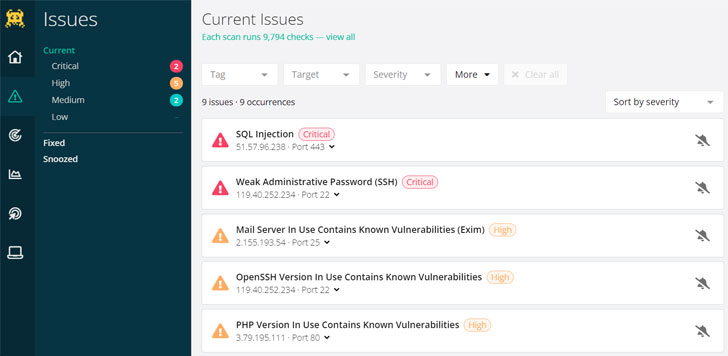 |
| Intruder automatically separates purely informational results from actionable issues, significantly saving technical teams time on analyzing their scan results. |
If you’d like to see the automated tool in action, you can take
Intruder’s Pro Plan for a spin with the 30-day free trial[2].
Social engineering
In comparison to previously described penetration testing types,
which focus on finding weaknesses in technology, social engineering
attempts to compromise the security of an organization by
exploiting human psychology. It can take a variety of forms and
could be executed both remotely, for example by trying to obtain
sensitive information from users through phishing emails or phone
calls, or on-site, in which case a penetration tester will attempt
to gain access to a physical facility. In all cases, an objective
of this penetration test is to manipulate individuals, usually the
company’s employees, to give away valuable information.
The success of a social engineering penetration test largely
depends on the information gathered in the “reconnaissance” phase,
which involves researching targeted individuals or an organization
by using publicly accessible open-source intelligence (OSINT).
After building a more precise image of their target, a penetration
tester can use discovered information to proceed with the creation
of a tailored attack strategy.
One of the most common attack vectors in social engineering is a
phishing attack, usually delivered by email. When performing a
phishing attack, a penetration tester does not necessarily stop
when an unsuspecting employee clicks on a malicious link, but can
go further, attempting to steal user credentials and get access to
an employee’s laptop. Such attacks can be extremely successful,
especially when performed by experienced penetration testers.
Social engineering penetration testing is not as widely adopted
as network or web application testing. However, if your
organization is already doing regular security awareness training,
conducting a dedicated social engineering test can be a great
addition to your arsenal for identifying and fixing security issues
in your operations.
Red teaming
This advanced technique has its origin in military training
exercises. It is designed to challenge an organization’s security,
processes, policies and plans by adopting an adversarial mindset.
In contrast, Blue teaming, otherwise known as “defensive security,”
involves detecting and withstanding Red team attacks as well as
real-life adversaries.
Red Teaming combines digital, social and physical domains to
implement comprehensive real-life attack scenarios. As such, Red
Teaming can be considered a distinct operation from penetration
testing, but since its tasks span all of the penetration testing
types described above, we thought it was worth mentioning it in
this article.
An objective of a standard penetration test is to find as many
vulnerabilities as possible within a given timeframe. The breath of
this test is naturally limited by the scope of work; but real-life
adversaries don’t have such artificial restrictions to follow. As a
result, even if an organization regularly performs penetration
tests and vulnerability scans, it can still be exposed to more
sophisticated attacks such as where social engineering and internal
network weaknesses are chained together. This is where Red Teaming
comes in. It assesses an organization’s environment as a whole,
understanding how all parts function together. It then applies
critical thinking to discover new vulnerabilities that attackers
can exploit, helping the organization to assess its response to
real-world attacks.
Compared to the standard penetration test, which lasts several
days or weeks, Red Team assessments generally take much longer, in
some cases several months to complete. Due to its complex nature,
it is a rather rare operation, typically performed by larger
organizations or by government contractors with well-established
security programmes.
To conclude
Penetration testing is a broad discipline that encompasses
different techniques, so it is important to understand the relative
risks that your organization is facing in order to choose the most
appropriate type. If you are still unsure what type of testing is
appropriate for your organization, you can reach out to Intruder’s
team of experienced penetration testers, who will be able to help
you.
About Intruder
Intruder is an international cyber security company that helps
organizations reduce their cyber exposure by providing an
effortless vulnerability scanning solution. Offering
industry-leading security checks, continuous monitoring, and an
easy-to-use platform, Intruder keeps businesses of all sizes safe
from hackers.
Visit their website[3]
to find out more about Intruder and to try their online
vulnerability scanner for free.
References
- ^
Intruder
(www.intruder.io) - ^
30-day
free trial (portal.intruder.io) - ^
Visit
their website (www.intruder.io)
Read more http://feedproxy.google.com/~r/TheHackersNews/~3/fVDGj88iYls/types-of-penetration-testing.html