
LemonDuck, a cross-platform cryptocurrency mining botnet, is
targeting Docker to mine cryptocurrency on Linux systems as part of
an active malware campaign.
“It runs an anonymous mining operation by the use of proxy
pools, which hide the wallet addresses,” CrowdStrike said[1]
in a new report. “It evades detection by targeting Alibaba Cloud’s
monitoring service and disabling it.”
Known to strike both Windows and Linux environments, LemonDuck
is primarily engineered for abusing the system resources to mine
Monero. But it’s also capable of credential theft, lateral
movement, and facilitating the deployment of additional payloads
for follow-on activities.
“It uses a wide range of spreading mechanisms — phishing emails,
exploits, USB devices, brute force, among others — and it has shown
that it can quickly take advantage of news, events, or the release
of new exploits to run effective campaigns,” Microsoft detailed[2]
in a technical write-up of the malware last July.
In early 2021, attack chains involving LemonDuck leveraged[3]
the then newly patched Exchange Server vulnerabilities[4] to gain access to
outdated Windows machines, before downloading backdoors and
information stealers, including Ramnit.
The latest campaign spotted by CrowdStrike takes advantage of
exposed Docker APIs as an initial access vector, using it to run a
rogue container to retrieve a Bash shell script file that’s
disguised as a harmless PNG image file from a remote server.
An analysis of historical data shows that similar image file
droppers hosted on LemonDuck-associated domains have been put to
use by the threat actor since at least January 2021, the
cybersecurity firm noted.

The dropper files are key to launching the attack, with the
shell script downloading the actual payload that then kills
competing processes, disables Alibaba Cloud’s monitoring services,
and finally downloads and runs the XMRig coin miner.
With compromised cloud instances[5] becoming a hotbed for
illicit cryptocurrency mining activities, the findings underscore
the need to secure containers from potential risks throughout the
software supply chain.
TeamTNT targets AWS, Alibaba Cloud
The disclosure comes as Cisco Talos exposed the toolset of a
cybercrime group named TeamTNT, which has a history of targeting
cloud infrastructure for cryptojacking and placing backdoors.
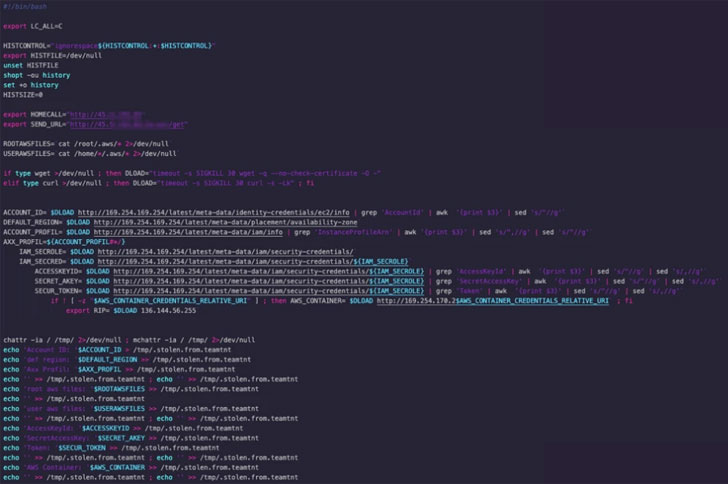
The malware payloads, which are said to have been modified in
response to previous public disclosures[6], are primarily designed
to target Amazon Web Services (AWS) while simultaneously focused on
cryptocurrency mining, persistence, lateral movement, and disabling
cloud security solutions.
“Cybercriminals who are outed by security researchers must
update their tools in order to continue to operate successfully,”
Talos researcher Darin Smith said[7].
“The tools used by TeamTNT demonstrate that cybercriminals are
increasingly comfortable attacking modern environments such as
Docker, Kubernetes, and public cloud providers, which have
traditionally been avoided by other cybercriminals who have instead
focused on on-premise or mobile environments.”
Spring4Shell exploited for cryptocurrency mining
That’s not all. In yet another instance of how threat actors
quickly co-opt newly disclosed flaws into their attacks, the
critical remote code execution bug in Spring Framework (CVE-2022-22965[8]) has been weaponized to
deploy cryptocurrency miners.
The exploitation attempts make use of a custom web shell to
deploy the cryptocurrency miners, but not before turning off the
firewall and terminating other virtual currency miner
processes.
“These cryptocurrency miners have the potential to affect a
large number of users, especially since Spring is the most widely
used framework for developing enterprise-level applications in
Java,” Trend Micro researchers Nitesh Surana and Ashish Verma
said[9].
References
- ^
said
(www.crowdstrike.com) - ^
detailed
(thehackernews.com) - ^
leveraged
(www.microsoft.com) - ^
Exchange
Server vulnerabilities (thehackernews.com) - ^
compromised cloud instances
(thehackernews.com) - ^
previous
public disclosures (www.trendmicro.com) - ^
said
(blog.talosintelligence.com) - ^
CVE-2022-22965
(thehackernews.com) - ^
said
(www.trendmicro.com)
Read more https://thehackernews.com/2022/04/watch-out-cryptocurrency-miners.html