
If the Pulse Connect Secure gateway is part of your organization
network, you need to be aware of a newly discovered critical
zero-day authentication bypass vulnerability (CVE-2021-22893) that
is currently being exploited in the wild and for which there is no
patch yet.
At least two threat actors have been behind a series of
intrusions targeting defense, government, and financial
organizations in the U.S. and elsewhere by leveraging critical
vulnerabilities in Pulse Secure VPN devices to circumvent
multi-factor authentication protections and breach enterprise
networks.
“A combination of prior vulnerabilities and a previously unknown
vulnerability discovered in April 2021, CVE-2021-22893[1], are responsible for the
initial infection vector,” cybersecurity firm FireEye said[2]
on Tuesday.
The company has identified 12 malware families associated with
the exploitation of Pulse Secure VPN appliances.
The cybersecurity firm is also tracking the activity under two
threat clusters UNC2630 and UNC2717 (“UNC[3]” for Uncategorized) —
the former linked to a break-in of U.S. Defense Industrial base
(DIB) networks, while the latter was found targeting a European
organization in March 2021 — with the investigation attributing
UNC2630 to operatives working on behalf of the Chinese government,
in addition to suggesting possible ties to another espionage actor
APT5[4]
based on “strong similarities to historic intrusions dating back to
2014 and 2015.”
Attacks staged by UNC2630 are believed to have commenced as
early as August 2020, before they expanded in October 2020, when
UNC2717 began repurposing the same flaws to install custom malware
on the networks of government agencies in Europe and the U.S. The
incidents continued until March 2021, according to FireEye.
The list of malware families is as follows –
- UNC2630 – SLOWPULSE, RADIALPULSE, THINBLOOD,
ATRIUM, PACEMAKER, SLIGHTPULSE, and PULSECHECK - UNC2717 – HARDPULSE, QUIETPULSE, AND
PULSEJUMP
Two additional malware strains, STEADYPULSE and LOCKPICK,
deployed during the intrusions have not been linked to a specific
group, citing lack of evidence.
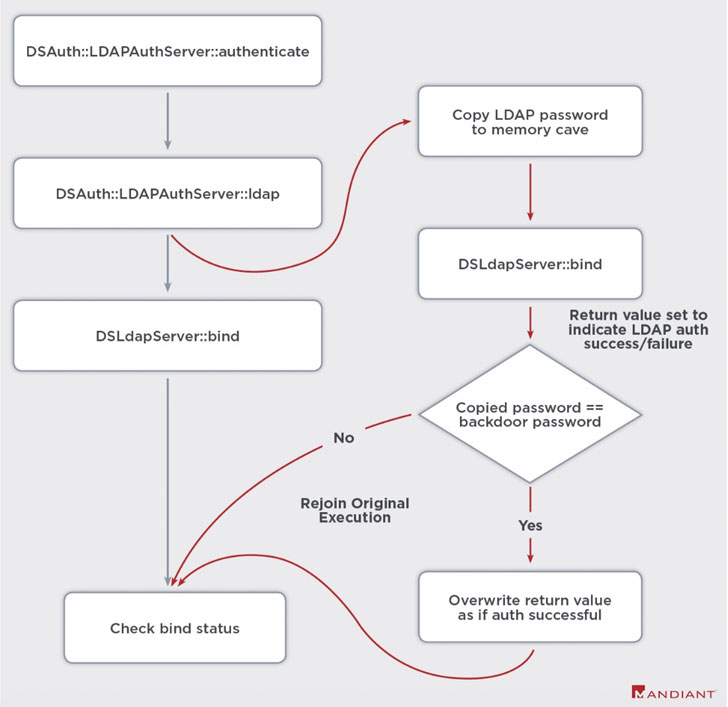
By exploiting Pulse Secure VPN weaknesses (CVE-2019-11510[5], CVE-2020-8260[6], CVE-2020-8243[7], and CVE-2021-22893),
UNC2630 is said to have harvested login credentials, using them to
move laterally into the affected environments. In order to maintain
persistence to the compromised networks, the actor utilized
legitimate, but modified, Pulse Secure binaries and scripts to
enable arbitrary command execution and inject web shells capable of
carrying out file operations and running malicious code.
Ivanti, the company behind the Pulse Secure VPN, has released
temporary mitigations[8]
to address the arbitrary file execution vulnerability (CVE-2021-22893[9], CVSS score: 10), while
a fix for the issue is expected to be in place by early May. The
Utah-based company acknowledged that the new flaw impacted a
“very limited number of customers[10],” adding it has
released a Pulse Security Integrity Checker
Tool[11] for customers to check
for signs of compromise.
Pulse Secure customers are recommended to upgrade to PCS Server
version 9.1R.11.4 when it becomes available.
News of compromises affecting government agencies, critical
infrastructure entities, and other private sector organizations
comes a week after the U.S. government released an advisory[12], warning businesses of
active exploitation of five publicly known vulnerabilities by the
Russian Foreign Intelligence Service (SVR), including
CVE-2019-11510, to gain initial footholds into victim devices and
networks.
References
- ^
CVE-2021-22893
(kb.pulsesecure.net) - ^
said
(www.fireeye.com) - ^
UNC
(www.fireeye.com) - ^
APT5
(malpedia.caad.fkie.fraunhofer.de) - ^
CVE-2019-11510
(thehackernews.com) - ^
CVE-2020-8260
(nvd.nist.gov) - ^
CVE-2020-8243
(nvd.nist.gov) - ^
temporary mitigations
(us-cert.cisa.gov) - ^
CVE-2021-22893
(kb.cert.org) - ^
very
limited number of customers
(blog.pulsesecure.net) - ^
Pulse
Security Integrity Checker Tool
(kb.pulsesecure.net) - ^
released an advisory
(thehackernews.com)