The U.S. government and its key allies, including the European
Union, the U.K, and NATO, formally attributed the massive
cyberattack against Microsoft Exchange email servers to
state-sponsored hacking crews working affiliated with the People’s
Republic of China’s Ministry of State Security (MSS).
In a statement[1]
issued by the White House on Monday, the administration said, “with
a high degree of confidence that malicious cyber actors affiliated
with PRC’s MSS conducted cyber-espionage operations utilizing the
zero-day vulnerabilities in Microsoft Exchange Server disclosed in
early March 2021. The U.K. government accused[2]
Beijing of a “pervasive pattern of hacking” and “systemic cyber
sabotage.”
The sweeping espionage campaign[3] exploited four
previously undiscovered vulnerabilities in Microsoft Exchange
software and is believed to have hit at least 30,000 organizations
in the U.S. and hundreds of thousands more worldwide. Microsoft
identified the group behind the hack as a skilled government-backed
actor operating out of China named Hafnium.
Calling it “the most significant and widespread cyber intrusion
against the U.K. and allies,” the National Cyber Security Centre
(NCSC) said[4]
the attack was highly likely to enable “acquiring personally
identifiable information and intellectual property.”
In addition, the MSS was also outed as the party behind a series
of malicious cyber activities tracked under the monikers “APT40”
and “APT31,” with the U.K. attributing the groups for targeting
maritime industries and naval defence contractors in the U.S. and
Europe, and as well as for executing the attack on the Finnish
parliament in 2020.
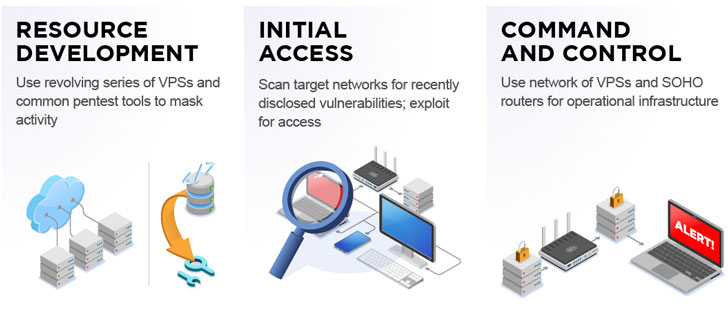
Also, on Monday, the U.S. Federal Bureau of Investigation (FBI),
National Security Agency (NSA), and Cybersecurity and
Infrastructure Security Agency (CISA) released[5]
a joint advisory[6]
listing over 50 tactics, techniques, and procedures employed by
APT40[7]
and other Chinese state-sponsored cyber
actors[8].
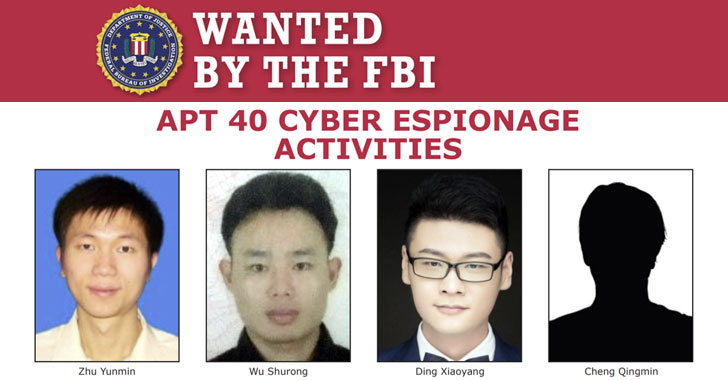
US Indicts Members of APT 40 Chinese Hacking Group
In a related development, the U.S. Department of Justice (DoJ)
pressed[9]
criminal charges against four MSS hackers belonging to the APT40
group concerning a multiyear campaign targeting foreign governments
and entities in maritime, aviation, defense, education, and
healthcare sectors in the least a dozen countries to facilitate the
theft of trade secrets, intellectual property, and high-value
information.
Separately, the NCSC also announced that a group known as
“APT10” acted on behalf of the MSS to carry out a sustained cyber
campaign focused on large-scale service providers with the goal of
seeking to gain access to commercial secrets and intellectual
property data in Europe, Asia, and the U.S.
“APT 10 has an enduring relationship with the Chinese Ministry
of State Security, and operates to meet Chinese State
requirements,” the intelligence agency said[10].
In a press statement, the European Union urged[11] Chinese authorities to
take action against malicious cyber activities undertaken from its
territory, stating the Microsoft Exchange server hacks resulted in
security risks and significant economic loss for government
institutions and private companies.
The Chinese government has repeatedly denied claims of
state-sponsored intrusions. A spokesperson for Chinese Embassy in
Washington, according to the Associated Press[12], painted China as “a
severe victim of the U.S. cyber theft, eavesdropping, and
surveillance,” noting that the “U.S. repeatedly made groundless
attacks and malicious smear against China on cybersecurity.”
“The PRC has fostered an intelligence enterprise that includes
contract hackers who also conduct unsanctioned cyber operations
worldwide, including for their own personal profit,” the White
House said, adding “hackers with a history of working for the PRC
Ministry of State Security (MSS) have engaged in ransomware
attacks, cyber enabled extortion, cryptojacking, and rank theft
from victims around the world, all for financial gain.”
References
- ^
statement
(www.whitehouse.gov) - ^
accused
(www.gov.uk) - ^
sweeping
espionage campaign (thehackernews.com) - ^
said
(www.ncsc.gov.uk) - ^
released
(us-cert.cisa.gov) - ^
joint
advisory (www.nsa.gov) - ^
APT40
(us-cert.cisa.gov) - ^
Chinese
state-sponsored cyber actors
(us-cert.cisa.gov) - ^
pressed
(www.justice.gov) - ^
said
(www.gov.uk) - ^
urged
(www.consilium.europa.eu) - ^
Associated Press
(apnews.com)