
Just as Colonial Pipeline restored[1]
all of its systems to operational status in the wake of a crippling
ransomware incident[2]
a week ago, DarkSide, the cybercrime syndicate behind the attack,
claimed it lost control of its infrastructure, citing a law
enforcement seizure.
All the dark websites operated by the gang, including its
DarkSide Leaks blog, ransom collection site, and breach data
content delivery network (CDN) servers, have gone dark and remain
inaccessible as of writing. In addition, the funds from their
cryptocurrency wallets were allegedly exfiltrated to an unknown
account, according to a note passed by DarkSide operators to its
affiliates.
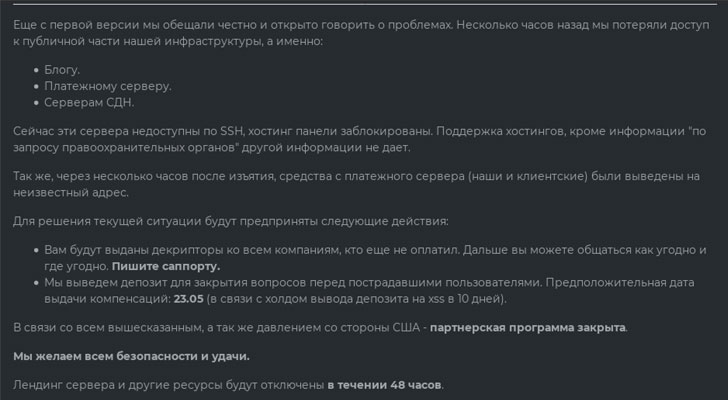
“At the moment, these servers cannot be accessed via SSH, and
the hosting panels have been blocked,” the announcement[3]
obtained by Intel 471 read.
The development comes as DarkSide closed its
Ransomware-as-a-Service (RaaS) affiliate program for good, with the
group stating that they would issue decryptors to all their
affiliates for the companies that were attacked, along with a
promise to compensate all outstanding financial obligations by May
23.
While the takedowns mark a surprise twist in the Colonial
Pipeline saga, it’s worth noting that there’s no evidence to
publicly corroborate these claims, raising concerns that this may
be an exit scam, an underhanded tactic that has plagued illegal darknet[4]
markets[5]
in recent years, or that the gang is giving the impression that
it’s retreating from the spotlight only to rebrand and stealthily
continue its operations in another format without attracting
unwanted attention.
According to blockchain analytics company Elliptic, the bitcoin
wallet used by the DarkSide ransomware group received a payment of
75 BTC ($3.2 million) on May 8 made by Colonial Pipeline, following
which the wallet was emptied of $5 million in bitcoin on May 13.
The wallet, which has been active since March 4, has received a
total of 57 payments amounting to $17.5 million from 21 different
wallets.
“There has been speculation that the bitcoins were seized by the
US government — if that is the case they didn’t actually seize most
of Colonial Pipeline’s ransom
payment[6] — the majority of that
was moved out of the wallet on the May 9,” Elliptic co-founder Tom
Robinson said[7].
By tracing the past cryptocurrency outflows from the wallet,
Elliptic said 18% of the bitcoin was sent to a small group of
exchanges, with an additional 4% sent to Hydra, the world’s largest
darknet bazaar which serves customers in Russia and Eastern Europe.
Hydra[8]
accounts for over 75% of darknet market revenue worldwide in 2020,
positioning it as a major player in the crypto crime landscape, per
Chainalysis[9].
DarkSide’s operational setbacks and the heightened scrutiny of
the Colonial Pipeline attack have also set in motion a wave of RaaS
bans on illicit cybercrime forums such as XSS[10] and Exploit[11], posing a major
short-term disruption of the ransomware economy. REvil, of the
prolific ransomware groups, has since introduced new restrictions
that prohibit the use of its software against health care,
educational, and government entities belonging to any country.
Viewed in this context, XSS, Exploit, and REvil’s actions can be
interpreted as a “ripple effect” of a series of high-profile
ransomware incidents in the past week, including that of Babuk’s on
the Metropolitan Police Department[12], increasingly landing
cybercrime groups in the crosshairs of law enforcement.
“Needless to say, however, it’s all but certain that ransomware
will remain a persistent threat for the foreseeable future given
their popularity and popularity among cybercriminal communities,”
Flashpoint said[13]. “If anything,
ransomware attacks will likely continue to grow in both scale and
frequency. After the closure of DarkSide, the ransomware landscape
is dominated by four major collectives: REvil, LockBit, Avaddon,
and Conti.”
In light of XSS and Exploit refusal to host RaaS operations on
their platforms, ransomware collectives are expected to go private
and advertise recruitment for new affiliates via their own leak
sites.
References
- ^
restored
(twitter.com) - ^
ransomware incident
(thehackernews.com) - ^
announcement
(www.intel471.com) - ^
illegal
darknet (www.digitalshadows.com) - ^
markets
(thehackernews.com) - ^
Colonial
Pipeline’s ransom payment
(thehackernews.com) - ^
said
(www.elliptic.co) - ^
Hydra
(geminiadvisory.io) - ^
Chainalysis
(blog.chainalysis.com) - ^
XSS
(thehackernews.com) - ^
Exploit
(twitter.com) - ^
Metropolitan Police Department
(thehackernews.com) - ^
said
(www.flashpoint-intel.com)