The ransomware attack[1]
against Colonial Pipeline’s networks has prompted the U.S. Federal
Motor Carrier Safety Administration (FMCSA) to issue a regional emergency declaration[2] in 17 states and the
District of Columbia (D.C.).
The declaration provides a temporary exemption to Parts 390
through 399 of the Federal Motor Carrier Safety Regulations
(FMCSRs[3]), allowing alternate
transportation of gasoline, diesel, and refined petroleum products
to address supply shortages stemming from the attack.
“Such [an] emergency is in response to the unanticipated
shutdown of the Colonial pipeline system due to network issues that
affect the supply of gasoline, diesel, jet fuel, and other refined
petroleum products throughout the Affected States,” the directive
said. “This Declaration addresses the emergency conditions creating
a need for immediate transportation of gasoline, diesel, jet fuel,
and other refined petroleum products and provides necessary
relief.”
The states and jurisdictions affected by the pipeline shut down
and included in the Emergency Declaration are Alabama, Arkansas,
District of Columbia, Delaware, Florida, Georgia, Kentucky,
Louisiana, Maryland, Mississippi, New Jersey, New York, North
Carolina, Pennsylvania, South Carolina, Tennessee, Texas, and
Virginia.
The exemptions, which aim to alleviate any shortages or supply
disruptions that may arise due to the shutdown, are expected to be
in effect until the end of the emergency or June 8, 2021, 11:59
p.m., whichever is earlier.
FBI Confirms DarkSide Ransomware
The development comes as the U.S. Federal Bureau of
Investigation (FBI) confirmed[4]
the disruption of one of the country’s largest pipelines over the
weekend was orchestrated by Darkside ransomware. The cyberattack
forced the company to shut down 5,500 miles of fuel pipeline from
the Texas city of Houston to New York harbor, raising concerns
about the vulnerability of the U.S. energy infrastructure to
cyberattacks.
“Colonial Pipeline is continuing to work in partnership with
third-party cybersecurity experts, law enforcement, and other
federal agencies to restore pipeline operations quickly and
safely,” Colonial Pipeline said[5]
in a statement. “While this situation remains fluid and continues
to evolve, the Colonial operations team is executing a plan that
involves an incremental process that will facilitate a return to
service in a phased approach.”
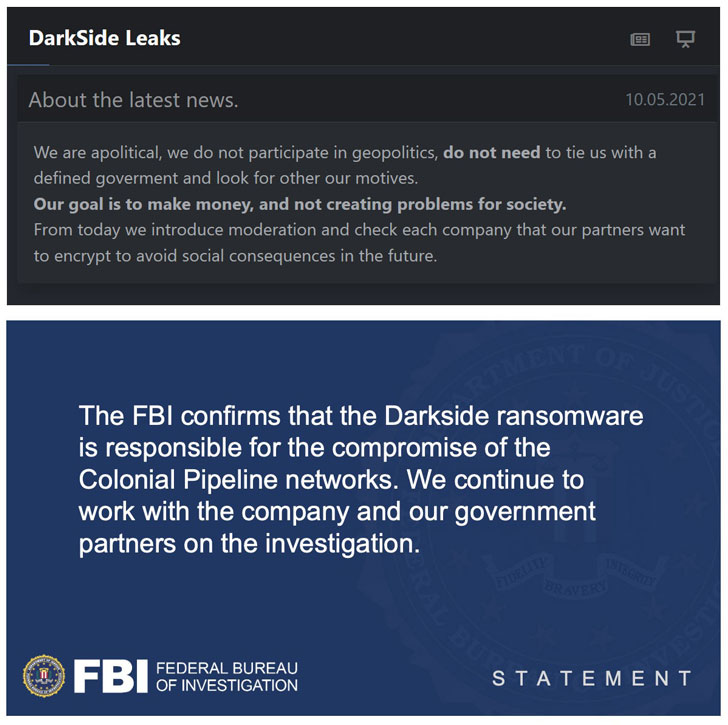
While the U.S. government on Monday said[6]
there was no evidence to imply that Russia was involved in the
Colonial Pipeline ransomware attack, the operators of the DarkSide
ransomware issued a statement on their dark web extortion site,
pledging it intends to vet the companies its affiliates are
targeting going forward to “avoid social consequences in the
future.”
“We are apolitical, we do not participate in geopolitics, do not
need to tie us with a defined government and look for other our
motives,” the cybercrime gang said, adding, “Our goal is to make
money, and not creating problems for society.”
DarkSide as Carbon Spider’s Ransomware campaign
The adversary, which is alleged to have leaked data pertaining
to at least 91
organizations[7]
since commencing operations in August 2020, functions as a
ransomware-as-a-service (RaaS) scheme, in which partners are roped
in to expand the criminal enterprise by breaching corporate
networks and deploying the ransomware, while the core developers
take charge of maintaining the malware and payment infrastructure.
Affiliates typically receive 60% to 70% of the proceeds, and the
developers earn the rest.
Among the victims whose internal data was published on the
DarkSide’s data leak site are other oil and gas companies such as
Forbes Energy Services and Gyrodata, both of which are based in
Texas. According to Crowdstrike[8], DarkSide is believed to
be the handiwork of Carbon Spider[9]
(aka Anunak, Carbanak, or FIN7), whose high-level manager and
systems administrator was recently sentenced to 10 years in prison[10] in the U.S.
“The DarkSide group is a relatively new player in the game of
ransomware. Despite being a new group, though, the DarkSide team
has already built itself quite a reputation for making their
operations more professional and organized,” Cybereason researchers
said[11] last month. “The group
has a phone number and even a help desk to facilitate negotiations
with victims, and they are making a great effort at collecting
information about their victims – not just technical information
about their environment, but more general information about the
company itself, like the organization’s size and estimated
revenue.”
DarkSide’s pattern of issuing corporate-style press releases on
their Tor domain to inject a veneer of professionalism into its
criminal activities has led cybersecurity firm Digital Shadows to
label its business model as a “ransomware-as-a-corporation[12]” (RaaC).
The Colonial Pipeline incident is the latest cyberattack to
confront the U.S. government in recent months, following the
SolarWinds hacks[13] by Russian intelligence
operatives and the exploitation of Microsoft Exchange Server[14] vulnerabilities by
Chinese threat actors.
“To take down extensive operations like the Colonial pipeline
reveals a sophisticated and well-designed cyberattack,” Check
Point’s Head of Threat Intelligence, Lotem Finkelsteen, said. “This
attack also requires a proper time frame to allow lateral movement
and data exhilaration. The Darkside is known to be part of a trend
of ransomware attacks that involve systems the cyber community
rarely sees involved in the compromised network, like ESXi servers.
This leads to suspicions that ICS network (critical infrastructure
systems) were involved.”
References
- ^
ransomware attack
(thehackernews.com) - ^
regional
emergency declaration (www.fmcsa.dot.gov) - ^
FMCSRs
(www.fmcsa.dot.gov) - ^
confirmed
(www.fbi.gov) - ^
said
(www.colpipe.com) - ^
said
(www.reuters.com) - ^
91 organizations
(twitter.com) - ^
Crowdstrike
(adversary.crowdstrike.com) - ^
Carbon
Spider (malpedia.caad.fkie.fraunhofer.de) - ^
sentenced to 10 years in prison
(thehackernews.com) - ^
said
(www.cybereason.com) - ^
ransomware-as-a-corporation
(www.digitalshadows.com) - ^
SolarWinds hacks
(thehackernews.com) - ^
Microsoft Exchange Server
(thehackernews.com)