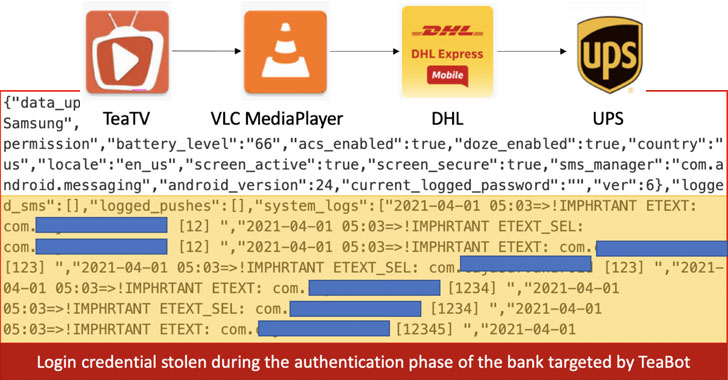
Cybersecurity researchers on Monday disclosed a new Android
trojan that hijacks users’ credentials and SMS messages to
facilitate fraudulent activities against banks in Spain, Germany,
Italy, Belgium, and the Netherlands.
Called “TeaBot[1]” (or Anatsa), the
malware is said to be in its early stages of development, with
malicious attacks targeting financial apps commencing in late March
2021, followed by a rash of infections in the first week of May
against Belgium and the Netherlands banks. The first signs of
TeaBot activity occurred in January.
“The main goal of TeaBot is stealing victim’s credentials and
SMS messages for enabling frauds scenarios against a predefined
list of banks,” Italian cybersecurity, and online fraud prevention
firm Cleafy said in a Monday write-up. “Once TeaBot is successfully
installed in the victim’s device, attackers can obtain a live
streaming of the device screen (on demand) and also interact with
it via Accessibility Services.”
The rogue Android application, which masquerades as media and
package delivery services like TeaTV, VLC Media Player, DHL, and
UPS, acts as a dropper that not only loads a second-stage payload
but also forces the victim into granting it accessibility service
permissions.
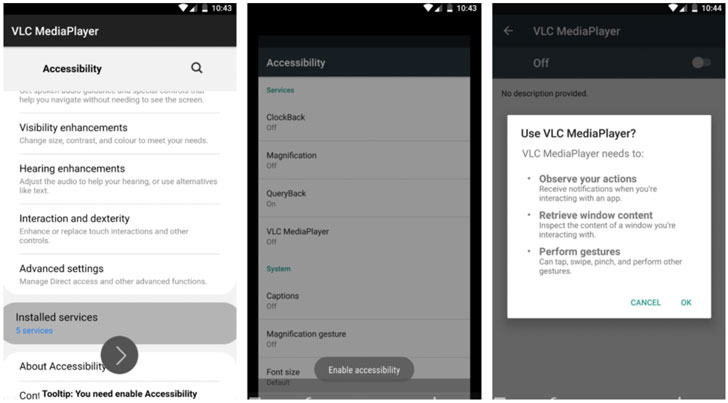
In the last link of the attack chain, TeaBot exploits the access
to achieve real-time interaction with the compromised device,
enabling the adversary to record keystrokes, in addition to taking
screenshots and injecting malicious overlays on top of login
screens of banking apps to steal credentials and credit card
information.
Other capabilities of TeaBot include disabling Google Play
Protect, intercepting SMS messages, and accessing Google
Authenticator 2FA codes. The collected information is then
exfiltrated every 10 seconds to a remote server controlled by the
attacker.
Android malware abusing accessibility services as a stepping
stone for perpetrating data theft has witnessed a surge in recent
months. Since the start of the year, at least three different
malware families — Oscorp[2], BRATA[3], and FluBot[4]
— have banked on the feature to gain total control of the infected
devices.
Interestingly, the fact that TeaBot employs the same decoy as
that of Flubot by posing as innocuous shipment apps could be an
attempt to mislead attribution and stay under the radar. The
heightened FluBot infections prompted Germany and the U.K. to issue
alerts last month warning of ongoing attacks via fraudulent SMS
messages that trick users into installing “spyware that steals
passwords and other sensitive data.”