
threat of Sim Swapping attacks very seriously.
Starting with the country’s first-ever
conviction[1] for ‘SIM Swapping’ this
February, U.S. Department of Justice has since then announced
charges against
several individuals[2]
for involving in the scheme to siphon millions of dollars in
cryptocurrency from victims.
In the latest incident, the U.S. authorities on Thursday
arrested two more alleged cybercriminals from Massachusetts,
charging them with stealing $550,000 in cryptocurrency from at
least 10 victims using SIM swapping between November 2015 and May
2018.
SIM Swapping, or SIM hijacking, is a technique that typically
involves the social engineering of a target’s mobile phone
provider.
An attacker makes a phony call posing as their targets and
convinces the mobile phone provider to port the target’s phone
number to a SIM card belonging to the attacker.
Once successful, the attacker can then obtain one-time
passwords, verification codes, and two-factor authentication
received on the target’s phone in order to reset passwords for and
gain access to target’s social media, email, bank, and
cryptocurrency accounts.
Hackers Also Targeted Executives of Cryptocurrency
Companies
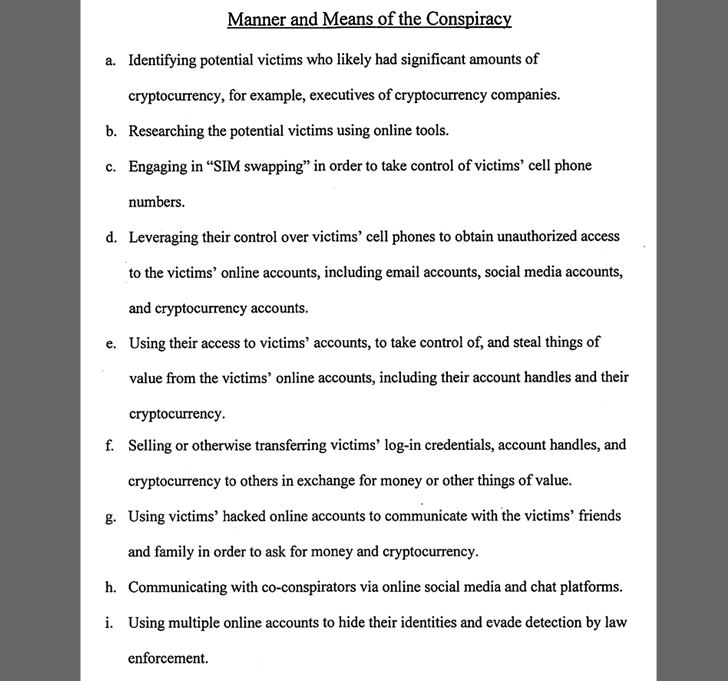
According to the indictment, the
two defendants — Eric Meiggs (20) and Declan Harrington (21) — not
just only targeted users with high-value cryptocurrency accounts,
but also targeted executives of cryptocurrency companies in an
attempt to make a significant profit.
Besides this, the two defendants have also been charged for
taking over social media accounts of their victims, including two
who “had high value or ‘O.G.’ (slang for ‘Original Gangster’)
social media account names.”
- one count of conspiracy to commit wire fraud,
- eight counts of wire fraud,
- one count of computer fraud and abuse, and
- one count of aggravated identity theft.
If convicted on the charge of conspiracy to commit wire fraud, each
defendant faces a maximum penalty of 20 years in prison. Meanwhile,
the aggravated identity theft charge carries a maximum sentence of
2 years in prison.
How to Protect Yourself from Sim Swapping
In the wake of several Sim Swapping incidents, the U.S. Federal
Trade Commission (FTC) in October issued a proper list of
guidelines that users can follow to protect themselves against
SIM swapping attacks:
- Don’t reply to calls, emails, or text messages that request
personal information. - Limit the personal information you share online.
- Set up a PIN or password on your cellular account.
- Consider using stronger authentication on accounts with
sensitive personal or financial information.
And in case you become a target of a SIM swap scam, you can take
some effective measures like:
- Contact your cellular service provider immediately to report
fraud and take control of your phone number back and immediately
change your account passwords. - Check your credit card, bank, and other financial accounts for
any unauthorized charges and report to the respective company if
you find any.
References
- ^
first-ever conviction
(thehackernews.com) - ^
charges against several individuals
(thehackernews.com) - ^
indictment
(www.justice.gov) - ^
list of guidelines
(www.consumer.ftc.gov)
Read more http://feedproxy.google.com/~r/TheHackersNews/~3/z67k8uQ5jAQ/hacking-with-sim-swapping.html