group of financially-motivated hackers that are targeting several
businesses and organizations in Germany, Italy, and the United
States in an attempt to infect them with backdoor, banking Trojan,
or ransomware malware.
Though the new malware campaigns are not customized for each
organization, the threat actors appear to be more interested in
businesses, IT services, manufacturing, and healthcare industries
who possess critical data and can likely afford high ransom
payouts.
According to a report
ProofPoint shared with The Hacker News, the newly discovered threat
actors are sending out low-volume emails impersonating
finance-related government entities with tax assessment and refund
lured emails to targeted organizations.
[1]
“Tax-themed Email Campaigns Target 2019 Filers, finance-related
lures have been used seasonally with upticks in tax-related malware
and phishing campaigns leading up to the annual tax filing
deadlines in different geographies,” the researchers said.
New Malware Campaigns Spotted in the Wild
In almost all spear-phishing email campaigns researchers observed
between October 16 and November 12 this year, the attackers used
malicious Word document attachments as an initial vector to
compromise the device.
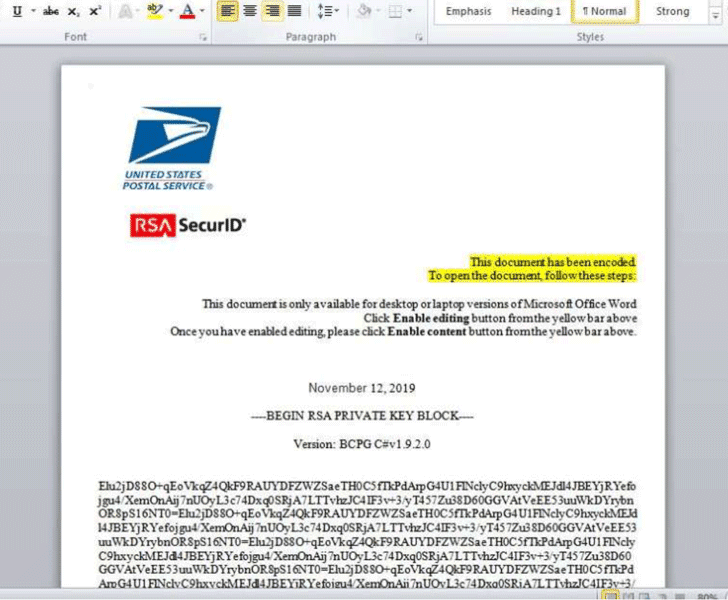
malicious PowerShell commands, which then eventually downloads and
installs one of the following payloads onto the victim’s system:
- Maze Ransomware,
- IcedID Banking Trojan,
- Cobalt Strike backdoor.
“Opening the Microsoft Word Document and enabling macros installs
Maze ransomware on the user’s system, encrypting all of their
files, and saves a ransom note resembling the following in TXT
format in every directory.”
emails more convincing, attackers are also using lookalike domains,
verbiage, and stolen branding to impersonate:
- Bundeszentralamt fur Steuern, the German Federal Ministry of
Finance, - Agenzia Delle Entrate, the Italian Revenue Agency,
- 1&1 Internet AG, a German internet service provider,
- USPS, the United States Postal Service.
“Similar campaigns leveraging local gov. agencies were also
observed in Germany and Italy. These social-engineered lures
indicate that cybercriminals overall are becoming more convincing
and sophisticated in their attacks.”
“Although these campaigns are small in volume, currently, they
are significant for their abuse of trusted brands, including
government agencies, and for their relatively rapid expansion
across multiple geographies. To date, the group appears to have
targeted organizations in Germany, Italy, and, most recently, the
United States, delivering geo-targeted payloads with lures in local
languages,” Christopher Dawson, Threat Intelligence Lead at
Proofpoint, told The Hacker News.
“We will be watching this new actor closely, given their
apparent global aspirations, well-crafted social engineering, and
steadily increasing scale.”
How to Protect Email-Based Cyber Attacks?
Thought most of the tools and techniques used by this new group are
neither new nor sophisticated; unfortunately, it’s still one of the
most successful ways criminals penetrate an organization.
The best ways to protect your computer against such attacks are
as simple as following basic online cybersecurity practices, such
as:
- Disable macros from running in office files,
- Always keep a regular backup of your important data,
- Make sure you run one of the best antivirus software on your
system, - Don’t open email attachments from unknown or untrusted
sources, - Don’t click on the links from unknown sources.
Read more http://feedproxy.google.com/~r/TheHackersNews/~3/CmDxbOWr_LU/financial-cyberattacks.html