The operators of TrickBot trojan are collaborating with the
Shathak threat group to distribute their wares, ultimately leading
to the deployment of Conti ransomware on infected machines.
“The implementation of TrickBot[1]
has evolved over the years, with recent versions of TrickBot
implementing malware-loading capabilities,” Cybereason security
analysts Aleksandar Milenkoski and Eli Salem said[2]
in a report analysing recent malware distribution campaigns
undertaken by the group. “TrickBot has played a major role in many
attack campaigns conducted by different threat actors, from common
cybercriminals to nation-state actors.”
The latest report builds on a report from IBM X-Force last
month, which revealed[3]
TrickBot’s partnerships with other cybercrime gangs, including
Shathak, to deliver proprietary malware. Also tracked under the
moniker TA551, Shathak is a sophisticated cybercrime actor
targeting end-users on a global scale, acting as a malware
distributor by leveraging password-protected ZIP archives
containing macro-enabled Office documents.
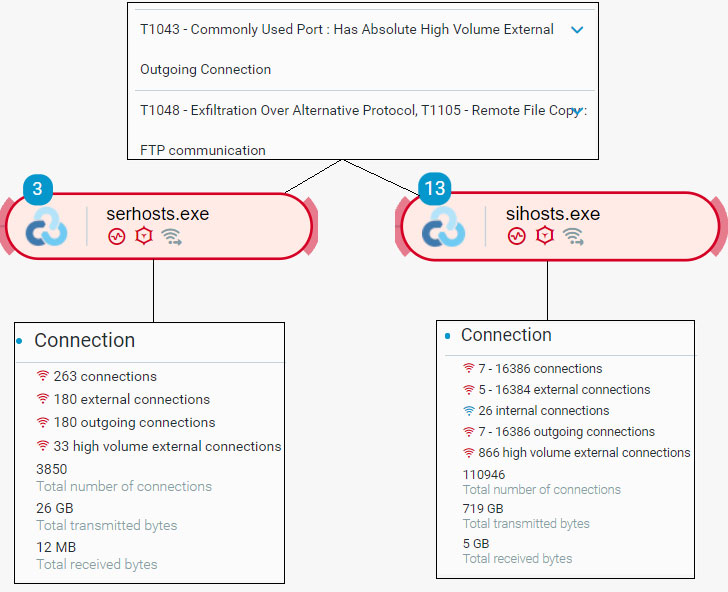
The TrickBot gang, known as ITG23 or Wizard Spider, is also
responsible for developing and maintaining the Conti ransomware, in
addition to leasing access to the malicious software to affiliates
via a ransomware-as-a-service (RaaS[4]) model.
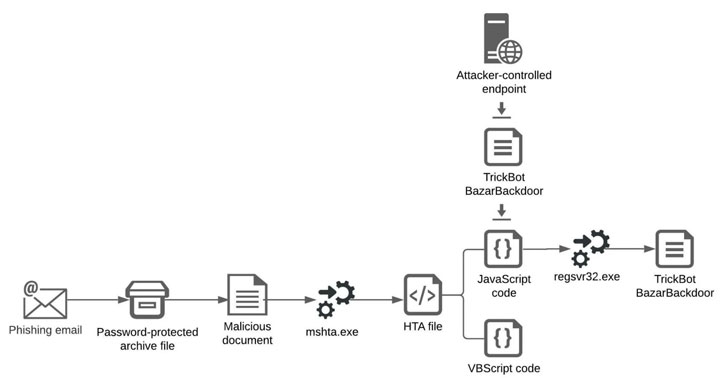
Infection chains involving Shathak typically involve sending
phishing emails that come embedded with malware-laced Word
documents that ultimately lead to the deployment of TrickBot or
BazarBackdoor malware, which is then used as a conduit to deploy
Cobalt Strike beacons as well as the ransomware, but not before
conducting reconnaissance, lateral movement, credential theft, and
data exfiltration activities.
Cybereason researchers said they observed an average
Time-to-Ransom (TTR) of two days post the compromises, denoting the
amount of time from when the threat actor gains initial access into
a network to the time the threat actor actually deploys the
ransomware.
The findings also come as the U.S. Cybersecurity and
Infrastructure Security Agency (CISA) and the Federal Bureau of
Investigation (FBI) reported[5]
that no fewer than 400 Conti ransomware attacks had taken place
targeting U.S. and international organizations as of September
2021.
To secure systems against Conti ransomware, the agencies
recommend enforcing a variety of mitigation measures, including
“requiring multi-factor authentication (MFA), implementing network
segmentation, and keeping operating systems and software up to
date.”
References
Read more https://thehackernews.com/2021/11/trickbot-operators-partner-with-shatak.html