Though we are recovering from the worst pandemic, cyber threats
have shown no sign of downshifting, and cybercriminals are still
not short of malicious and advanced ways to achieve their
goals.
The Global Threat Landscape Report[1] indicates a drastic rise
in sophisticated cyberattacks targeting digital infrastructures,
organizations, and individuals in 2021. Threats can take different
forms with the intent to commit fraud and damage businesses and
people. Ransomware, DDoS attacks[2], phishing, malware, and
man-in-the-middle attacks represent the greatest threat to
businesses today.
When new threats emerge, attackers take advantage of them –
however, most businesses are only aware of the current threats.
Organizations struggle to address these threats due to their
resource sophistication and their lack of understanding of evolving
threat landscapes. For these reasons, organizations need visibility
on the advanced threats especially targeting their infrastructure.
This article will outline the evolution in the cyber threat
landscape 2021.
Evolving Threat Landscape – Find Out What You Don’t Know
1 — Ransomware
Ransomware is still a common and evolving cyber security threat
with several highly publicized incidents. Ransomware incidents
affect organizations, businesses, and individuals resulting in
financial loss, operational disruptions, and data exfiltration.
Compromise through internet-facing vulnerabilities &
misconfigurations, third parties & managed service providers,
Remote Desktop Protocol (RDP) and phishing emails remain the most
common infection vectors.
The occurrence of extortion schemes has increased from single to
multiple schemes during 2021. After initially encrypting sensitive
information from the victim and threatening to reveal it publicly
unless a ransom is paid, attackers are now targeting the victim’s
partners and customers for ransom to maximize their profits.
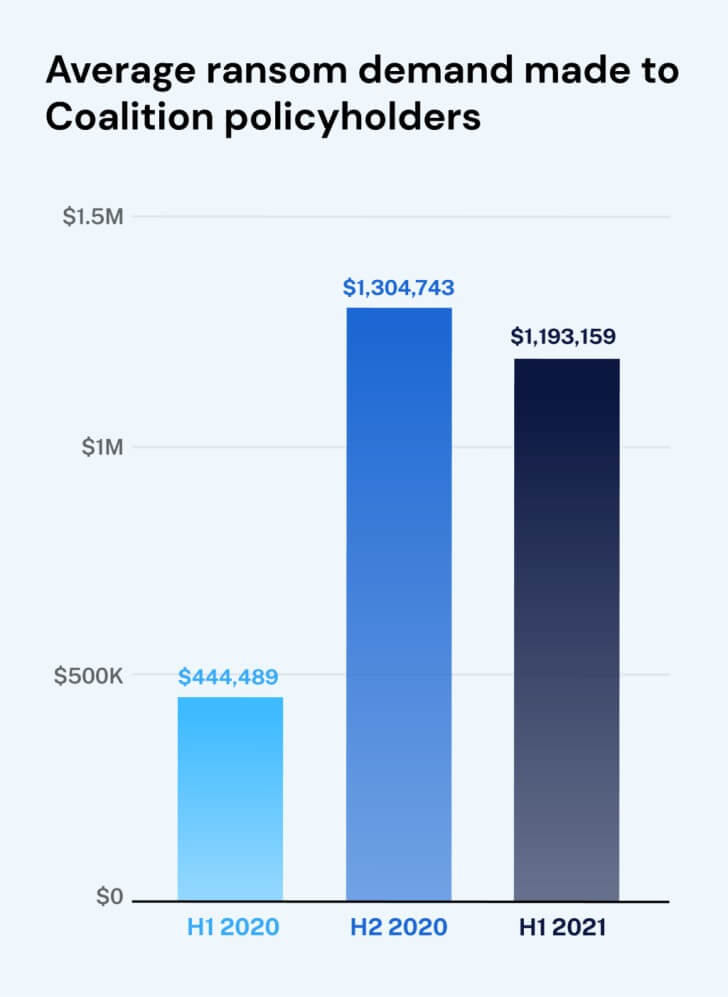
New research from Coalition[3]
revealed that there was a 170% increase in the average ransom
demand in the first half of 2021 compared to last year.
 |
| Image source: venturebeat |
It is likely to hit $100 million in 2022 – according to the
ENISA Threat Landscape[4]
2021.
Moreover, cryptocurrency becomes the choice of pay-out method
because it promises a secure, fast, and anonymous channel for money
transactions. Also, attackers shifted from Bitcoin to Monero as
their choice due to its enhanced anonymity.
Recommendations to prevent being a victim:
- Security awareness training
- Use secure websites
- Defense-in-depth cybersecurity strategy
- Vulnerability assessment & penetration testing
2 — Cryptojacking
Another attack trend in 2021 is cryptojacking, which is
associated with the expanding instability in the cryptocurrency
market. Given the anonymity of cryptocurrencies, it has become a
convenient and attractive means of exchange by attackers. In this
attack, cybercriminals deploy hidden cryptojacking software onto
the target’s devices, which steals from a cryptocurrency wallet.
Siloscape, a new malware, which emerged in June 2021 targets
Windows containers and creates malicious containers, loads
cryptocurrency miners, which identify and steal cryptocurrency.
Recommendations to counteract cryptojacking:
- Implement web filters and blacklist IP addresses from
cryptomining IP pools - Develop patches against well-known exploits
- Implement a robust vulnerability management program
3 — Data Breaches
Sensitive data being stolen from organizations or users is
nothing new, but how threat actors approach it has evolved. Just as
organizations embrace new technologies to survive in the digital
landscape, threat actors also harness sophisticated methods to
exploit attacks – Deepfake technology, for example.
Though it’s not a new concept, it has evolved significantly.
With MI and AI, Deepfake technology enables the digital creation of
an individual’s likeness, which can then be used to impersonate the
victim. AI and ML tools make it possible to make artificial
versions of any voice or any video.
Cybercube’s security researchers[5] alerted that deep fake
audio and video content could become a major cyber threat to
businesses worldwide. Also, the widespread damage associated with
this pretended content is expected to increase in the coming years.
It is also expected that the enhanced dependence on video-based
communication is the major factor that motivates attackers to focus
more on Deepfake technology.
Recommendations for Deepfake Monitoring and Removal:
- Improved digital archiving to identify the fake video and fake
voice clips - Implement Content Authenticity Initiative to validate the
creator as well as origin of data
4 — Botnets
Newer botnets continue to emerge as old ones keep transforming
to sidestep the current security solutions. This is because
cyber-criminals see a new paradigm with botnets-as-a-service where
bonnets can be leased/sold to corporations or individuals for
nefarious uses and financial benefits.
Furthermore, the existence of botnets in the cloud and mobile
environment proposes a new possibility that they may soon be able
to learn and exploit the weakness on their own in the patterns of
user interactions. The increased adoption of IoT and the lack of
security when they are developed as well as deployed presents
another feasible frontier for botnet proliferation.
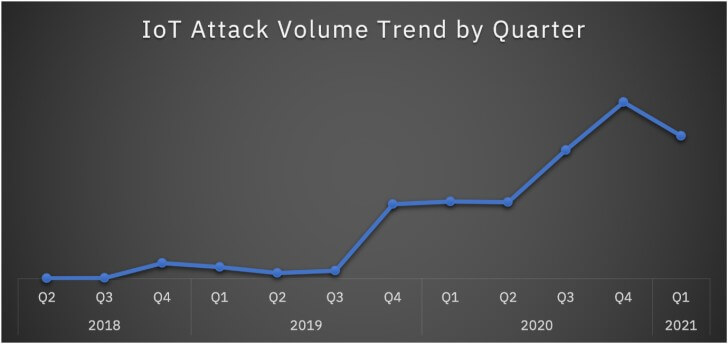
A recent report[6]
revealed there is a 500% rise in overall IoT attacks by prominent
IoT botnets like Mirai and Mozi.
 |
| Image source: Security Intelligence |
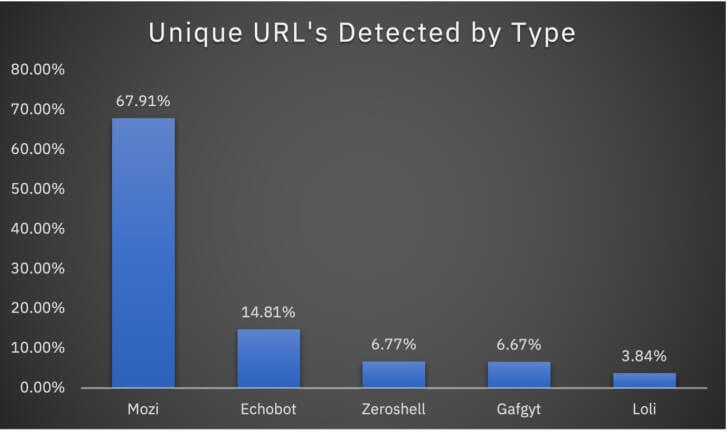
In 2020, the Mozi botnet attack[7]accounted for 89% of the
IoT attacks – according to X-Force research. In addition to Mozi,
several other botnets continue to target the IoT landscape. Ecobot,
Zeroshell, Gafgyt, and Loli are four notable botnets impacting
businesses all over the world.
 |
| Image source: Security Intelligence |
Recommendations to fight back:
- Employ penetration
testing[8] - Change your default IoT setting when installing any new
device - Implement a powerful patch management program
- Practice effective bot protection and mitigation strategy
The Big Picture
New cyber threats are being detected all the time, and they
possess the potential to affect any operating system, including
Linux, Windows, iOS, Mac OS, and Android. Additionally, new threats
vectors are evolving due to potential vulnerabilities in the
continuous adoption of remote working and a growing number of IoT
devices being connected.
This cyber threat landscape evolution has forced enterprises to
upgrade their vulnerability management program, security tools,
processes, and skills to stay ahead. Indusface AppTrana, a fully
managed Web Application and API protection
(WAAP)[9]addresses these
challenges and speeds up threat detection and response.
If you want to be proactive and actionable in protecting your
information, stay aware of the recent cyber security threat
landscape!
References
- ^
Global
Threat Landscape Report (go.fortinet.com) - ^
DDoS
attacks (www.indusface.com) - ^
Coalition
(www.coalitioninc.com) - ^
ENISA
Threat Landscape (www.enisa.europa.eu) - ^
Cybercube’s security researchers
(www.cybcube.com) - ^
recent
report (securityintelligence.com) - ^
botnet
attack (www.indusface.com) - ^
penetration testing
(www.indusface.com) - ^
Web
Application and API protection (WAAP)
(www.indusface.com)
Read more https://thehackernews.com/2021/11/navigating-threat-landscape-2021-from.html