Programming languages encompass the tech
world, and we, living in the 21st century, are seeing a historical
change. As we all know, these languages are widely used for
developing various apps, mobile phone system, etc. and thereby, the
demand for these is increasing rapidly over time among developers.
Among the different scripting dialects, the language which has
secured practically 80% of the site market and tech world is PHP.
PHP is utilized to fabricate sites and web applications. The use of
PHP frameworks improves the intricate procedure of development by
giving a stage where the engineers can work without much of a
stretch form PHP applications in the briefest time conceivable.
[1]
Popular PHP
Frameworks
PHP frameworks speed up the whole development process, and most
importantly, the responsiveness of sites and applications
fabricated utilizing PHP frameworks assists organizations and
businesses with satisfying their exhibition needs. Some of the
reasons that make Php frameworks so demanding and popular are its
speed, scalability, cross-platform, greater database diversity[2], etc. It reduces the
development time by a large scale, makes websites more secure, and
furthermore, numerous groups can work independently. In this
article, we have put together the Php framework list of the most
used and fastest ones.
01. Laravel
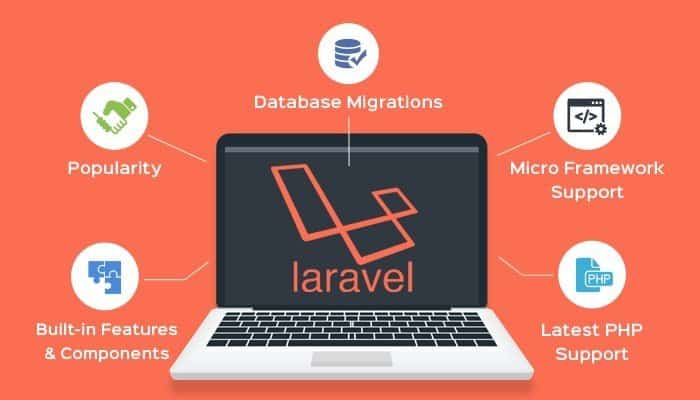
One of the topmost PHP framework used by developers is Laravel.
Since, it is a free, open source PHP Web application framework,
designed for developing MVC web applications, it makes development
easier and more creative. Laravel is known as the top and
foremost PHP framework among the top developers in the world as it
contains object-oriented libraries and several other pre-installed
ones, that we cannot find in any other PHP frameworks.
Features Available in Laravel
- Laravel is best for complex and robust website application
development as this particular framework is high quality and has
clear documentation, with a large community and advanced
security. - Due to its well-readable and well documentation, it helps to
speed up our coding. - Moreover, Laravel consists of strong encryption packets along
with huge libraries. - However, it is not good with shared hosting and also uses
several queries in the database. - Laravel framework makes the implementation of authentication
techniques became very simple because of Laravel.
02. Symfony
Symfony is an open-source PHP framework with MVC architecture.
Since it is used to build high-performance complicated web
applications, it is one of the most well-known application
frameworks among the open-source developers’ community. It is very
robust as well as a mighty PHP framework. Projects that are
generated using this particular PHP Framework are immensely
extensible because of its architecture that is modular-based.
Features Available in Symphony
- Due to Symfony’s inbuilt features, it speeds up the application
development. - As Symfony utilizes less memory, it permits developers to make
robust and high-performance applications. - Since Symfony is approved with MVC parts, it permits the
designer’s full control over the setup and other critical
highlights of improvement. - The system code is clear and demonstrated in this manner
decreasing the number of errors made. - Components in Symfony are supported with timely upgrades and
enhancement of security.
03. Aura

Aura is a UI framework for developing powerful web applications
for both mobiles as well as desktop devices, along with providing
an expandable and long-lived lifecycle to bear building
applications that are engineered for growth. Unlike the various PHP
frameworks we have referenced as of not long ago, Aura is an
assortment of decoupled libraries for PHP. It is normally refreshed
and kept up, thereby it is ideal for simple applications.
Features Available in Aura
- Aura consists of Object-oriented programming behaviors.
- This particular framework contains a tag-based layout as well
as a component definition. - Aura does not only include encased UI development with a
dynamically typed event prototype but also includes Integrated
functional and performance testing. - Aura thoroughly consumes events to associate with several
components. - Each accessible library is independent and might be utilized
autonomously in any task, with no kind of conditions.
04. Kohana
Kohana, in our list of PHP frameworks, is a very useful one.
This particular framework used to be a PHP5 HVMC framework. It has
proven to be one of the best platforms for providing professional
quality applications. This particular framework allows you to build
massive web applications while leveraging a quick development
architecture that is both powerful as well as instinctive. It is an
absolute delight for the developers as it offers new and
exceptional ways to find a solution to our existing business
problems.
Features Available in Kohana
- The file system of Kohana is the most vital feature of this
particular PHP framework as it uses HMVC (Hierarchical Model View
Controller), thus making it much easier to access. - Kohana is speedy, and it contains a smooth development process.
The cascading style supplies the easy and also very productive way
to approach to the files. - It makes debugging easier using Kohana as it is created with
exception handling features. - In Kohana, we don’t have to create the class every time rather
it will call the class automatically. - Configured files are placed in the respective configured
directory thus, as a result, it will return an array of key-value
pairs.
05. Flight

Flight falls under the well-known PHP framework list. It is a
widespread microstructure which is very swift, simple and has a
flexible framework. It is generally used to construct RESTful web
applications. Flight requires PHP 5.3 or more prominent and is
discharged under the MIT permit so in this manner, it is an
open-source network.
Features Available in Flight
- Developers use Flight not only because it is easy to handle,
but also because it provides tools to handle the usual development
tasks such as class loading and routing. - Flight also give green lights to developers to manage requests
through a logical routing system, set variables, add filters to
methods before naming them, handle views, etc. - To build heavy web applications, developers use Flight as it
allows them to create the applications promptly and easily, which
is one of the ideal parts of using Flight. - Since Flight uses static methods, it does not require for the
application class to be instantiated.
06. Medoo
Medoo is a very familiar framework used by developers, from the
PHP framework list. It is exceptionally lightweight,
straightforward to learn, and works well with other popular PHP
frameworks. Medoo is an open-source venture under MIT permit. The
best part about Medoo is that it will always be free to use. In
this day and age brimming with innovation, Medoo is a consolation
for a portion of those designers, who would prefer not to get
entwined in overseeing specialized coding necessities.
Features Available in Medoo
- We can use it anywhere we want, under an MIT license.
- Medoo bolsters all SQL databases, including MariaDB, Oracle,
MSSQL, PostgreSQL, MySQL, Sybase, SQLite, and so forth. - Medoo additionally underpins various conventional and complex
SQL questions, information mapping, and turn away SQL
infusion. - This framework is less than 100 KB.
- Since it has friendly construction, Medoo is very easy to learn
and use.
07. Code
Igniter

Code Igniter is one of the finest PHP frameworks used by
developers. It is an open-source web improvement PHP structure that
supports MVC design. The key undertaking of this
specific structure is to show a basic, simple and effective
approach to finish a web improvement venture, therefore, raising
the web advancement task hell free and quicker. [9]
Features Available in Code Igniter
- Because of the accessibility of inbuilt security instruments in
Code Igniter, it appoints an upgraded degree of security to the
sites and applications. - We can make, erase, addition, and update any announcement
without the contribution of crude SQL by utilizing the Code Igniter
PHP structure. - There is a primary folder while installing, that contains
several application files along with other sub-folders containing
config, model, controller, view, etc so while implementing any web
development project, everything will be organized. - Code Igniter contains a scope of highlights for unscrambling
and encryption that permits the developer to send any information
in a complete mystery establishment. - What makes Code Igniter an ideal choice for the top dedicated
web developers is its maturity, as it is one of the oldest and most
dedicated frameworks for PHP.
08. Yii
Yii is one of the top PHP frameworks used by developers. It
stands for “Yes, it is!” For all sorts of web apps, we can use Yii.
It is completely established in the object-oriented system. This
specific system contains some exceptional boss highlights like MVC,
DAO/Active Record, I18N/L10N, reserving, validation and job-based
access control, platform, testing, and so forth.
Features Available in Yii
- Yii isn’t truth be told, basic and transformative yet, in
addition, is an elite, part based PHP structure for creating
present-day web applications. - Moreover, Yii has a very easy installation process.
- Yii is ideal for quick development as it has code generators
for CRUD operations. - On the other hand, it consists of excellent speed and
implementation as it is thoroughly extensible, and also allows
developers to stay away from the difficulty of writing mundane SQL
statements, as they can represent the database data in terms of
objects. - Yii framework can generate customizable codes with MVC.
- It contains several built-in widgets to validate or output data
rapidly with Ajax support.
09. Zend
Zend PHP framework is an incredible choice for top developers to
work on their heavy projects with dynamic web development tasks. It
is related to the well-known brands such as Microsoft, Adobe, and
Google. This particular framework guarantees security and high
performance. It is very easy to learn and can be easily mastered.
Zend is entirely an open-source framework; hence it is free of
cost.
Features Available in Zend
- Zend is an object-oriented web application framework.
- Zend is made of cutting edge MVC usage.
- It consists of a light-weight component library, so it is
easier to work with. - On top of all these, Zend supports several languages and
numerous databases. - It is very easy to use and is solely an SEO-friendly
design. - However, we should keep in mind that Zend is not suitable for
small scale projects.
10. Pop PHP
Pop PHP is an outstanding PHP Framework, which is also referred
to as “Popcorn”. The absolute first form of Pop PHP was discharged
on 19 March 2012. It requires PHP 5.3 or more prominent and figures
out how to keep up its moderation and lightweight nature. This
specific framework, by default, uses a limited list of web-based
components. However, developers can also add other components when
needed.
Features Available in Pop Php
- Popcorn is a small scale structure layer that can be utilized
to construct REST applications and APIs. - Utilizing Popcorn, a designer can apply directing standards
dependent on demand techniques and quickly wire up a REST-based
application. - The POP PHP structure configuration is powerful; be that as it
may, it is easy to use with a compelling API. - This particular PHP system can be utilized both as a tool
compartment or as a significant structure.
11. CakePHP

Cake PHP is an elite PHP framework used by developers. It is an
open-source PHP framework for building web applications in a
quicker manner, as it is very simple and requires less code. It is
one of the most financially savvy and gainful structures for web
engineers of the 21st century. It features Model, Controller, and
View classes, along with with some other additional classes as well
as items that make the development process in MVC slightly faster
and more efficient.
Features Available in Cake Php
- No configuration is necessary for implementing Cake PHP as it
doesn’t require complicated XML or YAML files. - Cake PHP consists of a friendly license and is perfect to use
in commercial applications as it is licensed under MIT. - This particular framework is undoubtedly secure as it consists
of built-in tools for input validation, CSRF protection, Form
tampering defense, SQL injection hindrance, and XSS
prevention. - On top of that, this framework’s codebase has been surveyed
through the Mozilla secure open source.
12. Fat-Free
Among this list of PHP frameworks, the Fat-free framework is the
easiest to use and work with. It was started in 2009 by Bong Cosca.
Following a moderate methodology, it, in general, abstains from
including code and structure that are not carefully important,
while concentrating on the main thing.
Features Available in Fat-Free
- Fat-free is extremely powerful, yet, it is very easy to use. It
allows robust and dynamic web applications to be built very
quickly. - It is amazingly lightweight, that is, Fat-Free sums for
generally about 55kb only. - It has a delicate expectation to absorb information, which
enables designers to concentrate only on what makes a difference by
not changing their coding style.
13. Nette
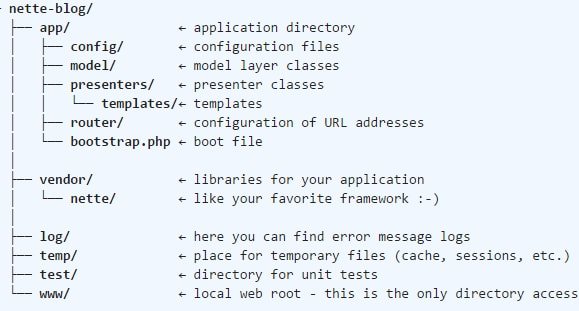
Nette is an opensource framework, which allows in building web
applications for PHP 5 and 7. Nette supports code reusability in
AJAX, DRY, and MVC. The first version was created by David Grudl,
and Nette was further improved by Nette Foundation. Nette is
opensource and Nette is licensed under GNU GPL version
3.
Features Available in Nette
- Nette assists you in building websites by checking for security
holes and their misuse. Potential misuse includes XSS, CSRF,
session hijacking, session fixation, among others. - The debug tools allow users to find efficiently.
- Nette also features AJAX/AJAJ, Dependency Injection, SEO, DRY,
MVC, Web 2.0, and cool URL. - The finder helps in searching for files with an intuitive
interface. - Safety traps such as CSRF are avoided.
14. FuelPHP
FuelPHP was being developed from October 2010 and FuelPHP was
first released in 2011. The main authors were Harro Verton, Jelmer
Schreuder, and Frank de Jonge. The FuelPHP project was developed by
taking other community developers’ views. It supports PHP 5.3+, in
both MVC and HMVC architecture. Thus, multiple pages can be viewed
simultaneously.
Features Available in FuelPHP
- Almost every component can be extended or replaced, making
FuelPHP very flexible. - A high level of security is also offered. FuelPHP has an
inbuilt validation condition. - A large set of templates and an integrated ORM are used.
- End-to-end web solutions vary in size and complexity.
- The application is further broken down into modules, making it
simpler to use.
15. Phalcon

Phalcon, which was released in 2012, writes in both C and C++,
thus achieving the highest optimization and quickest execution. One
very interesting feature is its C-extension, so developers do not
need to know C. Also, Phalcon is free to use. Phalcon is popular
because it does not use expensive file stats.
Features Available in Phalcon
- The project structure is flexible, with neat and secure
coding. - Zephir allows customization.
- The web architecture uses MVC.
- Phalcon can also handle a higher number of HTTP requests in a
single second than other frameworks. - The RAM of the server is used, so the very little resource is
required for Phalcon files.
16. Typo3 Flow
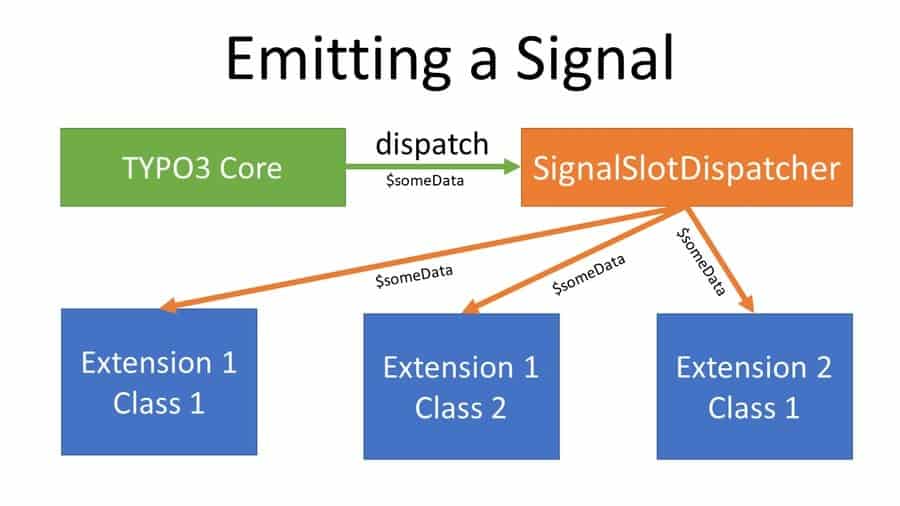
The first version of the Typo3 Flow framework was released in
2011. Despite the fact that Typo3 Flow depends on the substance
arrangement of Neos, Typo3 Flow can likewise be utilized
independently. The framework can conveniently interface with MySQL.
Using this PHP framework, good quality web solutions can be
implemented. The execution time is also very less for this
framework; hence complex applications use Typo3 Flow.
Features Available in Typo3 Flow
- The web architectures used are MVC (Model-View-Controller), AOP
(Aspect-Oriented-Programming), or DDD (Domain-Driven-Design). - The coding is well-documented as an attempt to eliminate
errors. - A simple syntax, involving conditions, loops, and arrays, are
used. - Typo3 Flow gives an XML structure to robotize layout
approval. - Modules written in other frameworks can also be used in Typo3
Flow with a few changes.
17. Silex
The designing of Silex was inspired by Symfony, Pimple, and
Sinatra. Silex is suitable for applications that have only one
file. The structure depends on Twig (format motor) and Doctrine
(database reflection). The API is brief. HTTPKernel is used to
process requests and responses. Users can define their own
controllers and map them to routes within a single step.
Features Available in Silex
- Third-party library functions can be incorporated as
extensions. - Even though Silex is used for small applications, Silex can be
used for an entire MVC framework. - Different advantages are the URL directing framework, web
security, sessions, and treats deliberation. - Monolog library logs demands and bugs.
- Testing web applications is easy due to the HTTPKernel being
able to handle requests and responses efficiently.
18. PHPixie
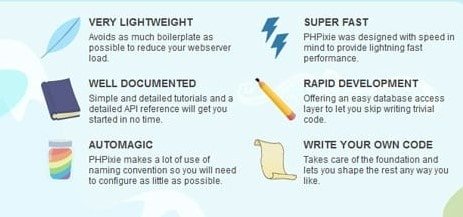
PHPixie was released in 2012. MHMV architecture is used. PHPixie
is thoroughly tested and extremely fast. The components can be used
both within a framework and without a framework. Codes are executed
line by line and static coding is not implemented. All these make
PHPPixie a favorable choice by industrial standards.
Feature Available in PHPixie
- Each component is 100% unit tested, so the user faces very
little dependency. - The configuration is easy, and the framework is lightweight
with the help of MongoDB. - Less time is required to load a webpage.
- The engineering can be changed deftly.
- A web developer who has already learned Codeigniter or Kohana
can also easily learn to code in PHPixie.
19. Slim
Slim is a microframework that has a minimalistic design, thus
Slim is easy for beginners. Slim can be readily downloaded through
the Composer dependency manager. Slim forms RESTful APIs and
services. Slim is used in small and large web applications alike.
Dependency injections are compatible with Slim. Slim can implement
quick prototyping. In a nutshell, Slim is among the most preferred
PHP frameworks.
Features Available in Slim
- Other wonderful features include URL routing, client-side HTTP
caching, session, and protecting cookie with AES-256
encryption. - Slim is continuously maintained and documented, so it is highly
user-accessible. - Any PSR-7 HTTP message implementation can be readily modified
to show status, URI, headers, cookies, and body. - Caching and logic control is also very sophisticated.
- Slim allows pattern matching in its HTTP router.
20. Agavi
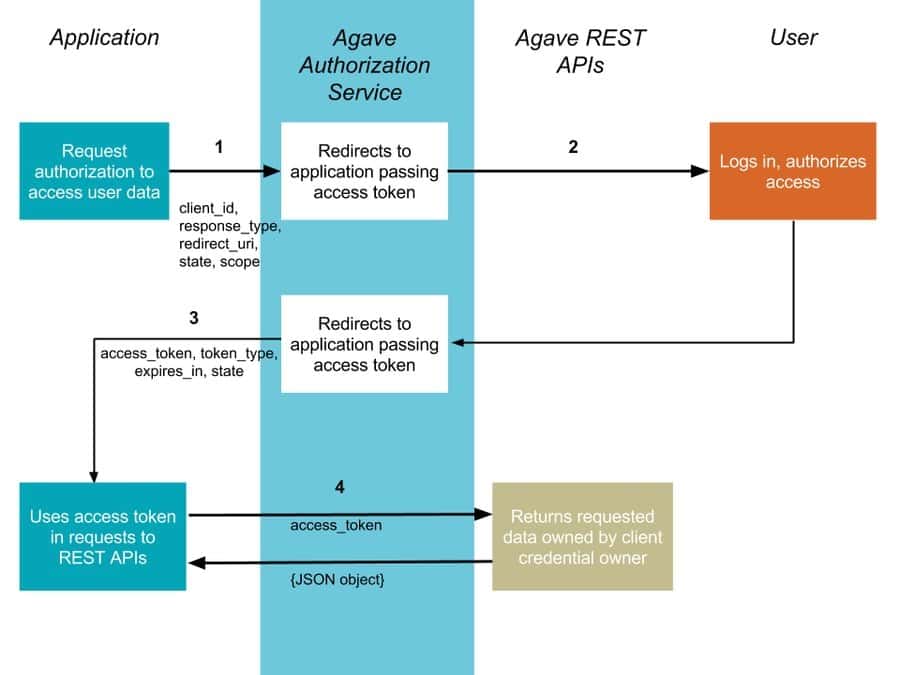
Agavi is licensed under LGPL. Agavi supports PHP 5. Agavi uses
MVC architecture. Agavi is an incomplete tool to create a website;
instead, you are expected to use Agavi as small chunks glued
together. Because of the fact that Agavi has a few simple in-built
functions, developers have the freedom to create their own
implementations in the coding process.
Feature Available in Agavi
- The code is neat and maintainable.
- Third-party library functions can be added as extensions.
- Agavi can be accessed by HTTP protocol, SOAP, and
Commands. - REST API can be used through Agavi.
- User input validation and user authentication can be
customized.
Finally, Insight
The decision of the framework truly relies on the kind of site
to be created for your business. The above mentioned 20 PHP
framework list is a thorough one. In any case, speed, versatility,
and security are a few rudiments that each designer searches for,
investigating these frameworks for a responsive and smooth web
application improvement venture.
We hope you liked our list of the 20 best PHP frameworks. We
hope that you will share this article and let others know about
this list as well. And don’t forget to share your suggestion and
experiences in the comment below.
References
- ^
Top 20
Most Popular Programming Languages To Learn For Your Open-source
Project (www.ubuntupit.com) - ^
Top 15
Best Database Management Systems for Linux in 2020
(www.ubuntupit.com) - ^
Get Laravel
(laravel.com) - ^
Symphony
(symfony.com) - ^
Aura
(auraphp.com) - ^
Kohana
(kohanaframework.org) - ^
Flight
(flightphp.com) - ^
Medoo
(medoo.in) - ^
MVC
design (en.wikipedia.org) - ^
Code
Igniter (codeigniter.com) - ^
yii
(www.yiiframework.com) - ^
Zend
(framework.zend.com) - ^
Pop
PHP (www.popphp.org) - ^
CakePhp
(cakephp.org) - ^
Fat-free
(fatfreeframework.com) - ^
Nette
(nette.org) - ^
FuelPHP
(fuelphp.com) - ^
Phalcon
(phalcon.io) - ^
Type3
Flow (sourceforge.net) - ^
Get Silex
(silex.symfony.com) - ^
Get PHPixie
(phpixie.com) - ^
Get Slim
(www.slimframework.com) - ^
Get
Agavi (webscripts.softpedia.com)
Read more https://www.ubuntupit.com/best-php-frameworks-for-modern-developers/