
Former members of the Conti cybercrime cartel have been
implicated in five different campaigns targeting Ukraine from April
to August 2022.
The findings, which come from Google’s Threat Analysis Group
(TAG), builds upon a prior report[1]
published in July 2022, detailing the continued cyber activity
aimed at the Eastern European nation amid the ongoing
Russo-Ukrainian war.
“UAC-0098 is a threat actor that historically delivered the
IcedID banking trojan[2], leading to
human-operated ransomware attacks,” TAG researcher Pierre-Marc
Bureau said[3]
in a report shared with The Hacker News.
“The attacker has recently shifted their focus to targeting
Ukrainian organizations, the Ukrainian government, and European
humanitarian and non-profit organizations.”
UAC-0098 is believed to have functioned as an initial access
broker for ransomware groups such as Quantum and Conti[4]
(aka FIN12, Gold Ulrick, or Wizard Spiker), the former of which was
subsumed by Conti[5]
in April 2022.
One of the prominent campaigns undertaken by the group in June
2022 entailed the abuse of Follina vulnerability[6]
(CVE-2022-30190) in the Windows operating system to deploy
CrescentImp and Cobalt Strike Beacons on to targeted hosts in media
and critical infrastructure entities.
But this appears to be a part of a series of attacks that
commenced way back in late April 2022, when the group conducted an
email phishing campaign to deliver AnchorMail[7]
(aka LackeyBuilder), a variant of the TrickBot group’s AnchorDNS
implant that uses SMTP for command-and-control.
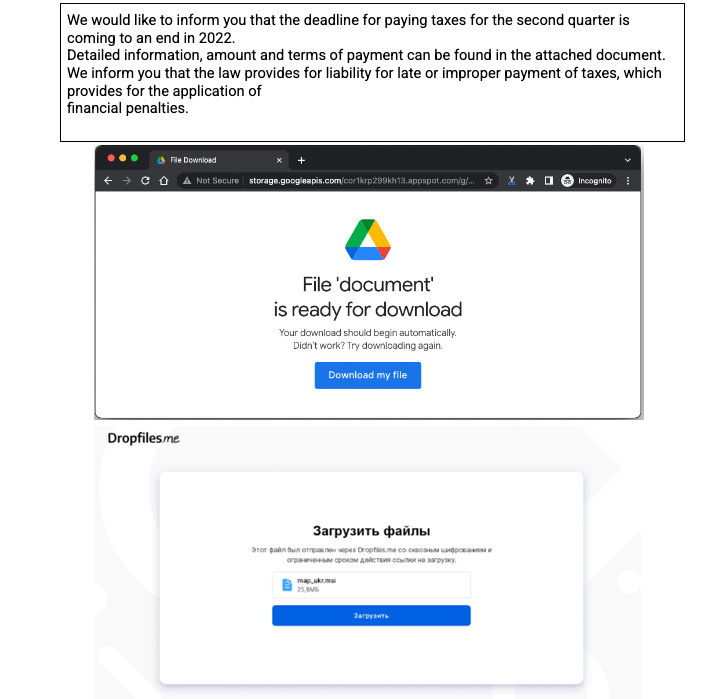
Subsequent phishing campaigns distributing IcedID and Cobalt
Strike have been directed against Ukrainian organizations,
repeatedly striking the hospitality sector, some of which
impersonated the National Cyber Police of Ukraine or
representatives of Elon Musk and StarLink.
Around mid-May, UAC-0098 is also said to have leveraged a
compromised account of a hotel in India to send malware-laced
attachments to organizations working in the hospitality industry in
Ukraine, before expanding to humanitarian NGOs in Italy.
Similar attacks have also been observed against entities in the
technology, retail and government sectors, with the IcedID binary
concealed as a Microsoft update to trigger the infection.
Post-exploitation steps carried out following a successful
compromise have not been identified.
UAC-0098 is far from the only Conti-affiliated hacking group to
set its sights on Ukraine since the onset of the war. In July 2022,
IBM Security X-Force disclosed[8]
that the TrickBot gang orchestrated six different campaigns to
systematically target the country with a plethora of malware.
“UAC-0098 activities are representative examples of blurring
lines between financially motivated and government backed groups in
Eastern Europe, illustrating a trend of threat actors changing
their targeting to align with regional geopolitical interests,”
Bureau said.
“The group demonstrates strong interest in breaching businesses
operating in the hospitality industry of Ukraine, going as far as
launching multiple distinct campaigns against the same hotel
chains.”
References
- ^
prior
report (thehackernews.com) - ^
IcedID
banking trojan (thehackernews.com) - ^
said
(blog.google) - ^
Conti
(thehackernews.com) - ^
subsumed
by Conti (thehackernews.com) - ^
Follina
vulnerability (thehackernews.com) - ^
AnchorMail
(thehackernews.com) - ^
disclosed
(thehackernews.com)
Read more https://thehackernews.com/2022/09/some-members-of-conti-group-targeting.html