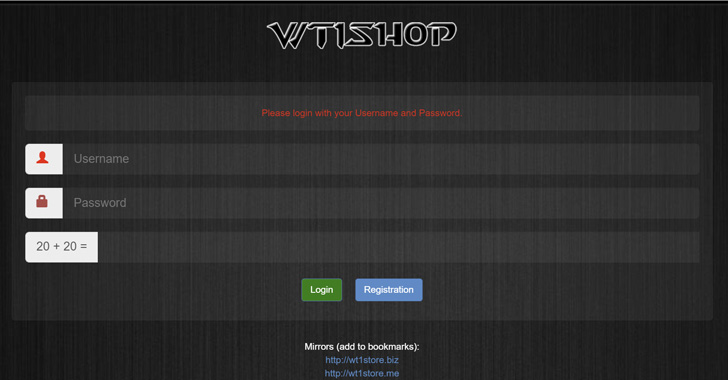
An international law enforcement operation has resulted in the
dismantling of WT1SHOP, an online criminal
marketplace that specialized in the sales of stolen login
credentials and other personal information.
The seizure was orchestrated by Portuguese authorities, with the
U.S. officials taking control of four domains used by the website:
“wt1shop[.]net,” “wt1store[.]cc,” “wt1store[.]com,” and
“wt1store[.]net.”
The website peddled over 5.85 million records of personally
identifying information (PII), including approximately 25,000
scanned driver’s licenses/passports, 1.7 million login credentials
for various online shops, 108,000 bank accounts, 21,800 credit
cards, the U.S. Justice Department (DoJ) said[1].
The DoJ also unveiled a criminal complaint against Nicolai
Colesnicov, accusing the 36-year-old individual from the Republic
of Moldova of running the marketplace. Colesnicov has been charged
with conspiracy and with trafficking in unauthorized access
devices.
According to unsealed court documents, WT1SHOP offered a payment
mechanism that facilitated the trafficking of pilfered PII using
Bitcoin. The account shop had 106,273 registered users and 94
sellers with a total of roughly 5.85 million credentials available
for sale as of December 2021.
The login credentials included those belonging to retailers and
financial institutions, email accounts, PayPal accounts, and
identification cards, as well as to remotely access and operate
computers, servers, and network devices without authorization.
The DoJ also said law enforcement was able to trace Bitcoin
transactions made on WT1SHOP, along with the email addresses and
the login information from those accounts, to Colesnicov, enabling
the authorities to determine his role as the administrator of the
illicit marketplace.
If convicted, Colesnicov faces a maximum sentence of 10 years in
federal prison.
The development comes over a year after law enforcement agencies
from the U.S., Germany, the Netherlands, and Romania disrupted and
took down the infrastructure of an underground marketplace known as
Slilpp[2]
that specialized in trading stolen login credentials.
Read more https://thehackernews.com/2022/09/authorities-shut-down-wt1shop-site-for.html