
Cybersecurity researchers today disclosed a new supply-chain
attack targeting the Vietnam Government Certification Authority
(VGCA) that compromised the agency’s digital signature toolkit to
install a backdoor on victim systems.
Uncovered by Slovak internet security company ESET[1]
early this month, the “SignSight” attack involved modifying
software installers hosted on the CA’s website[2] (“ca.gov.vn”) to insert
a spyware tool called PhantomNet[3]
or Smanager.
According to ESET’s telemetry, the breach happened from at least
July 23 to August 16, 2020, with the two installers[4]
in question — “gca01-client-v2-x32-8.3.msi” and
“gca01-client-v2-x64-8.3.msi” for 32-bit and 64-bit Windows systems
— tampered to include the backdoor.
After the attack was reported to VGCA, the certificate authority
confirmed that “they were aware of the attack before our
notification and that they notified the users who downloaded the
trojanized software.”
“The compromise of a certification authority website is a good
opportunity for APT groups, since visitors are likely to have a
high level of trust in a state organization responsible for digital
signatures,” ESET’s Matthieu Faou said.
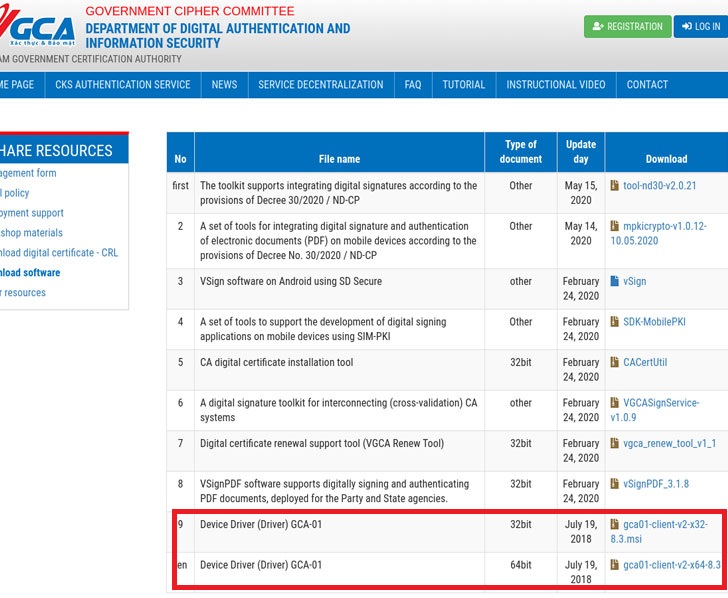
The digital signature tool, mandated by Vietnam’s Government
Cipher Committee as part of an electronic authentication scheme, is
used by the government sector as well as private companies to
digitally sign documents using a USB token (also called a PKI
token) that stores the digital signature and requires the
aforementioned driver to operate.
As a consequence, the only way a user can get infected is when
the compromised software hosted on the official website is manually
downloaded and executed on the target system.
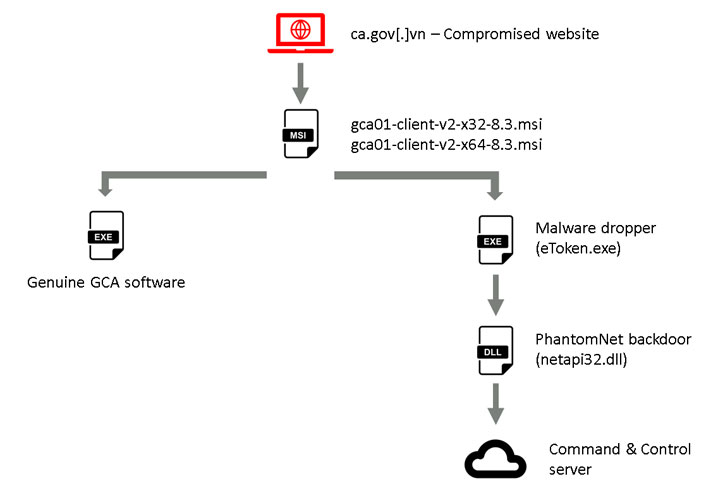
Once installed, the modified software starts the genuine GCA
program to mask the breach and then runs the PhantomNet backdoor
that masquerades as a seemingly harmless file named
“eToken.exe.”
The backdoor — compiled most recently on April 26 — takes the
responsibility of collecting system information, with additional
malicious capabilities deployed through plugins retrieved from
hardcoded command-and-control servers (e.g. “vgca.homeunix[.]org”
and “office365.blogdns[.]com”) that mimic the names of VGCA and
popular productivity software.
ESET said in addition to Vietnam, it saw victims in the
Philippines, but their delivery mechanism remains unknown. The
ultimate goal of the attackers remains unclear as well, what with
little to no information about the post-compromise activity.
If anything, the incident highlights why supply-chain attacks
are increasingly becoming a common attack vector among
cyberespionage groups, as it allows the adversaries to deploy
malware on many computers at the same time covertly.
In November, ESET disclosed a Lazarus campaign[5]
in South Korea that used legitimate security software and stolen
digital certificates to distribute remote administration tools
(RATs) on target systems.
Then last week, it also found that a chat software called Able
Desktop, used by 430 government agencies in Mongolia, was abused[6]
to deliver the HyperBro backdoor, the Korplug RAT, and another
Trojan called Tmanger.
Lastly, a supply-chain attack on SolarWinds Orion software[7] discovered this week was
exploited to breach several major US government agencies, including
the Departments of Homeland Security, Commerce, Treasury, and
State.
“Supply-chain attacks are typically hard to find, as the
malicious code is generally hidden among a lot of legitimate code,
making its discovery significantly more difficult,” Faou
concluded.
References
- ^
ESET
(www.welivesecurity.com) - ^
website
(dvc.ca.gov.vn) - ^
PhantomNet
(insight-jp.nttsecurity.com) - ^
two
installers (chukyso.ict-backan.gov.vn) - ^
Lazarus
campaign (thehackernews.com) - ^
abused
(www.welivesecurity.com) - ^
SolarWinds Orion software
(thehackernews.com)
Read more http://feedproxy.google.com/~r/TheHackersNews/~3/BDmQJHnUqjY/software-supply-chain-attack-hits.html