SideWinder, a prolific nation-state actor mainly known for
targeting Pakistan military entities, compromised the official
website of the National Electric Power Regulatory Authority (NEPRA)
to deliver a tailored malware called WarHawk.
“The newly discovered WarHawk backdoor contains various
malicious modules that deliver Cobalt Strike, incorporating new
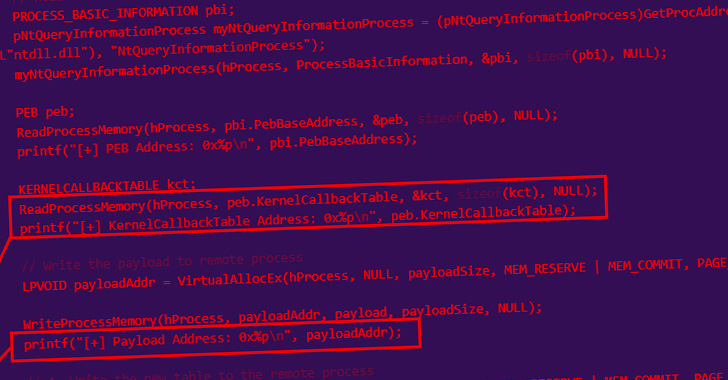
TTPs such as KernelCallBackTable injection[1] and Pakistan Standard
Time zone check in order to ensure a victorious campaign,” Zscaler
ThreatLabz said[2].
The threat group, also called APT-C-17, Rattlesnake, and Razor
Tiger, is suspected[3]
to be an Indian state-sponsored group, although a report from
Kaspersky earlier this May acknowledged previous indicators that
led to the attribution have since disappeared, making it
challenging it to link the threat cluster to a specific nation.
More than 1,000 attacks are said to have been launched by the group[4]
since April 2020, an indication of SideWinder’s newfound aggression
since it commenced operations a decade ago in 2012.
The intrusions have been significant not only with regard to
their frequency but also in their persistence, even as the group
takes advantage of a massive arsenal of obfuscated and
newly-developed components.
In June 2022, the threat actor was found leveraging an AntiBot script[5] that’s designed to
filter their victims to check the client browser environment,
specifically the IP address, to ensure the targets are located in
Pakistan.
The September campaign spotted by Zscaler entails the use of a
weaponized ISO file hosted on NEPRA’s website to activate a
killchain that leads to the deployment of the WarHawk malware, with
the artifact also acting as a decoy to hide the malicious activity
by displaying[6]
a legitimate advisory[7]
issued by the Cabinet Division of Pakistan on July 27, 2022.
WarHawk, for its part, masquerades as legitimate apps such as
ASUS Update Setup and Realtek HD Audio Manager to lure unsuspecting
victims into execution, resulting the exfiltration of system
metadata to a hard-coded remote server, while also receiving
additional payloads from the URL.
This includes a command execution module that’s responsible for
the execution of system commands on the infected machine received
from the command-and-control server, a file manager module that
recursively enumerates files present in different drives, and an
upload module that transmits files of interest to the server.
Also deployed as a second-stage payload using the aforementioned
command execution module is a Cobalt Strike Loader, which validates
the host’s time zone to confirm it matches the Pakistan Standard
Time (PKT), failing which the process is terminated.
Following the anti-anThe loader injects shellcode into a
notepad.exe process using a technique called KernelCallbackTable
process injection, with the malware author lifting source code from
a technical write-up[8]
published in April 2022 by a researcher who goes by the online
alias Capt. Meelo.
The shellcode then decrypts and loads Beacon[9], the default malware
payload used by Cobalt Strike to establish a connection to its
command-and-control server.
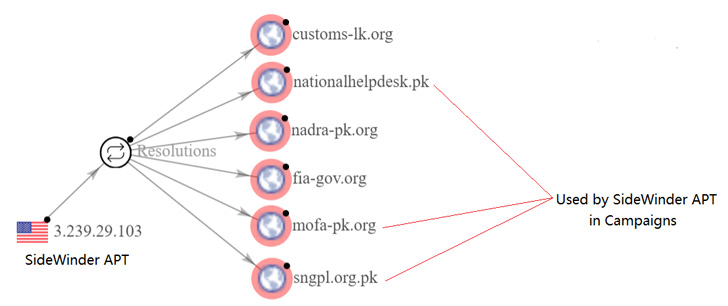
Per the cybersecurity company, the attack campaign’s connections
to the SideWinder APT stem from the reuse of network infrastructure
that has been identified as used by the group in prior
espionage-focused activities against Pakistan.
“The SideWinder APT Group is continuously evolving their tactics
and adding new malware to their arsenal in order to carry out
successful espionage attack campaigns against their targets,” the
researchers concluded.
References
- ^
KernelCallBackTable injection
(attack.mitre.org) - ^
said
(www.zscaler.com) - ^
suspected
(malpedia.caad.fkie.fraunhofer.de) - ^
launched
by the group (thehackernews.com) - ^
leveraging an AntiBot script
(thehackernews.com) - ^
displaying
(www.fbr.gov.pk) - ^
legitimate advisory
(cabinet.gov.pk) - ^
technical write-up
(captmeelo.com) - ^
Beacon
(thehackernews.com)
Read more https://thehackernews.com/2022/10/sidewinder-apt-using-new-warhawk.html