
U.S. cybersecurity and intelligence agencies have published a
joint advisory warning of attacks perpetrated by a cybercrime gang
known as the Daixin Team primarily targeting the
healthcare sector in the country.
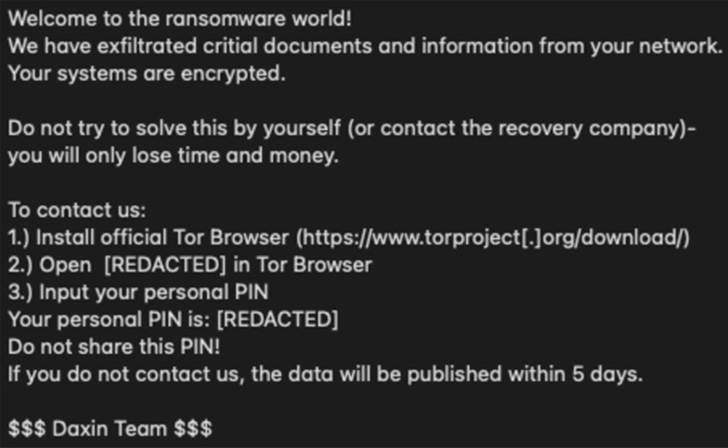
“The Daixin Team is a ransomware and data extortion group that
has targeted the HPH Sector with ransomware and data extortion
operations since at least June 2022,” the agencies said[1].
The alert was published Friday by the Federal Bureau of
Investigation (FBI), Cybersecurity and Infrastructure Security
Agency (CISA), and the Department of Health and Human Services
(HHS).
Over the past four months, the group has been linked to multiple
ransomware incidents in the Healthcare and Public Health (HPH)
sector, encrypting servers related to electronic health records,
diagnostics, imaging, and intranet services.
It’s also said to have exfiltrated personal identifiable
information (PII) and patient health information (PHI) as part of a
double extortion scheme to secure ransoms from victims.
One of those attacks was aimed at OakBend Medical
Center[2] on September 1, 2022,
with the group claiming to have siphoned roughly 3.5GB of data,
including[3]
over one million records with patient and employee information.
It also published a sample containing 2,000 patient records on
its data leak site, which included names, genders, dates of birth,
Social Security numbers, addresses, and other appointment details,
according to DataBreaches.net[4].
On October 11, 2022, it notified its customers of emails sent by
“third-parties” regarding the cyber attack, stating it’s directly
informing affected patients, in addition to offering free credit
monitoring services for 18 months.
Per the new alert, initial access to targeted networks is
achieved by means of virtual private network (VPN) servers, often
taking advantage of unpatched security flaws and compromised
credentials obtained via phishing emails.
Upon gaining a foothold, the Daixin Team has been observed
moving laterally by making use of remote desktop protocol (RDP) and
secure shell (SSH), followed by gaining elevated privileges using
techniques like credential dumping.
“The actors have leveraged privileged accounts to gain access to
VMware vCenter Server and reset account passwords for ESXi servers
in the environment,” the U.S. government said. “The actors have
then used SSH to connect to accessible ESXi servers and deploy
ransomware on those servers.”
What’s more, the Daixin Team’s ransomware is based on another
strain called Babuk that was leaked in September 2021, and has been
used as a foundation for a number of file-encrypting malware
families such as Rook, Night Sky, Pandora, and
Cheerscrypt[5].
As mitigations, it’s recommended that organizations apply the
latest software updates, enforce multi-factor authentication,
implement network segmentation, and maintain periodic offline
backups.
References
- ^
said
(www.cisa.gov) - ^
OakBend Medical Center
(www.oakbendmedcenter.org) - ^
including
(twitter.com) - ^
DataBreaches.net
(www.databreaches.net) - ^
Rook,
Night Sky, Pandora, and Cheerscrypt
(thehackernews.com)
Read more https://thehackernews.com/2022/10/cisa-warns-of-daixin-team-hackers.html