A threat cluster linked to the Russian nation-state actor
tracked as Sandworm has continued its targeting of Ukraine with
commodity malware by masquerading as telecom providers, new
findings show.
Recorded Future said it discovered new infrastructure belonging
to UAC-0113 that mimics operators like Datagroup and
EuroTransTelecom to deliver payloads such as Colibri loader[1]
and Warzone RAT[2].
The attacks are said to be an expansion of the same
campaign[3] that previously
distributed DCRat[4]
(or DarkCrystal RAT) using phishing emails with legal aid-themed
lures against providers of telecommunications in Ukraine.
Sandworm is a destructive Russian threat group[5] that’s best known for
carrying out attacks such as the 2015 and 2016 targeting of
Ukrainian electrical grid and 2017’s NotPetya attacks. It’s
confirmed to be Unit 74455 of Russia’s GRU military intelligence
agency.
The adversarial collective, also known as Voodoo Bear, sought to
damage high-voltage electrical substations, computers and
networking equipment for the third time in Ukraine earlier this
April through a new variant of a piece of malware[6] known as
Industroyer.
Russia’s invasion of Ukraine has also had the group unleash
numerous other attacks, including leveraging the Follina
vulnerability[7]
(CVE-2022-30190) in the Microsoft Windows Support Diagnostic Tool
(MSDT) to breach media entities in the Eastern European nation.
In addition, it was uncovered as the mastermind behind a new
modular botnet called Cyclops Blink[8]
that enslaved internet-connected firewall devices and routers from
WatchGuard and ASUS.
The U.S. government, for its part, has announced up to $10 million in rewards[9]
for information on six hackers associated with the APT group for
participating in malicious cyber activities against critical
infrastructure in the country.
“A transition from DarkCrystal RAT to Colibri Loader and Warzone
RAT demonstrates UAC-0113’s broadening but continuing use of
publicly available commodity malware,” Recorded Future said[10].
The attacks entail the fraudulent domains hosting a web page
purportedly about “Odesa Regional Military Administration,” while
an encoded ISO image payload is stealthily deployed via a technique
referred to as HTML smuggling[11].
HTML smuggling, as the name goes, is an evasive malware delivery
technique that leverages legitimate HTML and JavaScript features to
distribute malware and get around conventional security
controls.
Recorded Future also said it identified points of similarities
with another HTML dropper attachment[12] put to use by the APT29
threat actor in a campaign aimed at Western diplomatic missions
between May and June 2022.
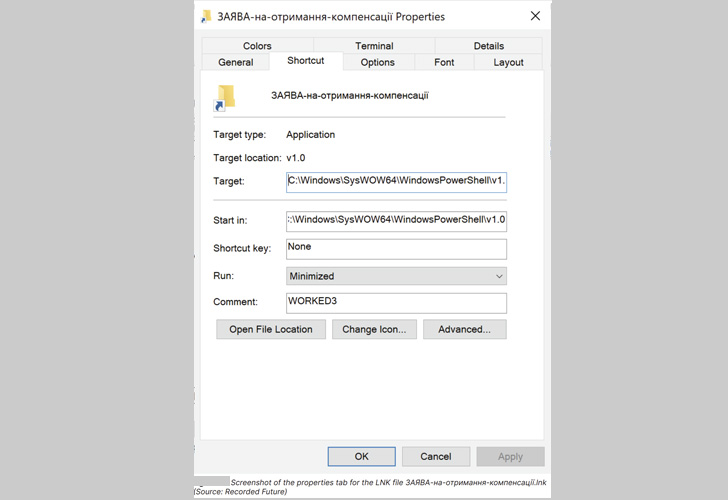
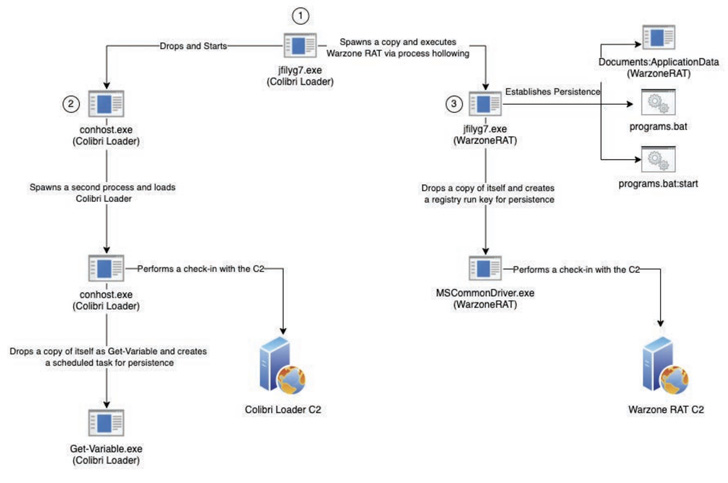
Embedded within the ISO file, which was created on August 5,
2022, are three files, including an LNK file that tricks the victim
into activating the infection sequence, resulting in the deployment
of both Colibri loader and Warzone RAT to the target machine.
The execution of the LNK file also launches an innocuous decoy
document – an application for Ukrainian citizens to request for
monetary compensation and fuel discounts – in an attempt to conceal
the malicious operations.
References
- ^
Colibri
loader (thehackernews.com) - ^
Warzone
RAT (malpedia.caad.fkie.fraunhofer.de) - ^
same
campaign (cert.gov.ua) - ^
DCRat
(thehackernews.com) - ^
destructive Russian threat group
(thehackernews.com) - ^
new
variant of a piece of malware
(thehackernews.com) - ^
leveraging the Follina
vulnerability (thehackernews.com) - ^
Cyclops
Blink (thehackernews.com) - ^
$10
million in rewards (thehackernews.com) - ^
said
(www.recordedfuture.com) - ^
HTML
smuggling (thehackernews.com) - ^
HTML
dropper attachment (thehackernews.com)
Read more https://thehackernews.com/2022/09/russian-sandworm-hackers-impersonate.html