it was one of the early countries in the world to realize the value
of remotely conducted cyber intrusions.
In recent years, many Russia hacking groups have emerged as one
of the most sophisticated nation-state actors in cyberspace,
producing highly specialized hacking techniques and toolkits for
cyber espionage.
Over the past three decades, many high profile hacking
incidents—like hacking the US presidential
elections, targeting a country with NotPetya
ransomware, causing blackout in
Ukrainian capital Kiev, and Pentagon breach—have been
attributed to Russian hacking groups, including Fancy
Bear (Sofacy), Turla, Cozy
Bear, Sandworm
Team and Berserk Bear.
[1][2][3][4][5][6][7]
Besides continuously expanding its cyberwar capabilities, the
ecosystem of Russian APT groups has also grown into a very complex
structure, making it harder to understand who’s who in Russian
cyber espionage.
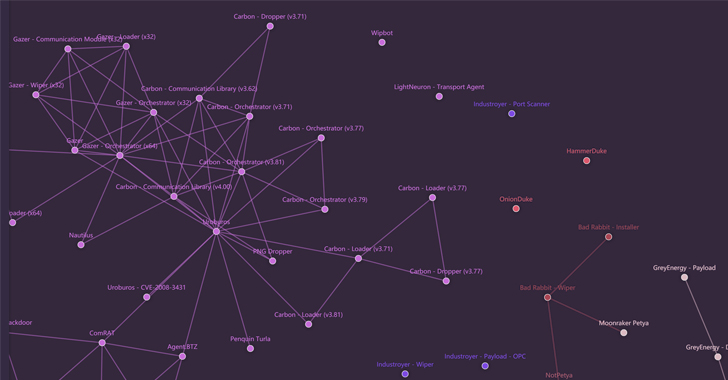
Now to illustrate the big picture and make it easier for
everyone to understand the Russian hackers and their operations,
researchers from Intezer[8] and Check Point Research
joint their hands to release a web-based, interactive map that
gives a full overview of this ecosystem.
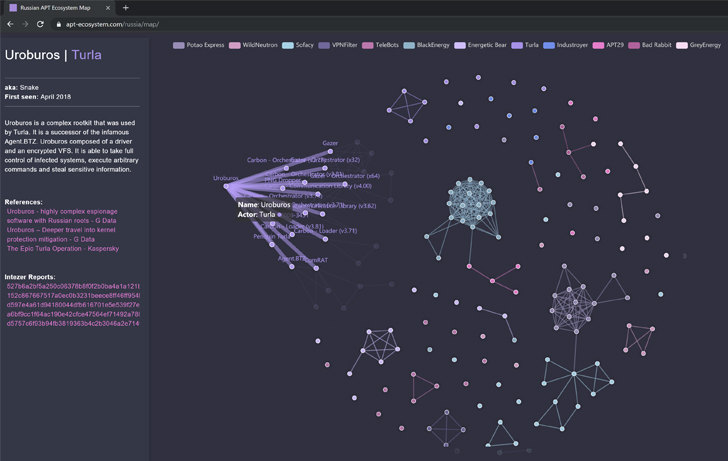
Dubbed “Russian APT Map[9],” the map can be used by
anyone to learn information about the connections between different
Russian APT malware samples, malware families, and threat
actors—all just clicking on nodes in the map.
“The [Russian APT] map is basically a one-stop-shop for anyone who
is interested to learn and understand the connections and
attributions of the samples, modules, families, and actors that
together comprise this ecosystem,” researchers told The Hacker
News.
“By clicking on nodes in the graph, a side panel will reveal,
containing information about the malware family the node belongs
to, as well as links to analysis reports on Intezer’s platform and
external links to related articles and publications.”
research where researchers gathered, classified and analyzed more
than 2,000 malware samples attributed to Russian hacking groups,
and mapped nearly 22,000 connections between them based on 3.85
million pieces of code they shared.
“Every actor or organization under the Russain APT umbrella has
its own dedicated malware development teams, working for years in
parallel on similar malware toolkits and frameworks. Knowing that a
lot of these toolkits serve the same purpose, it is possible to
spot redundancy in this parallel activity.”
Russian APT Map also reveals that though most of the hacking groups
were re-using their own code in their own different tools and
frameworks, no different groups were found using each other’s code.
“By avoiding different organizations re-using the same tools on
a wide range of targets, they overcome the risk that one
compromised operation will expose other active operations,
preventing a sensitive house of cards from collapsing,” researchers
say.
“Another hypothesis is that different organizations do not share
code due to internal politics.”
To make it more efficient and up-to-date in the future,
researchers have also open-sourced the map and the data behind
it.
Besides this, researchers have also released a Yara rules-based
scanning tool, dubbed “Russian APT
Detector[10],” that can be used by
anyone to scan a specific file, a folder, or a whole file system
and search for infections by Russian hackers.
References
- ^
US presidential elections
(thehackernews.com) - ^
NotPetya ransomware
(thehackernews.com) - ^
blackout in Ukrainian capital Kiev
(thehackernews.com) - ^
Fancy Bear
(thehackernews.com) - ^
Turla
(thehackernews.com) - ^
Cozy Bear
(thehackernews.com) - ^
Sandworm Team
(thehackernews.com) - ^
Intezer
(www.intezer.com) - ^
Russian APT Map
(apt-ecosystem.com) - ^
Russian APT Detector
(github.com)
Read more http://feedproxy.google.com/~r/TheHackersNews/~3/4oAE0oHpl8Q/russia-hacking-groups-map.html