sophisticated and targeted mobile hacking campaign that is
targeting high-profile members of various Tibetan groups with
one-click exploits for iOS and Android devices.
Dubbed Poison Carp by University of Toronto’s Citizen Lab, the
hacking group behind this campaign sent tailored malicious web
links to its targets over WhatsApp, which, when opened, exploited
web browser and privilege escalation vulnerabilities to install
spyware on iOS and Android devices stealthily.
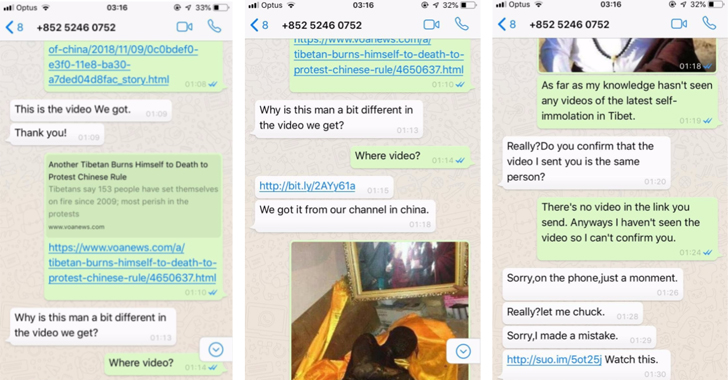
“Between November 2018 and May 2019, senior members of Tibetan
groups received malicious links in individually tailored WhatsApp
text exchanges with operators posing as NGO workers, journalists,
and other fake personas,” the researchers say[1].
of Poison Carp with two recently discovered campaigns against the
Uyghur community in China—the iPhone hacking
campaign[2] reported by experts at
Google and the Evil Eye campaign published[3]
by Volexity last month.
Based on the similarities of the three campaigns, researchers
believed that the Chinese government sponsors Poison Carp group.
Poison Carp campaign exploits a total of 8 distinct Android
browser exploits to install a previously undocumented
fully-featured Android spyware, called MOONSHINE and one iOS
exploit chain to stealthily install iOS spyware on ‘users’
device—none of which were zero days.

exploit code posted by security researchers on bug trackers or
GitHub pages,” the report says.
Researchers observed a total of 17 intrusion attempts against
Tibetan targets that were made over that period, 12 of which
contained links to the iOS exploit.
Once installed, the malicious implant allows attackers to:
- gain full control of victims device,
- exfiltrate data including text messages, contacts, call logs,
and location data, - access the ‘device’s camera and microphone,
- exfiltrate private data from Viber, Telegram, Gmail, Twitter,
and WhatsApp, - downloads and install additional malicious plugins.
Besides this, researchers also observed a malicious OAuth
application that the same group of attackers used to gain access to
its ‘victims’ Gmail accounts by redirecting them to a decoy page
designed to convince them that the app served a legitimate
purpose.
Among the victims that were targeted by the Poison Carp hackers
between November 2018 and May 2019 include the Private Office of
Tibetan Buddhist leader the Dalai Lama, the Central Tibetan
Administration, the Tibetan Parliament, Tibetan human rights
groups, and individuals holding senior positions in their
respective organizations.
Though this is not the first case attempting to target Tibetan
government, the researchers say the new Poison Carp campaign is
“the first documented case of one-click mobile exploits used to
target Tibetan groups.”
“It represents a significant escalation in social engineering
tactics and technical sophistication compared to what we typically
have observed being used against the Tibetan community,” the report
reads.
statement last month confirming that the iOS campaign targeted the
Uyghur community and saying that the company patched the
vulnerabilities in question in February this year.
Since none of the iOS and Android vulnerabilities exploited in
the campaign is zero-day, users are highly recommended always to
keep their mobile devices up-to-date to become a victim of such
attacks.
References
Read more http://feedproxy.google.com/~r/TheHackersNews/~3/j8jKy5XJIXQ/iphone-android-hacking-tibet.html