
Cybersecurity researchers on Tuesday took the wraps off four
up-and-coming ransomware groups that could pose a serious threat to
enterprises and critical infrastructure, as the ripple effect of a
recent spurt in ransomware incidents show that attackers are
growing more sophisticated and more profitable in extracting
payouts from victims.
“While the ransomware crisis appears poised to get worse before
it gets better, the cast of cybercrime groups that cause the most
damage is constantly changing,” Palo Alto Networks’ Unit 42 threat
intelligence team said[1]
in a report shared with The Hacker News.
“Groups sometimes go quiet when they’ve achieved so much
notoriety that they become a priority for law enforcement. Others
reboot their operations to make them more lucrative by revising
their tactics, techniques and procedures, updating their software
and launching marketing campaigns to recruit new affiliates.”
The development comes as ransomware attacks are getting bigger
and more frequent, growing in size and severity, while also
evolving beyond financial extortion to an urgent national security
and safety concern that has threatened schools, hospitals,
businesses, and governments across the world, prompting
international authorities to formulate a series of actions[2] against both operators
of ransomware and the broader ecosystem of IT and money laundering
infrastructure that’s abused to siphon funds.
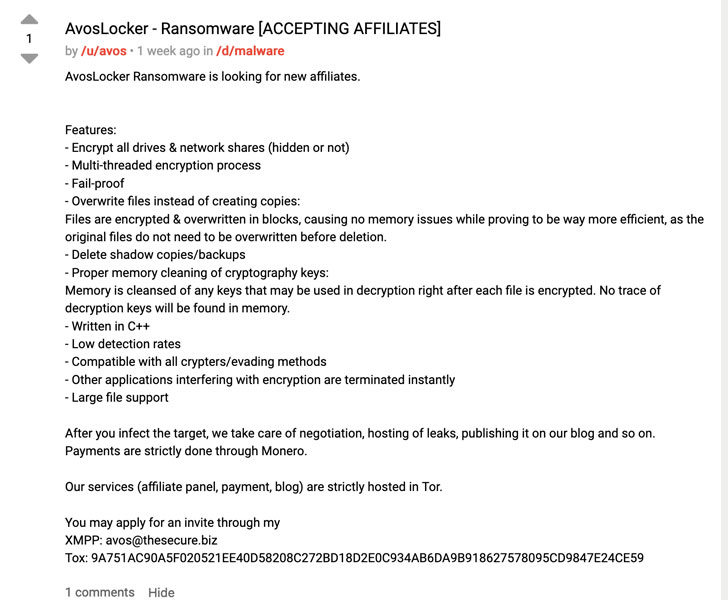
Chief among the new entrants is AvosLocker, a
ransomware-as-a-service (RaaS) group that commenced operations in
late June via “press releases” that are branded with a blue beetle
logo to recruit new affiliates. The cartel, which also runs a data
leak and extortion site, is said to have breached six organizations
in the U.S., U.K., U.A.E., Belgium, Spain, and Lebanon, with ransom
demands ranging anywhere from $50,000 to $75,000.
In contrast, Hive, despite opening shop in the same month as
AvosLocker, has already hit several healthcare providers and
mid-size organizations, including a European airline company and
three U.S.-based entities, among other victims located in
Australia, China, India, Netherlands, Norway, Peru, Portugal,
Switzerland, Thailand, and the U.K.
Also detected in the wild is a Linux variant of the HelloKitty
ransomware, which singles out Linux servers running VMware’s ESXi
hypervisor. “The observed variants impacted five organizations in
Italy, Australia, Germany, the Netherlands and the U.S.,” Unit 42
researchers Doel Santos and Ruchna Nigam said. “The highest ransom
demand observed from this group was $10 million, but at the time of
writing, the threat actors have only received three transactions
that sum up to about $1.48 million.”
Last to join the list is LockBit 2.0, an established ransomware
group that resurfaced in June[3]
with 2.0 version of their affiliate program touting its
“unparalleled benefits” of “encryption speed and self-spread
function.” Not only do the developers claim it’s “the fastest
encryption software all over the world,” the group offers a stealer
named StealBit that enables the attackers to download victims’
data.

Since its June 2021 debut, LockBit 2.0 has compromised 52
organizations in accounting, automotive, consulting, engineering,
finance, high-tech, hospitality, insurance, law enforcement, legal
services, manufacturing, non-profit energy, retail, transportation,
and logistics industries spanning across Argentina, Australia,
Austria, Belgium, Brazil, Germany, Italy, Malaysia, Mexico,
Romania, Switzerland, the U.K., and the U.S.
If anything, the emergence of new ransomware variants show that
cybercriminals are doubling down on ransomware attacks,
underscoring the extremely profitable nature of the crime.
“With major ransomware groups such as REvil[4]
and DarkSide[5]
lying low or rebranding to evade law enforcement heat and media
attention, new groups will emerge to replace the ones that are no
longer actively targeting victims,” the researchers said. “While
LockBit and HelloKitty have been previously active, their recent
evolution makes them a good example on how old groups can re-emerge
and remain persistent threats.”
References
- ^
said
(unit42.paloaltonetworks.com) - ^
formulate a series of actions
(securityandtechnology.org) - ^
resurfaced in June
(twitter.com) - ^
REvil
(thehackernews.com) - ^
DarkSide
(thehackernews.com)