
More than 38 million records from 47 different entities that
rely on Microsoft’s Power Apps portals platform were inadvertently
left exposed online, bringing into sharp focus a “new vector of
data exposure.”
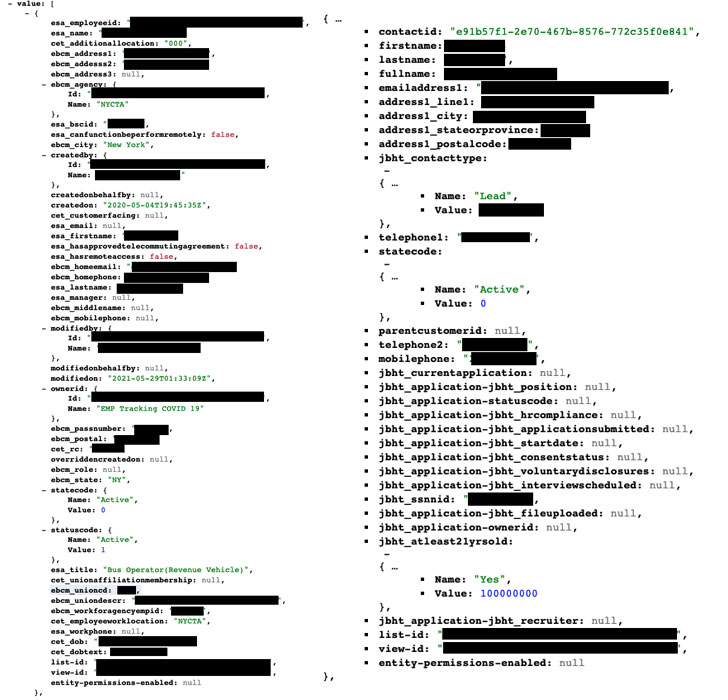
“The types of data varied between portals, including personal
information used for COVID-19 contact tracing, COVID-19 vaccination
appointments, social security numbers for job applicants, employee
IDs, and millions of names and email addresses,” UpGuard Research
team said[1]
in a disclosure made public on Monday.
Governmental bodies like Indiana, Maryland, and New York City,
and private companies such as American Airlines, Ford, J.B. Hunt,
and Microsoft are said to have been impacted. Among the most
sensitive information that was left in the open were 332,000 email
addresses and employee IDs used by Microsoft’s own global payroll
services, as well as more than 85,000 records related to Business
Tools Support and Mixed Reality portals.
Power Apps[2]
is a Microsoft-powered development platform for building low-code
custom business apps that work across mobile and the web using
prebuilt templates, in addition to offering APIs to enable access
to data by other applications, including options to retrieve and
store information. The company describes the service as a “suite of
apps, services, and connectors, as well as a data platform, that
provides a rapid development environment to build custom apps for
your business needs.”
But a misconfiguration in the way a portal could share and store
data could lead to a scenario wherein sensitive data is made
publicly accessible, resulting in a potential data leak.
“Power Apps portals have options built in for sharing data, but
they also have built in data types that are inherently sensitive,”
the researchers said. “In cases like registration pages for
COVID-19 vaccinations, there are data types that should be public,
like the locations of vaccination sites and available appointment
times, and sensitive data that should be private, like the
personally identifying information of the people being
vaccinated.”
UpGuard said it notified Microsoft of the data leakage in June
24, 2021, only for the company to initially close the case, citing
the behavior was “by design” but subsequently take actions to alert
its government cloud customers of the issue in the wake of an abuse
report filed by the security firm on July 15.
Additionally, Microsoft has released a tool called Portal Checker[3]
to diagnose any potential exposure arising out of misconfiguration
reasons and has made updates[4]
so that “newly created portals will have table permissions enforced
for all forms and lists irrespective of the Enable Table
Permissions setting.”
“While we understand (and agree with) Microsoft’s position that
the issue here is not strictly a software vulnerability, it is a
platform issue that requires code changes to the product, and thus
should go in the same workstream as vulnerabilities,” the
researchers noted.
“It is a better resolution to change the product in response to
observed user behaviors than to label systemic loss of data
confidentiality an end user misconfiguration, allowing the problem
to persist and exposing end users to the cybersecurity risk of a
data breach.”
References
- ^
said
(www.upguard.com) - ^
Power
Apps (powerapps.microsoft.com) - ^
Portal
Checker (docs.microsoft.com) - ^
updates
(docs.microsoft.com)
Read more http://feedproxy.google.com/~r/TheHackersNews/~3/3tsPAcpbuxU/38-million-records-exposed-from.html