Mar 13, 2023Ravie Lakshmanan
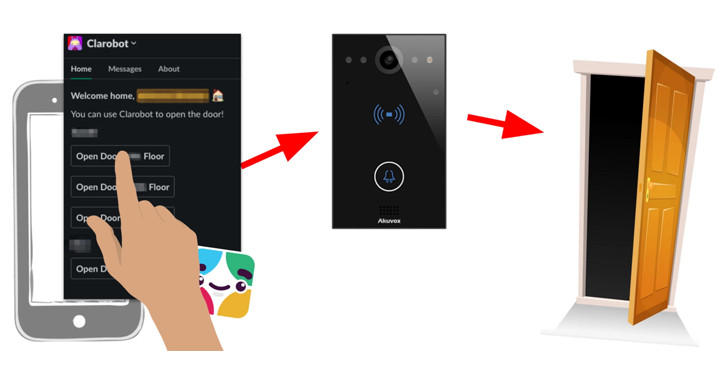
More than a dozen security flaws have been disclosed in E11, a
smart intercom product made by Chinese company Akuvox.
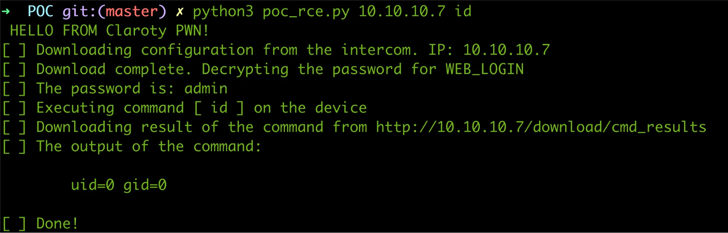
“The vulnerabilities could allow attackers to execute code
remotely in order to activate and control the device’s camera and
microphone, steal video and images, or gain a network foothold,”
Claroty security researcher Vera Mens said[1]
in a technical write-up.
Akuvox E11 is described by the company on its website as a
“SIP[2]
[Session Initiation Protocol] video doorphone specially designed
for villas, houses, and apartments.”
The product listing[3], however, has been taken
down from the website, displaying an error message: “Page does not
exist.” A snapshot[4]
captured by Google shows that the page was live as recently as
March 12, 2023, 05:59:51 GMT.
The attacks can manifest either through remote code execution
within the local area network (LAN) or remote activation of the
E11’s camera and microphone, allowing the adversary to collect and
exfiltrate multimedia recordings.
A third attack vector takes advantage of an external, insecure
file transfer protocol (FTP) server to download stored images and
data.
The most severe of the issues are as follows –
- CVE-2023-0344[5] (CVSS score: 9.1) –
Akuvox E11 appears to be using a custom version of dropbear SSH
server. This server allows an insecure option that by default is
not in the official dropbear SSH server.
- CVE-2023-0345[6] (CVSS score: 9.8) – The
Akuvox E11 secure shell (SSH) server is enabled by default and can
be accessed by the root user. This password cannot be changed by
the user.
- CVE-2023-0352[7] (CVSS score: 9.1) – The
Akuvox E11 password recovery webpage can be accessed without
authentication, and an attacker could download the device key file.
An attacker could then use this page to reset the password back to
the default.
- CVE-2023-0354[8] (CVSS score: 9.1) – The
Akuvox E11 web server can be accessed without any user
authentication, and this could allow an attacker to access
sensitive information, as well as create and download packet
captures with known default URLs.
A majority of the 13 security issues remain unpatched to date,
with the industrial and IoT security company noting that Akuvox has
since addressed the FTP server permissions issue by disabling the
“the ability to list its content so malicious actors could not
enumerate files anymore.”
WEBINAR
Discover the Hidden Dangers of Third-Party SaaS Apps
Are you aware of the risks associated with third-party app
access to your company’s SaaS apps? Join our webinar to learn about
the types of permissions being granted and how to minimize
risk.
The findings have also prompted the U.S. Cybersecurity and
Infrastructure Security Agency (CISA) to release[10] an Industrial Control
Systems (ICS) advisory of its own last week.
“Successful exploitation of these vulnerabilities could cause
loss of sensitive information, unauthorized access, and grant full
administrative control to an attacker,” the agency cautioned[11].
In the absence of patches, organizations using the doorphone are
advised to disconnect it from the internet until the
vulnerabilities are fixed to mitigate potential remote attacks.
It’s also advised to change the default password used to secure
the web interface and “segment and isolate the Akuvox device from
the rest of the enterprise network” to prevent lateral movement
attacks.
The development comes as Wago released patches for several of
its programmable logic controllers (PLCs) to address[12] four vulnerabilities
(CVE-2022-45137, CVE-2022-45138, CVE-2022-45139, and
CVE-2022-45140) two of which could be exploited to achieve full
system compromise.
Found this article interesting? Follow us on Twitter [13] and LinkedIn[14] to read more exclusive
content we post.
References
- ^
said
(claroty.com) - ^
SIP
(en.wikipedia.org) - ^
product
listing (www.akuvox.com) - ^
snapshot
(webcache.googleusercontent.com) - ^
CVE-2023-0344
(claroty.com) - ^
CVE-2023-0345
(claroty.com) - ^
CVE-2023-0352
(claroty.com) - ^
CVE-2023-0354
(claroty.com) - ^
RESERVE YOUR SEAT
(thn.news) - ^
release
(www.cisa.gov) - ^
cautioned
(www.cisa.gov) - ^
address
(cert.vde.com) - ^
Twitter
(twitter.com) - ^
LinkedIn
(www.linkedin.com)
Read more https://thehackernews.com/2023/03/researchers-uncover-over-dozen-security.html