Mar 13, 2023Ravie Lakshmanan
The Dark Pink advanced persistent threat (APT)
actor has been linked to a fresh set of attacks targeting
government and military entities in Southeast Asian countries with
a malware called KamiKakaBot.
Dark Pink, also called Saaiwc, was first profiled[1]
by Group-IB earlier this year, describing its use of custom tools
such as TelePowerBot and KamiKakaBot to run arbitrary commands and
exfiltrate sensitive information.
The threat actor is suspected to be of Asia-Pacific origin and
has been active since at least mid-2021, with an increased tempo
observed in 2022.
“The latest attacks, which took place in February 2023, were
almost identical to previous attacks,” Dutch cybersecurity company
EclecticIQ disclosed[2]
in a new report published last week.
“The main difference in the February campaign is that the
malware’s obfuscation routine has improved to better evade
anti-malware measures.”
The attacks play out in the form of social engineering lures
that contain ISO image file attachments in email messages to
deliver the malware.
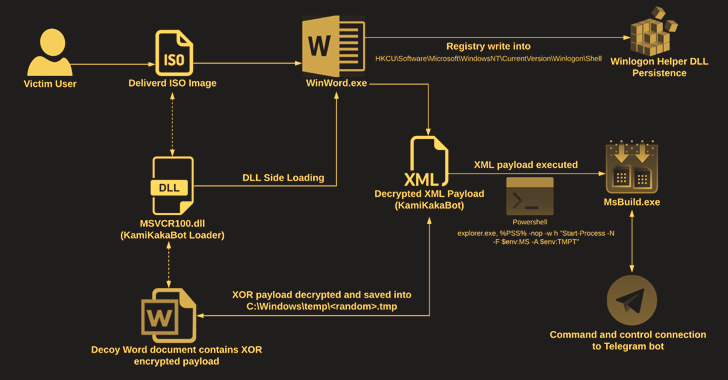
The ISO image includes an executable (Winword.exe), a loader
(MSVCR100.dll), and a decoy Microsoft Word document, the latter of
which comes embedded with the KamiKakaBot payload.

The loader, for its part, is designed to load the KamiKakaBot
malware by leveraging the DLL side-loading method[3]
to evade security protections and load it into the memory of the
Winword.exe binary.
KamiKakaBot is primarily engineered to steal data stored in web
browsers and execute remote code using Command Prompt (cmd.exe),
while also embracing evasion techniques to blend in with victim
environments and hinder detection.
WEBINAR
Discover the Hidden Dangers of Third-Party SaaS Apps
Are you aware of the risks associated with third-party app
access to your company’s SaaS apps? Join our webinar to learn about
the types of permissions being granted and how to minimize
risk.
Persistence on the compromised host is achieved by abusing the
Winlogon Helper library[5]
to make malicious Windows Registry key modifications. The gathered
data is subsequently exfiltrated to a Telegram bot as a ZIP
archive.
“The use of legitimate web services as a command-and-control
(C2) server, such as Telegram, remains the number one choice for
different threat actors, ranging from regular cyber criminals to
advanced persistent threat actors,” the Amsterdam-based company
said.
“The Dark Pink APT group is very likely a cyber
espionage-motivated threat actor that specifically exploits
relations between ASEAN and European nations to create phishing
lures during the February 2023 campaign.”
Found this article interesting? Follow us on Twitter [6]
and LinkedIn[7]
to read more exclusive content we post.
References
- ^
first
profiled (thehackernews.com) - ^
disclosed
(blog.eclecticiq.com) - ^
DLL
side-loading method (attack.mitre.org) - ^
RESERVE YOUR SEAT
(thn.news) - ^
Winlogon
Helper library (attack.mitre.org) - ^
Twitter
(twitter.com) - ^
LinkedIn
(www.linkedin.com)
Read more https://thehackernews.com/2023/03/kamikakabot-malware-used-in-latest-dark.html