Jan 27, 2023Ravie Lakshmanan
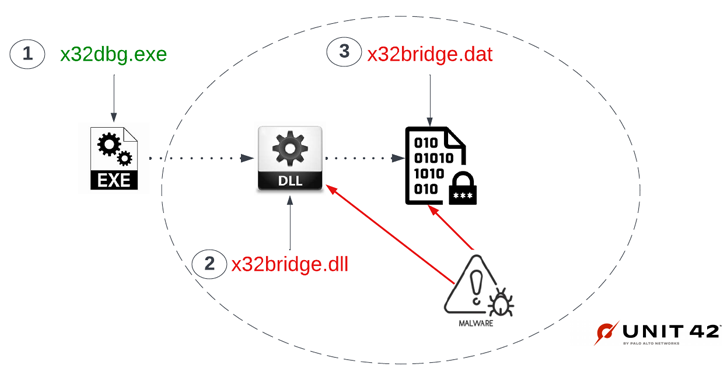
Cybersecurity researchers have uncovered a PlugX sample that
employs sneaky methods to infect attached removable USB media
devices in order to propagate the malware to additional
systems.
“This PlugX variant is wormable and infects USB devices in such
a way that it conceals itself from the Windows operating file
system,” Palo Alto Networks Unit 42 researchers Mike Harbison and
Jen Miller-Osborn said[1]. “A user would not know
their USB device is infected or possibly used to exfiltrate data
out of their networks.”
The cybersecurity company said it uncovered the artifact during
an incident response effort following a Black Basta ransomware
attack against an unnamed victim. Among other tools discovered in
the compromised environment include the Gootkit[2]
malware loader and the Brute Ratel C4[3]
red team framework.
The use of Brute Ratel by the Black Basta group was previously
highlighted[4]
by Trend Micro in October 2022, with the software delivered as a
second-stage payload by means of a Qakbot phishing campaign. The
attack chain has since been used against a large, regional energy
outfit based in the southeastern U.S., according to Quadrant Security[5].
However, there is no evidence that ties PlugX, a backdoor
extensively[6]
shared[7]
across several Chinese nation-state groups, or Gootkit to the Black
Basta ransomware gang, suggesting that it may have been deployed by
other actors.
The USB variant of PlugX is notable for the fact that it uses a
particular Unicode character called non-breaking space (U+00A0[8]) to hide files in a USB
device plugged into a workstation.
“The whitespace character prevents the Windows operating system
from rendering the directory name, concealing it rather than
leaving a nameless folder in Explorer,” the researchers said,
explaining the novel technique.
Ultimately, a Windows shortcut (.LNK) file created in the root
folder of the flash drive is used to execute the malware from the
hidden directory. The PlugX sample is not only tasked with
implanting the malware on the host, but also copying it on any
removable device that may be connected to it by camouflaging it
inside a recycle bin folder.
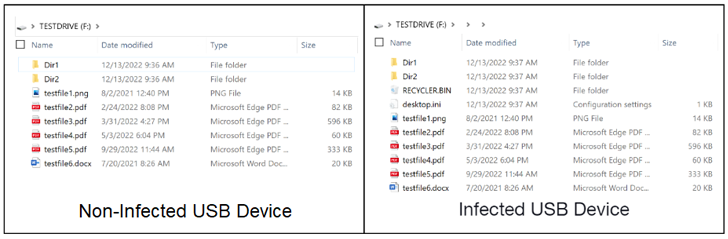
The shortcut file, for its part, carries the same name as that
of the USB device and appears as a drive icon, with the existing
files or directories on the root of the removable device moved to a
hidden folder created inside the “shortcut” folder.
“Whenever the shortcut file from the infected USB device is
clicked, the PlugX malware launches Windows Explorer and passes the
directory path as a parameter,” Unit 42 said. “This then displays
the files on the USB device from within the hidden directories and
also infects the host with the PlugX malware.”
The technique banks on the fact that Windows File Explorer
(previously Windows Explorer) by default does not show hidden items[9]. But the clever twist
here is that the malicious files within the so-called recycle bin
do not get displayed when with the setting enabled.
This effectively means that the rogue files can only be viewed
on a Unix-like operating system like Ubuntu or by mounting the USB
device in a forensic tool.
“Once a USB device is discovered and infected, any new files
written to the USB device root folder post-infection are moved to
the hidden folder within the USB device,” the researchers said.
“Since the Windows shortcut file resembles that of a USB device and
the malware displays the victim’s files, they unwittingly continue
to spread the PlugX malware.”
Unit 42 said it also discovered a second variant of PlugX that,
in addition to infecting USB devices, further copies all Adobe PDF
and Microsoft Word files from the host to another hidden folder on
the USB device created by the malware.
The use of USB drives as a means to exfiltrate specific files of
interest from its targets indicates an attempt on part of the
threat actors to jump over air-gapped networks[10].
With the latest development, PlugX joins the ranks of other
malware families such as ANDROMEDA[11] and Raspberry Robin[12] that have added the
capability to spread via infected USB drives.
“The discovery of these samples indicates PlugX development is
still alive and well among at least some technically skilled
attackers, and it remains an active threat,” the researchers
concluded.
Found this article interesting? Follow us on Twitter [13] and LinkedIn[14] to read more exclusive
content we post.
References
- ^
said
(unit42.paloaltonetworks.com) - ^
Gootkit
(thehackernews.com) - ^
Brute
Ratel C4 (thehackernews.com) - ^
highlighted
(thehackernews.com) - ^
Quadrant
Security (quadrantsec.com) - ^
extensively
(thehackernews.com) - ^
shared
(thehackernews.com) - ^
U+00A0
(en.wikipedia.org) - ^
hidden
items (support.microsoft.com) - ^
air-gapped networks
(thehackernews.com) - ^
ANDROMEDA
(thehackernews.com) - ^
Raspberry Robin
(thehackernews.com) - ^
Twitter
(twitter.com) - ^
LinkedIn
(www.linkedin.com)
Read more https://thehackernews.com/2023/01/researchers-discover-new-plugx-malware.html