South Africa, were left without electricity after the city’s power
company got attacked by a ransomware virus.
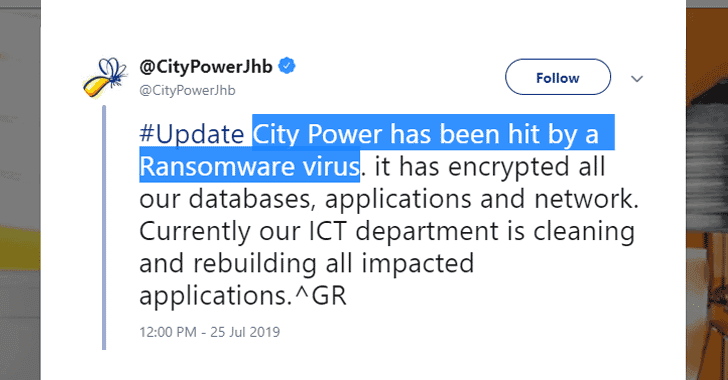
City Power, the company responsible for powering South Africa’s
financial capital Johannesburg, confirmed[1]
Thursday on Twitter that it had been hit by a Ransomware virus that
had encrypted all of its databases, applications, and network.
The attack prevented prepaid customers from buying electricity
units, upload invoices when making payments, or access the City
Power’s official website, eventually leaving them without
power.
“Please note that the virus hit us early Thursday morning,
compromising our database and other software, impacting most of our
applications and networks,” the city government said in a tweet.
[2]
However, the company has also ensured its customers that none of
their details were compromised in the cyber attack.
At the time of writing, the company confirmed they have restored
electricity supply in many areas and also most of the critical
applications, including the prepaid vending system responsible for
enabling its customers to buy electricity.
However, customers seeking to access the City Power website to
log faults are still not able to do so. They are requested to log
calls by their mobile phones using citypower.mobi.
Depending on the type and severity of the cyberattack, it is
believed that the complete clean up of the affected services and
networks could take weeks.
Also, it could cost millions of dollars—just like the City of
Baltimore[3] recently spent
$5,310,546[4] in hiring security
consultant firms and upgrading its infrastructure following a
ransomware attack that shut down the majority of its servers.
The city government did not provide any details on the type of
ransomware virus that hit the power company, or if the company has
a backup for critical files encrypted by the malware.
“Customers should not panic as none of their details were
compromised,” the city government said[5] Thursday afternoon. “We
apologize for the inconvenience caused to the people of the City of
Joburg. Please be patient with us, and we expect to have everything
back in order by the end of Thursday.”
Johannesburg is not the only one that was recently hit by a
ransomware attack. A growing number of cities has targeted in the
last few months with ransomware as cybercriminals aim
municipalities around the world.
Last month, ransomware viruses
hit two cities in Florida[6]
that made large ransom payments to gain back access to city files
that were encrypted in the attacks—these cities include Riviera
Beach City ($600,000) and Lake City ($500,000) in Florida.
However, federal authorities and cybersecurity experts have
always advised victims not to pay ransoms since it encourages
criminals, and also there’s no guarantee of files or computer
systems being completely restored.
Instead of paying the ransom, organizations and companies should
consider having robust backups of their important and required
files and data in place as well as educating their employees to
avoid being a victim of such cyber attacks.
References
- ^
confirmed
(twitter.com) - ^
tweet
(twitter.com) - ^
City of Baltimore
(thehackernews.com) - ^
spent $5,310,546
(mayor.baltimorecity.gov) - ^
said
(twitter.com) - ^
ransomware viruses hit two cities in
Florida (thehackernews.com)
Read more http://feedproxy.google.com/~r/TheHackersNews/~3/kJqw9GTYXWU/cyberattack-power-outage.html