An ongoing malicious campaign that employs phony call centers
has been found to trick victims into downloading malware capable of
data exfiltration as well as deploying ransomware on infected
systems.
The attacks — dubbed “BazaCall” — eschew traditional social
engineering techniques that rely on rogue URLs and malware-laced
documents in favor of a vishing-like method wherein targeted users
are sent email messages informing them of a forthcoming
subscription charge unless they call a specific phone number.
By tricking the recipients into calling the number, the
unsuspecting victims are connected with actual human operators at
the fraudulent call centers, who then provide them with
instructions to download the BazaLoader malware.
BazaLoader[1]
is a C++ downloader malware with the ability to install various
types of malicious programs on infected computers, including
deploying ransomware and other malware and stealing sensitive data
from victimized systems. First observed in April 2020, BazaLoader
campaigns have been used by multiple threat actors and frequently
serves as a loader for disruptive malware, including Ryuk and Conti
ransomware.
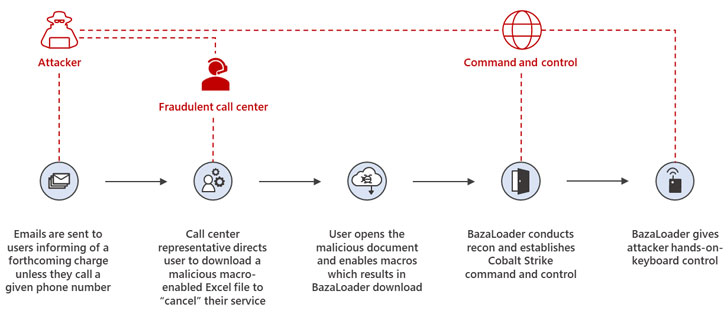 |
| BazaCall Attack Flow |
“Attacks emanating from the BazaCall threat could move quickly
within a network, conduct extensive data exfiltration and
credential theft, and distribute ransomware within 48 hours of the
initial compromise,” Microsoft 365 Defender Threat Intelligence
Team said[2]
in a report published Thursday.
Because the malware isn’t distributed via a link or document
within the message body itself, the lures add a level of difficulty
that enables attackers to evade phishing and malware detection
software. This campaign is part of a broader trend in which
BazaLoader-affiliated criminals in which they use call centers —
the operators seemingly non-native English speakers — as part of an
intricate attack chain.
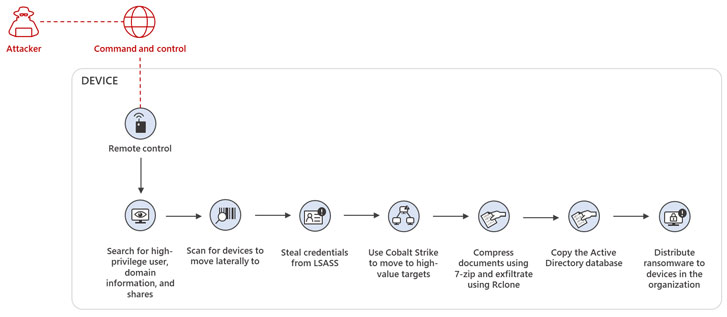 |
| Post-Compromise Activities |
Earlier this May, Palo Alto Networks[3]
and Proofpoint[4]
revealed an elaborate infection mechanism that leveraged fake
ebooks (World Books) and movie streaming subscription services
(BravoMovies), using the websites as a stepping stone to deliver a
rigged Excel spreadsheet containing the BazaLoader malware. The
latest attack disclosed by Microsoft is no different in that the
call center agent serves as a conduit, urging the caller to
navigate a recipe website (“topcooks[.]us”) in order to cancel the
non-existent trial subscription.
“The use of another human element in BazaCall’s attack chain
through the above mentioned hands-on-keyboard control further makes
this threat more dangerous and more evasive than traditional,
automated malware attacks,” the researchers said. “BazaCall
campaigns highlight the importance of cross-domain optics and the
ability to correlate events in building a comprehensive defense
against complex threats.”
References
- ^
BazaLoader
(malpedia.caad.fkie.fraunhofer.de) - ^
said
(www.microsoft.com) - ^
Palo
Alto Networks (unit42.paloaltonetworks.com) - ^
Proofpoint
(www.proofpoint.com)