A cyber attack that derailed websites of Iran’s transport
ministry and its national railway system earlier this month,
causing widespread disruptions in train services, was the result of
a never-before-seen reusable wiper malware called “Meteor.”
The campaign — dubbed “MeteorExpress[1]” — has not been linked
to any previously identified threat group or to additional attacks,
making it the first incident involving the deployment of this
malware, according to researchers from Iranian antivirus firm
Amn Pardaz[2]
and SentinelOne. Meteor is believed to have been in the works over
the past three years.
“Despite a lack of specific indicators of compromise, we were
able to recover most of the attack components,” SentinelOne’s
Principal Threat Researcher, Juan Andres Guerrero-Saade, noted.
“Behind this outlandish tale of stopped trains and glib trolls, we
found the fingerprints of an unfamiliar attacker,” adding the
offensive is “designed to cripple the victim’s systems, leaving no
recourse to simple remediation via domain administration or
recovery of shadow copies.”
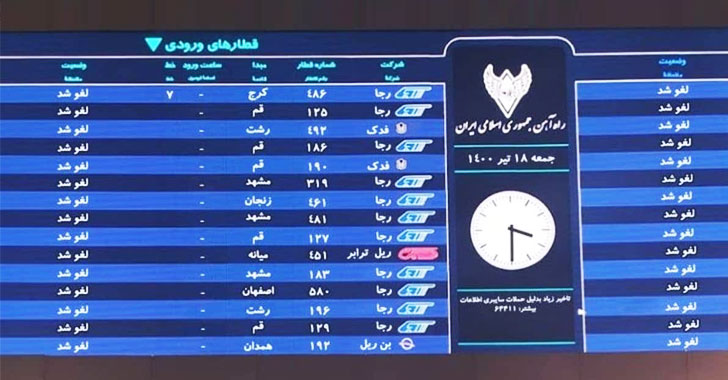
On July 9, the Iranian train system was left paralyzed in the
wake of a major attack[3], with the hackers
defacing electronic displays to instruct passengers to direct their
complaints to the phone number of the Iranian Supreme Leader
Ayatollah Ali Khamenei’s office. The incident is said to have
reportedly caused “unprecedented chaos” at stations with hundreds
of trains delayed or canceled.
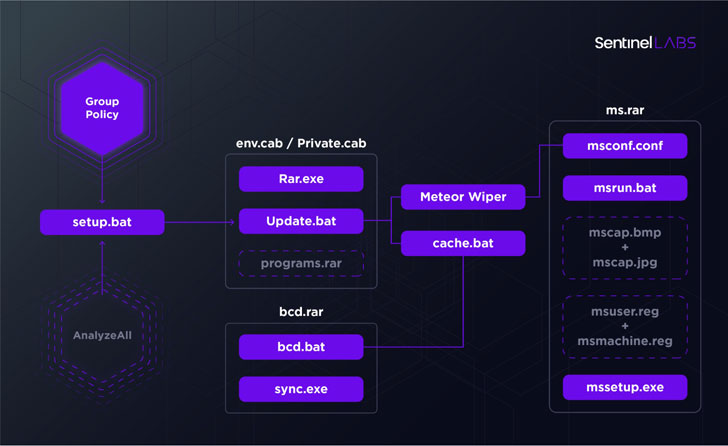
Now according to SentinelOne, the infection chain commenced with
the abuse of Group Policy[4]
to deploy a toolkit that consisted of a combination of batch files
orchestrating different components, which are extracted from
multiple RAR archives and are chained together to facilitate the
encryption of the filesystem, corruption of the master boot record
(MBR[5]), and locking of the
system in question.
Other batch script files dropped during the attack were found to
take charge of disconnecting the infected device from the network
and creating Windows Defender exclusions for all of the components,
a tactic that’s becoming increasingly[6]
prevalent[7]
among threat actors to hide their malicious activities from
antimalware solutions installed on the machine.
Meteor, for its part, is an externally configurable wiper with
an extensive set of features, including the ability to delete
shadow copies as well as a “wealth of additional functionality”
such as changing user passwords, terminating arbitrary processes,
disabling recovery mode, and executing malicious commands.
The wiper has been characterized as “a bizarre amalgam of custom
code” that blends open-source components with ancient software
that’s “rife with sanity checks, error checking, and redundancy in
accomplishing its goals,” suggesting a fragmented approach and a
lack of coordination across different teams involved in the
development.
“Conflict in cyberspace is overpopulated with increasingly
brazen threat actors. Behind the artistry of this epic troll lies
an uncomfortable reality where a previously unknown threat actor is
willing to leverage wiper malware against public railways systems,”
Guerrero-Saade said. “The attacker is an intermediate level player
whose different operational components sharply oscillate from
clunky and rudimentary to slick and well-developed.”
“We should keep in mind that the attackers were already familiar
with the general setup of their target, features of the domain
controller, and the target’s choice of backup system (Veeam). That
implies a reconnaissance phase that flew entirely under the radar
and a wealth of espionage tooling that we’ve yet to uncover.”
References
- ^
MeteorExpress
(labs.sentinelone.com) - ^
Amn
Pardaz (threats.amnpardaz.com) - ^
major
attack (www.theguardian.com) - ^
Group
Policy (en.wikipedia.org) - ^
MBR
(en.wikipedia.org) - ^
increasingly
(thehackernews.com) - ^
prevalent
(thehackernews.com)