A state-backed threat actor with ties to the Democratic People’s
Republic of Korea (DRPK) has been attributed to a spear-phishing
campaign targeting journalists covering the country with the
ultimate goal of deploying a backdoor on infected Windows
systems.
The intrusions, said to be the work of Ricochet Chollima,
resulted in the deployment of a novel malware strain called
GOLDBACKDOOR, an artifact that shares technical overlaps with
another malware named BLUELIGHT, which has been previously linked
to the group.
“Journalists are high-value targets for hostile governments,”
cybersecurity firm Stairwell said[1]
in a report published last week. “Compromising a journalist can
provide access to highly-sensitive information and enable
additional attacks against their sources.”
Ricochet Chollima, also known as APT37[2], InkySquid, and
ScarCruft, is a North Korean-nexus targeted intrusion adversary
that has been involved in espionage attacks since at least 2016.
The threat actor has a track record of targeting the Republic of
Korea with a noted focus on government officials, non-governmental
organizations, academics, journalists, and North Korean
defectors.
In November 2021, Kaspersky unearthed evidence of the hacking
crew delivering a previously undocumented implant called Chinotto[3]
as part of a new wave of highly-targeted surveillance attacks,
while other prior operations have made use of a remote access tool
called BLUELIGHT[4].
Stairwell’s investigation into the campaign comes weeks after NK
News disclosed[5]
that the lure messages were sent from a personal email address
belonging to a former South Korean intelligence official,
ultimately leading to the deployment of the backdoor in a
multi-stage infection process to evade detection.
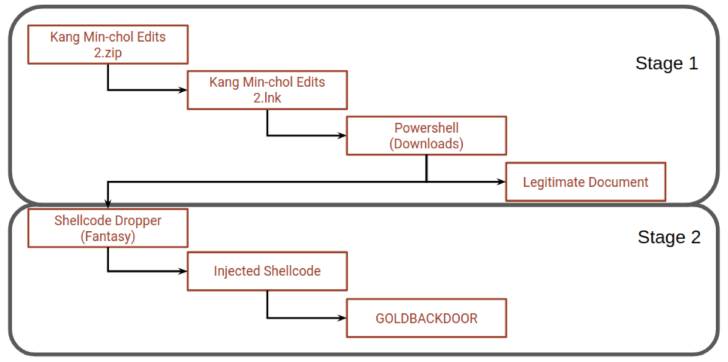
The email messages were found to contain a link to download a
ZIP archive from a remote server designed to impersonate the North
Korea-focused news portal. Embedded within the file is a Windows
shortcut file that acts as a jumping-off point to execute the
PowerShell script, which opens a decoy document while
simultaneously installing the GOLDBACKDOOR backdoor.
The implant, for its part, is fashioned as a Portable Executable
file that’s capable of retrieving commands from a remote server,
uploading and downloading files, recording files, and remotely
uninstalling itself from the compromised machines.
“Over the past 10 years, the Democratic People’s Republic of
Korea DPRK has adopted cyber operations as a key means of
supporting the regime,” Stairwell’s Silas Cutler said.
“While significant attention has been paid to the purported use
of these operations as a means of funding DPRK’s military programs,
the targeting of researchers, dissidents, and journalists likely
remains a key area for supporting the country’s intelligence
operations.”
References
Read more https://thehackernews.com/2022/04/north-korean-hackers-target-journalists.html