
The infamous ransomware group known as Conti has continued[1]
its onslaught against entities despite suffering a massive data
leak of its own earlier this year, according to new research.
Conti, attributed to a Russia-based threat actor known as
Gold Ulrick, is one of the most prevalent malware strains in
the ransomware landscape, accounting for 19% of all attacks[2]
during the three-month-period between October and December
2021.
One of the most prolific ransomware groups of the last year
along the likes of LockBit 2.0, PYSA, and Hive, Conti has locked
the networks of hospitals, businesses, and government agencies,
while receiving a ransom payment in exchange for sharing the
decryption key as part of its name-and-shame scheme.
But after the cybercriminal cartel came out in support of Russia
over its invasion of Ukraine in February, an anonymous Ukrainian
security researcher under the Twitter handle ContiLeaks[3]
began leaking the source code as well as private conversations
between its members, offering an unprecedented insight into the
group’s workings.
“The chats reveal a mature cybercrime ecosystem across multiple
threat groups with frequent collaboration and support,” Secureworks
said[4]
in a report published in March. The groups include Gold Blackburn
(TrickBot and Diavol[5]), Gold Crestwood
(Emotet[6]), Gold Mystic (LockBit),
and Gold Swathmore (IcedID[7]).
Indeed, Intel 471’s technical monitoring[8]
of Emotet campaigns between December 25, 2021, and March 25, 2022,
identified that over a dozen Conti ransomware targets were, in
fact, victims of Emotet malspam attacks, highlighting how the
two operations are intertwined[9].
That said, the leaks don’t seem to have put a dampener on the
syndicate’s activities, with the number of Conti victims posted in
March surged to the second-highest monthly total since January
2021, according to the cybersecurity firm.
What’s more, the group is said to have added 11 victims in the
first four days of April, even as the operators continue to “evolve
its ransomware, intrusion methods, and approaches” in response to
the public disclosure of their arsenal.
The findings have also been corroborated by NCC Group[10] late last month, which
said that “Conti operators continue their business as usual by
proceeding to compromise networks, exfiltrating data and finally
deploying their ransomware.”
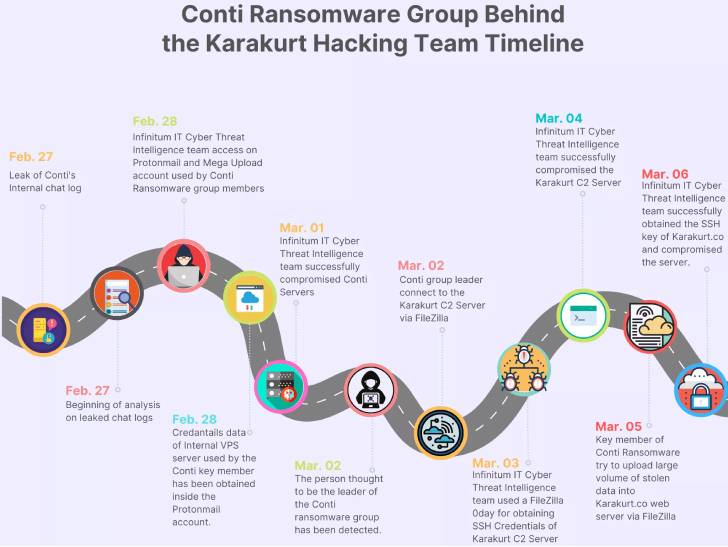
A web of connections between Conti and Karakurt
The development comes as financial and tactical overlaps[11] have been uncovered
between Conti and the Karakurt[12] data extortion group
based on information published during the ContiLeaks saga, weeks
after TrickBot’s operators had been subsumed[13] into the ransomware
cartel.
An analysis of blockchain transactions associated with
cryptocurrency addresses belonging to Karakurt has shown “Karakurt
wallets sending substantial sums of cryptocurrency to Conti
wallets,” according to a joint investigation[14] by researchers from
Arctic Wolf and Chainalysis.
The shared wallet hosting is also said to involve the
now-defunct TrickBot gang’s Diavol ransomware, with a “Diavol
extortion address hosted by a wallet containing addresses used in
Conti ransomware attacks,” indicating that Diavol is being deployed
by the same set of actors behind Conti and Karakurt.
Further forensic examination of an unnamed client that was hit
with a subsequent wave of extortion attacks following a Conti
ransomware infection has revealed that the second group used the
same Cobalt Strike backdoor left behind by Conti, implying a strong
association between seemingly disparate cybercrime actors.
“Whether Karakurt is an elaborate side hustle by Conti and
Diavol operatives or whether this is an enterprise sanctioned by
the overall organization remains to be seen,” Arctic Wolf said.
“This connection perhaps explains why Karakurt is surviving and
thriving despite some of its exfiltration-only competitors dying
out,” the researchers said, adding, “Or, alternatively, perhaps
this was the trial run of a strategic diversification authorized by
the main group.”
References
- ^
continued
(www.secureworks.com) - ^
19% of
all attacks (thehackernews.com) - ^
ContiLeaks
(thehackernews.com) - ^
said
(www.secureworks.com) - ^
Diavol
(thehackernews.com) - ^
Emotet
(thehackernews.com) - ^
IcedID
(thehackernews.com) - ^
technical monitoring
(intel471.com) - ^
two
operations are intertwined
(thehackernews.com) - ^
NCC
Group (research.nccgroup.com) - ^
tactical overlaps
(www.infinitumit.com.tr) - ^
Karakurt
(thehackernews.com) - ^
subsumed
(thehackernews.com) - ^
joint
investigation (arcticwolf.com)
Read more https://thehackernews.com/2022/04/gold-ulrick-hackers-still-in-action.html