
Security researchers Thursday disclosed a new critical
vulnerability affecting Domain Name System (DNS) resolvers that
could be exploited by adversaries to carry out reflection-based
denial-of-service attacks against authoritative nameservers.
The flaw, called ‘TsuNAME[1],’ was discovered by
researchers from SIDN Labs and InternetNZ, which manage the
national top-level internet domains ‘.nl’ and ‘.nz’ for the
Netherlands and New Zealand, respectively.
“TsuNAME occurs when domain names are misconfigured with cyclic
dependent DNS records, and when vulnerable resolvers access these
misconfigurations, they begin looping and send DNS queries rapidly
to authoritative servers and other resolvers,” the researchers
said.
A recursive DNS resolver is one of the core components involved
in DNS resolution[2], i.e., converting a
hostname such as www.google.com into a computer-friendly IP address
like 142.250.71.36. To achieve this, it responds to a client’s
request for a web page by making a series of requests until it
reaches the authoritative DNS nameserver for the requested DNS
record. The authoritative DNS server is akin to a dictionary that
holds the exact IP address for the domain that’s being looked
up.
But with TsuNAME, the idea is that misconfigurations during
domain registration can create a cyclic dependency such that
nameserver records for two zones[3] point to each other,
leading vulnerable resolvers to “simply bounce back from zone to
zone, sending non-stop queries to the authoritative servers of both
parent zones,” thereby overwhelming their parent zone authoritative
servers.
As to how this happens, it all boils down to recursive resolvers
being oblivious to the cycle and not caching cyclically dependent
name records.
Data gathered from the .nz domain found that two misconfigured
domains alone led to a 50% increase in overall traffic volume for
the .nz’s authoritative servers. Google Public DNS (GDNS) and Cisco
OpenDNS — which were abused to target .nz and .nl domains in 2020 —
have since addressed the issue in their DNS resolver software.
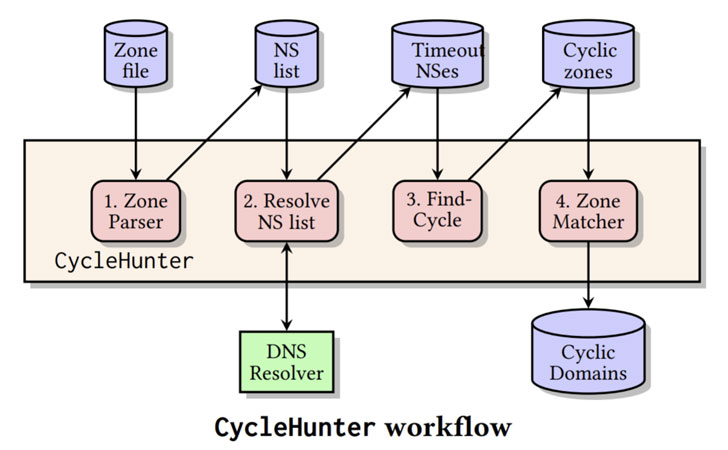
To mitigate the impact of TsuNAME in the wild, the researchers
have published an open-source tool called CycleHunter[4]
that allows for authoritative DNS server operators to detect cyclic
dependencies. The study also analyzed 184 million domains spanning
seven large top-level domains and 3.6 million distinct nameserver
records, uncovering 44 cyclic dependencies used by 1,435 domain
names.
“Given that [nameserver] records can change at any time, there
is no permanent solution,” the researchers cautioned. “In other
words, if a DNS zone has no cyclically dependent NS records at time
t, it means that this zone is not vulnerable at only that
particular time t. We therefore also recommend that registrars run
CycleHunter on a regular basis, for instance, as part of their
domain name registration process.”
References
- ^
‘TsuNAME
(tsuname.io) - ^
DNS
resolution (www.cloudflare.com) - ^
zones
(en.wikipedia.org) - ^
CycleHunter
(github.com)