An unknown threat actor with the capabilities to evolve and
tailor its toolset to target environments infiltrated high-profile
organizations in Asia and Africa with an evasive Windows rootkit
since at least 2018.
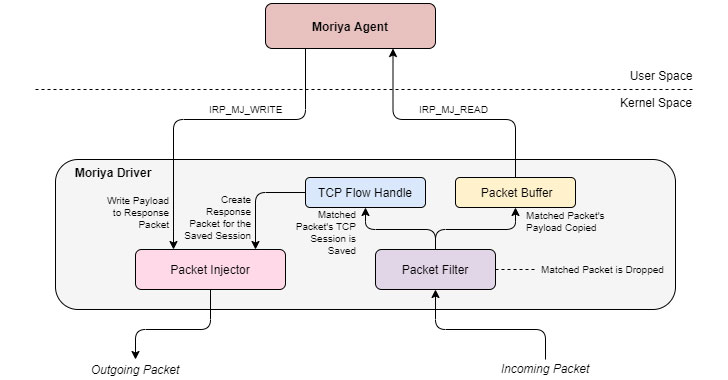
Called ‘Moriya[1],’ the malware is a
“passive backdoor which allows attackers to inspect all incoming
traffic to the infected machine, filter out packets that are marked
as designated for the malware and respond to them,” said Kaspersky
researchers Mark Lechtik and Giampaolo Dedola in a Thursday
deep-dive.
The Russian cybersecurity firm termed the ongoing espionage
campaign ‘TunnelSnake[2].’ Based on telemetry
analysis, less than 10 victims around the world have been targeted
to date, with the most prominent victims being two large diplomatic
entities in Southeast Asia and Africa. All the other victims were
located in South Asia.
The first reports of Moriya emerged last November when Kaspersky
said it discovered the stealthy implant in the networks of regional
inter-governmental organizations in Asia and Africa. Malicious
activity associated with the operation is said to have dated back
to November 2019, with the rootkit persisting in the victim
networks for several months following the initial infection.
“This tool was used to control public facing servers in those
organizations by establishing a covert channel with a C2 server and
passing shell commands and their outputs to the C2,” the company
said[3]
in its APT trends report for Q3 2020. “This capability is
facilitated using a Windows kernel mode driver.”
Rootkits[4]
are particularly dangerous as they allow attackers to gain high
privileges in the system, enabling them to intercept core input/output operations[5]
conducted by the underlying operating system and better blend with
the landscape, thus making it difficult to trace the attacker’s
digital footprints.
Microsoft, for its part, has implemented several protections[6]
into Windows over the years to prevent successful deployment and
execution of rootkits, which makes Moriya all the more
noteworthy.
Bulk of the toolset, apart from the backdoor, consists of both
proprietary and well-known pieces of malware such as China Chopper
web shell, BOUNCER, Earthworm, and Termite that have been
previously used by Chinese-speaking threat actors, giving an
insight into the attacker’s origins. The tactics, techniques, and
procedures (TTPs) used in the attacks also show that the targeted
entities fit the victimology pattern associated with
Chinese-speaking adversaries.
The revelations come as advanced persistent threats (APTs)
continue to ramp up highly-targeted data-stealing missions, while
simultaneously going to great lengths to stay under the radar for
as long as possible, rebuild their malware arsenal, making them
more tailored, complex, and harder to detect.
“The TunnelSnake campaign demonstrates the activity of a
sophisticated actor that invests significant resources in designing
an evasive toolset and infiltrating networks of high-profile
organizations,” Lechtik and Dedola said. “By leveraging Windows
drivers, covert communications channels and proprietary malware,
the group behind it maintains a considerable level of stealth.”
References
- ^
‘Moriya
(securelist.com) - ^
‘TunnelSnake
(usa.kaspersky.com) - ^
said
(securelist.com) - ^
Rootkits
(en.wikipedia.org) - ^
input/output operations
(en.wikipedia.org) - ^
several
protections (docs.microsoft.com)
Read more http://feedproxy.google.com/~r/TheHackersNews/~3/M93FJhe-tOY/new-stealthy-rootkit-infiltrated.html