
Days after the first malware[1]
targeting Apple M1 chips were discovered in the wild, researchers
have disclosed yet another previously undetected piece of malicious
software that has already infected 29,139 Macs running Intel x86_64
and the iPhone maker’s M1 processors.
However, the ultimate goal of the operation remains something of
a conundrum, what with the lack of a next-stage or final payload
leaving researchers unsure of its distribution timeline and whether
the threat is just under active development.
Calling the malware “Silver Sparrow,” cybersecurity firm Red
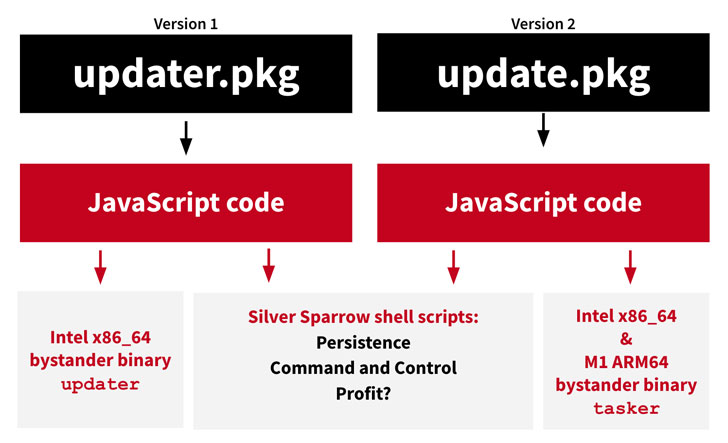
Canary said it identified two different versions of the malware —
one compiled only for Intel x86_64 and uploaded to VirusTotal on
August 31, 2020 (version 1[2]), and a second variant
submitted to the database on January 22 that’s compatible with both
Intel x86_64 and M1 ARM64 architectures (version 2[3]).
Adding to the mystery, the x86_64 binary, upon execution, simply
displays the message “Hello, World!” whereas the M1 binary reads
“You did it!,” which the researchers suspect is being used as a
placeholder.
“The Mach-O compiled binaries don’t seem to do all that much
[…] and so we’ve been calling them ‘bystander binaries,'” Red
Canary’s Tony Lambert said[4].
“We have no way of knowing with certainty what payload would be
distributed by the malware, if a payload has already been delivered
and removed, or if the adversary has a future timeline for
distribution,” Lambert added.
The macOS endpoints are located across 153 countries as of
February 17, including high volumes of detection in the U.S., the
U.K., Canada, France, and Germany, according to data from
Malwarebytes.
Despite the difference in the targeting macOS platform, the two
samples follow the same modus operandi: using the macOS Installer
JavaScript API to execute attack commands by dynamically generating
two shell scripts that are written to the target’s file system.
While “agent.sh” executes immediately at the end of the
installation to inform an AWS command-and-control (C2) server of a
successful installation, “verx.sh” runs once every hour, contacting
the C2 server for additional content to download and execute.
Additionally, the malware also comes with the capabilities to
completely erase its presence from the compromised host, suggesting
the actors associated with the campaign may be motivated by stealth
techniques.
In response to the findings, Apple has revoked the binaries that
were signed with the Apple Developer ID’s Saotia Seay (v1) and
Julie Willey (v2), thus preventing further installations.
Silver Sparrow is the second piece of malware to contain code
that runs natively on Apple’s new M1 chip. A Safari adware
extension called GoSearch22 was identified last week to have been
ported to run on the latest generation of Macs powered by the new
processors.
“Though we haven’t observed Silver Sparrow delivering additional
malicious payloads yet, its forward-looking M1 chip compatibility,
global reach, relatively high infection rate, and operational
maturity suggest Silver Sparrow is a reasonably serious threat,
uniquely positioned to deliver a potentially impactful payload at a
moment’s notice,” Lambert said.