
On August 13, 2016, a hacking unit calling itself “The Shadow Brokers[1]” announced that it had
stolen malware tools and exploits used by the Equation Group, a
sophisticated threat actor believed to be affiliated to the
Tailored Access Operations (TAO) unit of the U.S. National Security Agency[2] (NSA).
Although the group has since signed off following the
unprecedented disclosures, new “conclusive” evidence unearthed by
Check Point Research shows that this was not an isolated
incident.
The previously undocumented cyber-theft took place more than two
years before the Shadow Brokers episode, the American-Israeli
cybersecurity company said in an exhaustive report published today,
resulting in U.S.-developed cyber tools reaching the hands of a
Chinese advanced persistent threat which then repurposed them in
order to attack U.S. targets.
“The caught-in-the-wild exploit of CVE-2017-0005, a zero-day
attributed by Microsoft to the Chinese APT31 (aka Zirconium), is in
fact a replica of an Equation Group exploit codenamed ‘EpMe,'”
Check Point[3]
researchers Eyal Itkin and Itay Cohen said. “APT31 had access to
EpMe’s files, both their 32-bits and 64-bits versions, more than
two years before the Shadow Brokers leak.”
The Equation Group, so-called by researchers from cybersecurity
firm Kaspersky in February 2015, has been linked to a string of
attacks affecting “tens of thousands of victims” as early as 2001,
with some of the registered command-and-control servers dating back
to 1996. Kaspersky called[4]
the group the “crown creator of cyberespionage.”
An Unknown Privilege Escalation Exploit
First revealed in March 2017, CVE-2017-0005[5]
is a security vulnerability in the Windows Win32k component that
could potentially allow elevation of privileges (EoP) in systems
running Windows XP and up to Windows 8. The flaw was reported[6]
to Microsoft by Lockheed Martin’s Computer Incident Response
Team.
Check Point has named the cloned variant “Jian” after a
double-edged straight sword used in China during the last 2,500
years, referencing its origins as an attack tool developed by the
Equation Group that was then weaponized to serve as a “double-edged
sword” to attack U.S. entities.
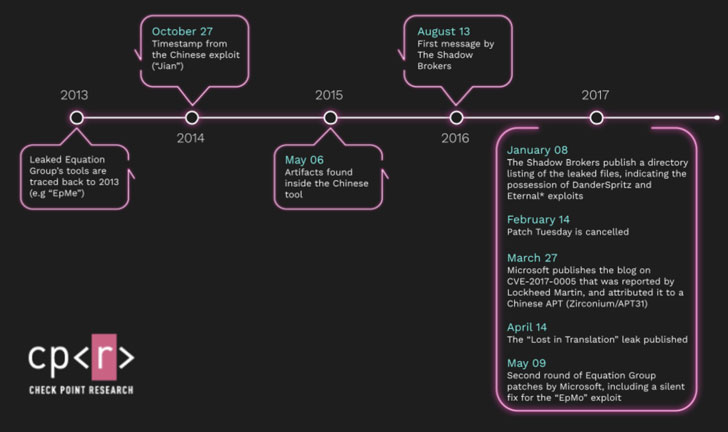 |
| Timeline of the events detailing the story of EpMe / Jian / CVE-2017-0005 |
Jian is said to have been replicated in 2014 and put in
operation since at least 2015 until the underlying flaw was patched
by Microsoft in 2017.
APT31[7], a state-sponsored
hacking collective, is alleged to conduct reconnaissance operations
at the behest of the Chinese Government, specializing in
intellectual property theft and credential harvesting, with
recent campaigns[8]
targeting U.S. election staff with spear-phishing emails containing
links that would download a Python-based implant hosted on GitHub,
allowing an attacker to upload and download files as well as
execute arbitrary commands.
Stating that the DanderSpritz post-exploitation framework
contained four different Windows EoP modules, two of which were
zero-days at the time of its development in 2013, Check Point said
one of the zero-days — dubbed “EpMo” — was silently patched by
Microsoft “with no apparent CVE-ID” in May 2017 in response to the
Shadow Brokers leak. EpMe was the other zero-day.
DanderSpritz was among the several exploit tools leaked by the
Shadow Breakers on April 14, 2017, under a dispatch titled “Lost in
Translation.” The leak is best known for publishing the EternalBlue exploit[9]
that would later power the WannaCry[10] and NotPetya ransomware[11] infections that caused
tens of billions of dollars’ worth of damage in over 65
countries.
This is the first time a new Equation Group exploit has come to
light despite EpMo’s source code being publicly accessible on
GitHub[12] since the leak almost
four years ago.
For its part, EpMo was deployed in machines running Windows 2000
to Windows Server 2008 R2 by exploiting a NULL-Deref vulnerability
in Graphics Device Interface’s (GDI[13]) User Mode Print Driver
(UMPD) component.
Jian and EpMe Overlap
“On top of our analysis of both the Equation Group and APT31
exploits, the EpMe exploit aligns perfectly with the details
reported in Microsoft’s blog on CVE-2017-0005,” the researchers
noted. “And if that wasn’t enough, the exploit indeed stopped
working after Microsoft’s March 2017 patch, the patch that
addressed the said vulnerability.”
Apart from this overlap, both EpMe and Jian have been found to
share an identical memory layout and the same hard-coded constants,
lending credence to the fact that one of the exploits was most
probably copied from the other, or that both parties were inspired
by an unknown third-party.
But so far, there are no clues alluding to the latter, the
researchers said.
Interestingly, while EpMe didn’t support Windows 2000, Check
Point’s analysis uncovered Jian to have “special cases” for the
platform, raising the possibility that APT31 copied the exploit
from the Equation Group at some point in 2014, before tweaking it
to suit their needs and ultimately deploying the new version
against targets, including Lockheed Martin.
That Jian, a zero-day exploit previously attributed to APT31, is
actually a cyber offensive tool created by the Equation Group for
the same vulnerability signifies the importance of attribution for
both strategic and tactical decision making.
“Even though ‘Jian’ was caught and analyzed by Microsoft at the
beginning of 2017, and even though the Shadow Brokers leak exposed
Equation Group’s tools almost four years ago, there is still a lot
one can learn from analyzing these past events,” Cohen said.
“The mere fact that an entire exploitation module, containing
four different exploits, was just lying around unnoticed for four
years on GitHub, teaches us about the enormity of the leak around
Equation Group tools.”
References
- ^
The
Shadow Brokers (thehackernews.com) - ^
National
Security Agency (thehackernews.com) - ^
Check
Point (research.checkpoint.com) - ^
called
(www.kaspersky.com) - ^
CVE-2017-0005
(www.microsoft.com) - ^
reported
(msrc.microsoft.com) - ^
APT31
(malpedia.caad.fkie.fraunhofer.de) - ^
recent
campaigns (blog.google) - ^
EternalBlue exploit
(thehackernews.com) - ^
WannaCry
(thehackernews.com) - ^
NotPetya ransomware
(thehackernews.com) - ^
GitHub
(github.com) - ^
GDI
(docs.microsoft.com)
Read more http://feedproxy.google.com/~r/TheHackersNews/~3/cBTKbRgGhns/chinese-hackers-had-access-to-us.html