
An ongoing search engine optimization (SEO) poisoning attack
campaign has been observed abusing trust in legitimate software
utilities to trick users into downloading BATLOADER malware on
compromised machines.
“The threat actor used ‘free productivity apps installation’ or
‘free software development tools installation’ themes as SEO
keywords to lure victims to a compromised website and to download a
malicious installer,” researchers from Mandiant said[1]
in a report published this week.
In SEO poisoning[2]
attacks, adversaries artificially increase the search engine
ranking of websites (genuine or otherwise) hosting their malware to
make them show up on top of search results so that users searching
for specific apps like TeamViewer, Visual Studio, and Zoom are
infected with malware.
The installer, while packing the legitimate software, is also
bundled with the BATLOADER payload that’s executed during the
installation process. The malware then acts as a stepping stone for
gaining further insight into the targeted organization by
downloading next-stage executables that propagate the multi-stage
infection chain.

One of those executables is a tampered version of an internal
component of Microsoft Windows that’s appended with a malicious
VBScript. The attack subsequently leverages a technique called
signed binary proxy execution[3] to run the DLL file
using the legitimate “Mshta.exe” utility.
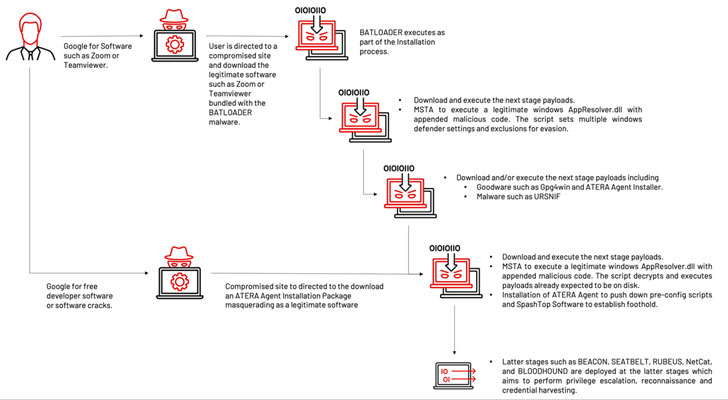
This results in the execution of the VBScript code, effectively
triggering the next phase of the attack wherein additional payloads
such as Atera Agent, Cobalt Strike Beacon[4], and Ursnif[5]
are delivered in the later stages to help perform remote
reconnaissance, privilege escalation, and credential
harvesting.
What’s more, in a sign that the operators experimented with
different ploys, an alternative variant of the same campaign
delivered the Atera remote monitoring management software directly
as a consequence of the initial compromise for further follow-on
post-exploitation activities.
Mandiant also called out the attacks’ overlaps with that of
techniques adopted by the Conti ransomware gang, which were
publicized[6]
in August 2021[7]. “At this time, due to
the public release of this information, other unaffiliated actors
may be replicating the techniques for their own motives and
objectives,” the researchers said.
References
- ^
said
(www.mandiant.com) - ^
SEO
poisoning (thehackernews.com) - ^
signed
binary proxy execution (attack.mitre.org) - ^
Cobalt
Strike Beacon (www.mandiant.com) - ^
Ursnif
(malpedia.caad.fkie.fraunhofer.de) - ^
publicized
(www.advintel.io) - ^
August
2021 (www.advintel.io)
Read more https://thehackernews.com/2022/02/new-seo-poisoning-campaign-distributing.html